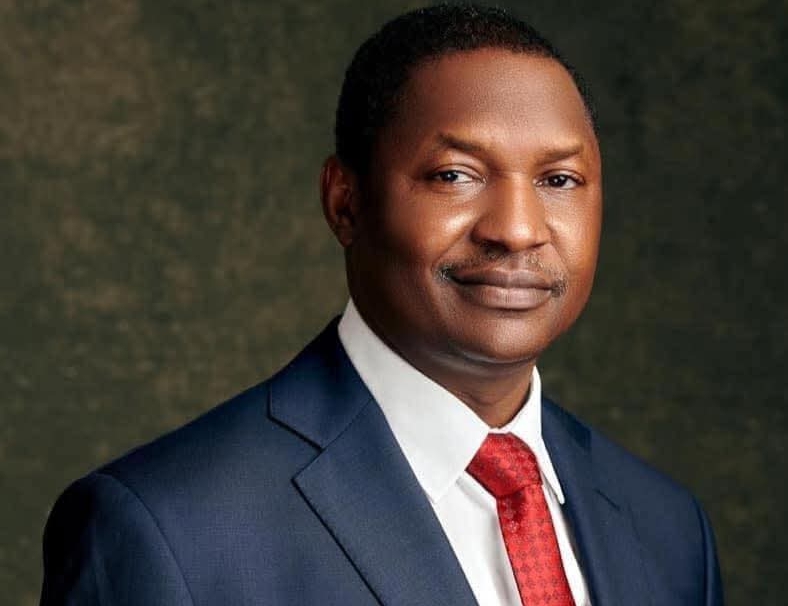
Former Attorney-General of the Federation and Minister of Justice, Abubakar Malami, has firmly rejected allegations suggesting he is connected to terrorism financing.
The claims surfaced after SaharaReporters published a story on Friday alleging that two individuals arrested in a counter-terrorism operation were “linked” to the former minister and other prominent Nigerians.
Responding through a statement on his Facebook page, the Senior Advocate of Nigeria said he has never been accused, investigated, or charged by any Nigerian or international authority over terrorism-related offences.
He also corrected the report’s portrayal of a retired military officer cited as a source, stressing that the individual never accused him of wrongdoing and that the publication distorted the facts.
Although Malami himself was never personally implicated in terrorism financing during his time in office, the administration of former President Muhammadu Buhari where he served as a key figure faced criticism for withholding the identities of alleged high-profile terror financiers.

In May 2021, Malami announced that investigations had identified several influential Nigerians allegedly involved in financing terrorism, adding that they were being profiled for prosecution. However, their identities were never made public before the administration left office in 2023.
The new allegations emerged amid ongoing attention surrounding Malami’s recent questioning by the Economic and Financial Crimes Commission (EFCC) over alleged mismanagement of recovered public funds, including portions of the Abacha loot.
He was invited for questioning on 28 November and later released on administrative bail. Malami has denied all accusations and has not been charged with any crime.
Highlighting his contributions to national security reforms, Malami emphasised his role in strengthening Nigeria’s anti-money laundering and counter-terrorism financing regime.
He cited the passage and implementation of the Terrorism (Prevention and Prohibition) Act, 2022, which modernised Nigeria’s legal framework and aligned it with international standards.
These reforms, he said, contributed to Nigeria’s eventual removal from the Financial Action Task Force (FATF) grey list.
He further noted that engaging with a wide range of individuals is a normal part of public service and does not suggest criminal behaviour.
Malami urged the media to report national security matters responsibly to avoid damaging reputations and eroding public trust in state institutions.
Reaffirming his commitment to the rule of law, the former minister said he would continue to protect his legal rights against publications that distort his role in combating money laundering and terrorism financing.