


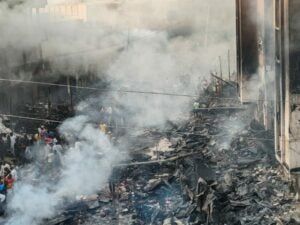
(DDM) – The alarming wave of market fires sweeping across Nigeria has once again ignited national outrage, with billions of naira in goods destroyed and livelihoods shattered.
Diaspora Digital Media (DDM) gathered that repeated infernos in major commercial hubs are largely linked to preventable human errors, regulatory failures, and poor infrastructure planning.
The commercial city of Kano recently witnessed three separate fire outbreaks within three weeks, raising serious concerns about market safety standards.
Two of the incidents occurred at Singer Market within two weeks, while a third engulfed the Fatima Simra Multi-Purpose Market in the Dakata area shortly after.
Singer Market is widely regarded as the largest commodity hub in northern Nigeria.

The market supplies goods to states across the northern region and even to neighbouring West and Central African countries.
Such strategic economic importance makes the repeated disasters particularly troubling.
On the evening of February 14, a second fire outbreak at Singer Market raged into the early hours of Sunday, leaving extensive destruction.
The Chairman of the market association, Junaid Zakari, estimated that about 1,000 businesses were affected.
He further disclosed that goods worth approximately N5 billion were lost in the inferno.
Earlier, on February 2, another fire had razed more than 70 shops at the same market.
Barely a week after the second disaster, the Fatima Simra Multi-Purpose Market fire destroyed about 50 additional shops.
Although no fatalities were recorded in the Kano incidents, the financial losses were devastating.
Vice-President Kashim Shettima led a Federal Government delegation to Kano in response to the tragedy.
He announced a N5 billion intervention fund on behalf of President Bola Tinubu to support affected traders.
Governors elected under the All Progressives Congress also donated N3 billion to the victims.
Despite these financial interventions, observers argue that such donations barely scratch the surface of the losses incurred.
Across Nigeria, market fires have become disturbingly frequent.
Reports indicate that at least 25 major market fires occurred across different states within five months in 2025.
Markets affected include Akinola Market in Osun, Talata Marafa Central Market and Gusau Central Market in Zamfara, Ladipo Market and Owode Onirin Market in Lagos, Ogoja LGA Central Market in Cross River, Onitsha Main Market in Anambra, and Gwagwa Market in the Federal Capital Territory.
Business analysts estimate that Nigeria’s largely uninsured informal economy has lost about N4.6 trillion to recurring fire outbreaks.
Beyond financial loss, the psychological and social consequences for traders are severe.
Many victims lose lifetime investments overnight.
Some are unable to pay school fees for their children.
Others suffer serious mental and physical health challenges following the trauma.
In a country where informal sector pension security is virtually nonexistent, the consequences are even more dire.
The Director-General of PENCOM, Omolara Oloworaran, recently warned that 75 million Nigerians risk retiring without pension benefits.
Frequent market fires only widen that vulnerability.
Preliminary reports suggest that electrical faults, illegal wiring alterations, and the storage of inflammable materials are major causes of the outbreaks.
Traders often modify shop structures to expand space, sometimes ignoring safety regulations.
Poorly installed lithium solar batteries have also reportedly triggered explosions in some markets.
Many markets are overcrowded, with narrow pathways that hinder rescue and firefighting efforts during emergencies.
Fire extinguishers are often unavailable, inadequate, or non-functional.
Water supply systems and emergency access roads remain grossly insufficient in several markets.
Insurance firms are reportedly reluctant to insure traders due to chaotic market structures and recurring fire incidents.
Experts insist that donations after disasters cannot replace structural reforms and proactive safety measures.
They advocate modern market planning, proper electrical installations, fire service attachments, and strict regulatory enforcement.
Local governments are urged to construct additional market stalls to decongest overcrowded facilities.
Authorities are also advised to collaborate with private developers to build safer and more organized market complexes.
Real estate experts argue that although modern shop structures may cost more, they are far cheaper than the price of human lives and destroyed livelihoods.
Governments at all levels are being called upon to adopt comprehensive safety standards and enforce compliance strictly.
Market leaders are equally expected to educate traders on fire prevention and environmental safety measures.
Stakeholders agree that making markets safe and secure is a shared responsibility.
Without decisive action, recurring market fires will continue to embarrass the nation and devastate struggling traders.
The time to stop Nigeria’s market fire epidemic, analysts say, is now.



 and then