


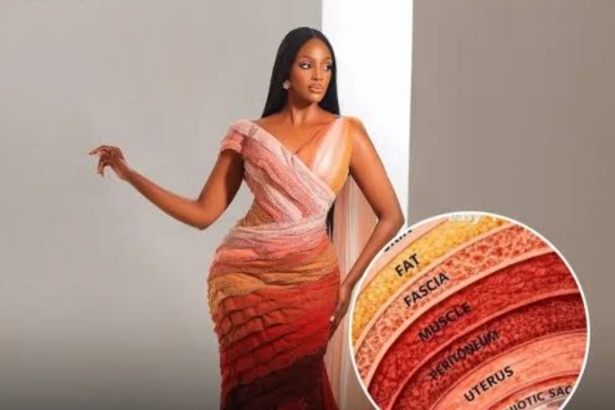
Miss Uganda, Trivia Elle Muhoza, has attracted international attention after appearing on the Miss World stage in a striking couture gown inspired by the layers of a Caesarean section, transforming what would ordinarily be regarded as a medical procedure into a powerful statement about motherhood, childbirth, healing and the strength of women.
The unusual fashion creation, titled “Layers of Life,” was designed by Ugandan designer Keesha Abdallah and presented during the Miss World competition in Vietnam. Far from being created merely to impress judges or capture attention with glamour, the gown was designed to tell a deeply symbolic story about what happens inside a woman’s body during a Caesarean birth. The concept has since received international recognition, including praise from World Health Organization Director-General Dr Tedros Adhanom Ghebreyesus.

Muhoza, who is representing Uganda at Miss World 2026, stepped onto the international stage wearing the dramatic creation as part of the World Designer Award segment. The gown immediately stood out because of its layered structure and its unusual inspiration. Rather than drawing from the more familiar themes of flowers, traditional costumes, architecture or fantasy, Abdallah looked to the human body and the surgical journey involved in a Caesarean section.
The design represents seven anatomical layers associated with the procedure, including the skin, subcutaneous tissue, fascia, rectus muscles, peritoneum, uterus and amniotic sac. These layers were translated into fabric, colour, texture and movement, creating a gown that visually communicates the journey doctors undertake during a Caesarean delivery.
The colours of the gown move through shades of peach, gold, coral, red, maroon and burgundy, giving the outfit an almost anatomical appearance while maintaining the elegance expected of a major international pageant. According to the designer, however, the colours were not intended to represent different races or skin tones. Instead, each colour and layer was chosen to represent a particular stage, texture or transition in the story of childbirth.
The idea behind the dress becomes even more significant when viewed through the personal story of its creator. Abdallah, herself a new mother, drew inspiration from her own experience of childbirth when developing the concept. Her intention was to celebrate motherhood and womanhood while bringing attention to an experience that millions of women around the world undergo but which is rarely represented in fashion in such a direct and artistic way.
For DDM News, the gown represents an interesting meeting point between fashion and public awareness. What began as a pageant appearance has developed into a conversation about maternal health, the realities of Caesarean childbirth and the physical and emotional experiences of mothers after delivery.
The attention surrounding the gown increased significantly after Dr Tedros Adhanom Ghebreyesus, Director-General of the World Health Organization, publicly praised the message behind it. In his reaction, the WHO chief described the gown as telling the story of Caesarean childbirth in a unique and powerful way. He also pointed out that when medically necessary, Caesarean sections can make the difference between life and death for mothers and babies. At the same time, he noted that despite improvements in safety, the procedure remains a complex medical intervention and recovery can be challenging.
The endorsement from the WHO chief gave the fashion moment an entirely different dimension. Instead of remaining simply a viral pageant outfit, the gown became part of a wider conversation about women’s health. The attention also highlighted the importance of educating the public about Caesarean births and challenging misconceptions surrounding women who deliver their babies through surgery.
Muhoza herself has emphasised that the gown was created to be more than fashion. She explained that its purpose was to bring visibility to the realities of Caesarean childbirth, including the layers a mother’s body goes through and the strength required during birth, healing and recovery. She also dedicated the message of the gown to women who have experienced Caesarean births, stressing that their scars can carry stories of courage, sacrifice, healing and life.
That message is particularly important because Caesarean delivery is sometimes misunderstood or unfairly described as an easier alternative to vaginal childbirth. In reality, a C-section is major abdominal surgery. It may be planned in advance or carried out as an emergency when complications make vaginal delivery unsafe. Medical reasons can include obstructed labour, fetal distress, certain abnormal positions of the baby and placenta-related complications, among other conditions.
The gown therefore attempts to make visible something that is normally hidden from public view. The surgical layers represented in the design are normally encountered inside an operating theatre, away from cameras and audiences. By transforming them into couture, Abdallah has effectively brought an unseen part of childbirth onto an international fashion stage.
The timing and setting of the presentation also helped amplify its impact. The gown was showcased in Vietnam during the Miss World Beauty Fashion Fest’s 17th edition, where contestants presented couture designs. Reports indicate that the event took place on August 27, with Muhoza using the opportunity to combine Ugandan creativity with a universal message about motherhood.
Muhoza’s wider Miss World journey has also focused on issues affecting women and girls. Her advocacy has included menstrual health education, and she has participated in initiatives aimed at supporting girls and promoting confidence, hygiene and self-care. Her “Wings of Hope” initiative has also helped position her pageant platform around social issues rather than beauty alone.
The significance of the gown also extends to Uganda’s history. Uganda has a notable place in the history of Caesarean delivery because British medical student and missionary physician Robert Felkin documented a Caesarean operation he witnessed in what is now Uganda in 1879. The procedure was carried out by Bunyoro medical practitioners, and both mother and child reportedly survived. More than a century later, Muhoza has taken a story connected to childbirth and Ugandan history onto one of the world’s most visible international stages.
The response to “Layers of Life” demonstrates how fashion can sometimes communicate a message more powerfully than words alone. The gown does not simply ask audiences to admire its construction; it encourages them to think about the physical reality behind childbirth. Every layer becomes a reminder of the journey a mother may undergo before holding her newborn.
For many women who have experienced Caesarean delivery, the design has also carried an emotional significance. Instead of treating the surgical scar as something to hide, the gown presents the experience as a story of survival, strength and life. It reframes the scar from a mark of surgery into a symbol of the journey that brought a child into the world.
The international reaction to Muhoza’s gown is therefore about much more than pageant fashion. It is about using creativity to open conversations around issues that affect millions of women. It is also a demonstration of how African designers and beauty queens can use global platforms to communicate messages that extend beyond entertainment.
For DDM News, Trivia Elle Muhoza’s “Layers of Life” gown has shown that fashion can be both beautiful and meaningful. With the support of a renowned Ugandan designer and the recognition of the WHO Director-General, a single pageant appearance has become a global conversation about Caesarean childbirth, maternal health and the extraordinary strength of mothers.
As Muhoza continues her Miss World journey, her gown has already achieved something that cannot be measured simply by a competition score. It has made people stop, look, ask questions and, most importantly, think about the women behind the scars. In transforming the hidden layers of a Caesarean section into an elegant work of art, “Layers of Life” has turned fashion into a tribute to motherhood and a reminder that behind every birth is a story of courage, sacrifice, healing and life.




