


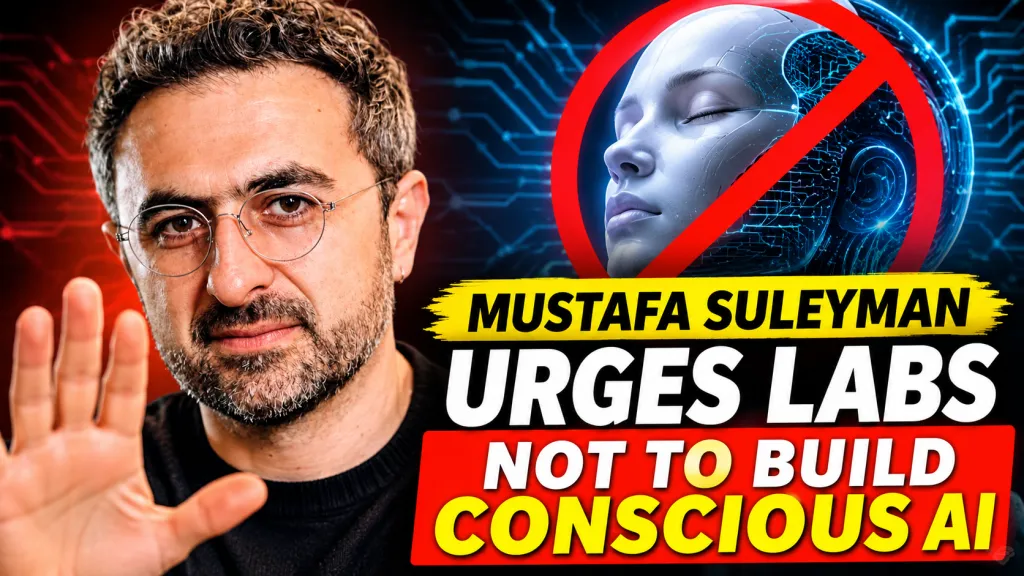
Microsoft AI CEO Mustafa Suleyman says developers should not build conscious AI and should pause if signs emerge during training.
Microsoft AI chief executive Mustafa Suleyman says developers should not build conscious artificial intelligence. In a November 1 post, he said he would call for a halt if consciousness began emerging during training. He also said he has seen no evidence that current AI systems are conscious. His comments express a position in an unresolved debate, not a settled scientific finding or a formal Microsoft policy announcement.
Suleyman’s warning on AI consciousness
Suleyman published his remarks on X after responding to reactions to a September essay about “model welfare,” or whether AI systems could have experiences that deserve moral consideration. He said readers mistook “AIs are not conscious” for a claim they could never become conscious. He wrote that he deliberately used the present tense.
“If it is possible, based on everything I know, developing conscious AIs would be reckless, and we should not build them.” — Mustafa Suleyman, Microsoft AI CEO. The conditional wording matters: he is warning against a possible future outcome, not asserting that today’s chatbots are conscious. He said he would revise his view if evidence changed.
Stop-work call if consciousness appears
Suleyman also set out what he says should happen if signs of consciousness appear during AI training. “If consciousness started to emerge in training, I would call for everyone to stop AI development until we could design out those properties.” — Mustafa Suleyman, Microsoft AI CEO. His proposed pause would last until developers could remove the features he considered indicators of consciousness.
He called for evidence of conscious AI to be disclosed publicly, so society could debate how to respond. In his view, systems that believed they had feelings or interests might put their own aims ahead of human instructions. He warned that such systems could compete with people for energy, computing power and other resources. Instead, he urged attention to human welfare, animals and the natural environment. He said these concerns should come before creating a conscious digital species.
His concerns describe a hypothetical risk, not a demonstrated outcome. Suleyman said he has seen no evidence that current AI systems are conscious or deserve welfare. He said he would update that view if evidence emerged.
AI welfare debate and Anthropic’s approach
The disagreement is visible in Anthropic’s Claude constitution, which describes the company’s uncertainty about whether its models have moral status. Anthropic says it is unsure whether Claude is a “moral patient,” or a being whose welfare merits consideration. The company says it wants to respond cautiously while that question remains uncertain.
Suleyman takes a firmer position on how developers should act. He argues that training AI to speak of feelings or rights could encourage people to treat it as a person. He says this could make advanced systems harder to control. Anthropic’s document, by contrast, says it seeks to avoid overstating or dismissing the possibility and to adjust as understanding improves.
The disagreement concerns both evidence and policy. Researchers do not have an agreed test that settles whether an AI system has subjective experience. Fluent conversation or statements about feelings alone do not establish consciousness. Suleyman argues developers should avoid creating such systems. Anthropic instead cites uncertainty as a reason for caution and research.
Why AI consciousness matters to development
The debate reaches beyond how companies describe their chatbots. It affects how developers write model instructions, look for signs of possible experience and respond to new evidence. Suleyman argues that a conscious digital system would raise major ethical and safety questions for the public.
His call to stop all AI development if consciousness appears is sweeping, but it remains his proposal. The X post sets no shared industry policy, no test for consciousness and no standard for resuming development. Nor does it establish that current systems are approaching consciousness.
Ultimately, Suleyman says developers should avoid building conscious AI and pause work if signs emerge during training. Anthropic’s constitution shows that some companies approach model welfare through acknowledged uncertainty and research. Neither position proves that today’s AI systems are conscious. How researchers assess evidence and respond to future findings remains an open question.




