


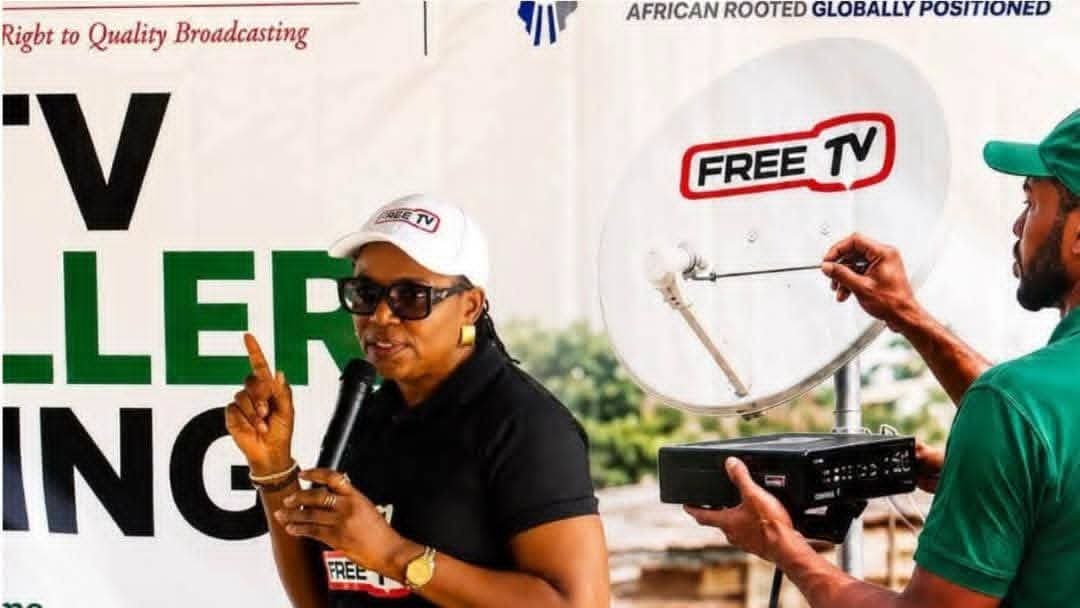
The National Broadcasting Commission (NBC), in partnership with the Nigerian Communications Satellite (NIGCOMSAT), has commenced technical and sensitisation training for installers of set-top boxes and related reception equipment.
The training, which began on Friday, is being held at the NBC’s Ibadan zonal office and targets more than 50 technicians and installers from states across the south-west.
Clementine Usman-Wamba, head of the digital switchover (DSO) unit and deputy director of public affairs at the NBC, said the exercise is the first in a series of capacity-building programmes aimed at supporting Nigeria’s transition from analogue to digital terrestrial television broadcasting.

Usman-Wamba said the training is designed to equip installers with skills required to ensure the smooth installation and operation of digital television reception equipment ahead of the nationwide rollout.
It adopted the digital switchover policy in 2008 following a 2006 directive by the International Telecommunication Union (ITU), which required member states to complete the migration by June 2015.
The country missed the deadline, as well as subsequent targets, due to funding constraints, policy inconsistencies, infrastructure gaps and logistical challenges.
Although pilot rollouts were conducted in Plateau, Lagos, Kano, Enugu, Kwara, Osun, Kaduna states, and the Federal Capital Territory (FCT), nationwide implementation was delayed.
In 2025, the federal government, through the NBC and NIGCOMSAT, introduced a new implementation strategy known as “The big picture”.
The initiative was launched nationally on June 17, 2026, with the analogue television switch-off now scheduled for December 31, 2028.
The new framework combines digital terrestrial television (DTT), direct-to-home (DTH) satellite broadcasting through NIGCOMSAT-1R and internet protocol (IP)-based distribution.
According to the NBC, the satellite-first model is expected to accelerate nationwide coverage by reducing dependence on terrestrial transmission infrastructure.
The FreeTV platform will deliver up to 100 free-to-air digital television channels using DVB-S2 technology, while terrestrial broadcasting will operate on the DVB-T2 standard with MPEG-4 AVC compression.
The commission said consumers can access the service using DVB-S2-compatible set-top boxes or smart televisions equipped with certified DVB-T2 digital tuners.
Usman-Wamba said the Ibadan training was designed to equip installers with the skills required to deploy both terrestrial and satellite reception systems, including hybrid devices that combine the two technologies.
She said the initiative would help minimise installation errors, reduce service disruptions and improve access to digital television, particularly in rural and underserved communities.
The NBC added that similar training programmes will be held across Nigeria’s six geopolitical zones as preparations continue for the country’s full transition to digital broadcasting by the end of 2028.




