



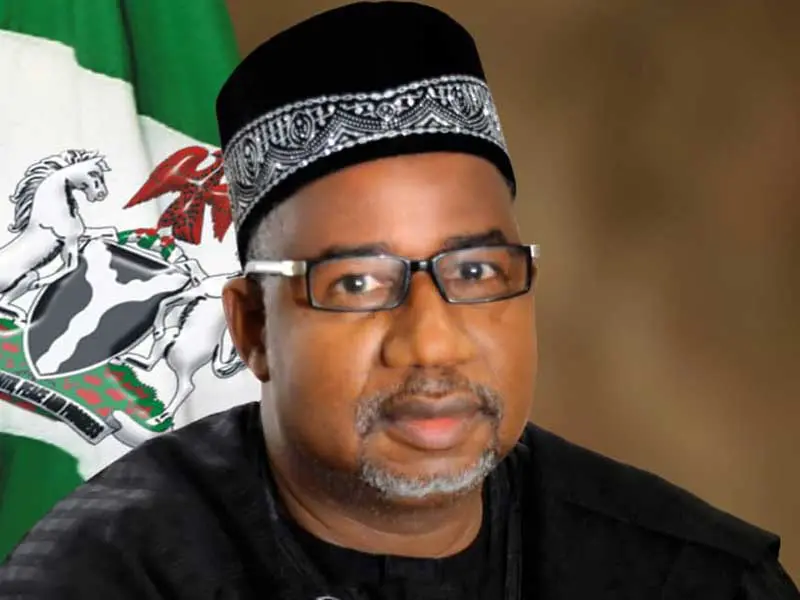
In what is rapidly emerging as one of the most politically charged and legally consequential corruption and terrorism-financing cases in recent Nigerian history, the Federal Government has formally linked the Governor of Bauchi State, Senator Bala Abdulkadir Mohammed, to an alleged $9.7 million terrorism financing scheme involving senior officials of his administration. The unfolding developments, now before a Federal High Court in Abuja, have sent shockwaves across Nigeria’s political landscape, raising profound questions about the intersection of national security enforcement, constitutional immunity, opposition politics, and the expanding reach of anti-graft agencies. DDM NEWS reports that the case, which centers on alleged clandestine cash transfers and approvals traced to the Bauchi State Government, could redefine the legal and political boundaries of accountability for sitting governors in Nigeria.
At the heart of the controversy is Yakubu Adamu, the Bauchi State Commissioner for Finance, who on Wednesday was arraigned by the Economic and Financial Crimes Commission (EFCC) alongside three other defendants: Balarabe Abdullahi Ilelah, Aminu Mohammed Bose, and Kabiru Yahaya Mohammed. The four were brought before Justice Emeka Nwite of the Federal High Court, Abuja, on a multi-count charge bordering on conspiracy, unlawful conversion of public funds, money laundering, and terrorism financing, offenses anchored on provisions of the Money Laundering (Prevention and Prohibition) Act, 2022, and the Terrorism (Prevention and Prohibition) Act, 2022. The EFCC alleges that the defendants collectively played critical roles in the movement of millions of dollars in cash to individuals allegedly associated with terrorist activities, with approvals purportedly originating from the highest levels of the Bauchi State Government.
According to the charge sheet exclusively reviewed by DDM NEWS, the prosecution contends that between January and May 2024, the accused conspired to provide financial resources amounting to approximately $2.3 million in cash to Bello Bodejo and persons linked to him, despite having reasonable grounds to believe that the funds would be used, wholly or in part, to finance terrorism or terrorist groups. The EFCC further alleges that additional sums of $500,000 and a staggering $6.9 million were delivered in cash through a Bureau de Change operator, in transactions designed to evade regulatory scrutiny and violate Nigeria’s anti-terror financing laws. These transactions, the commission insists, were executed in breach of Sections 21 and 26 of the Terrorism (Prevention and Prohibition) Act, 2022, as well as critical provisions of the Money Laundering Act.
One of the most explosive elements of the case, DDM NEWS observes, is the explicit reference to Governor Bala Mohammed within the terrorism financing charge. In a count that has already ignited fierce legal and political debate, the EFCC alleges that the funds were released “pursuant to approvals granted by the Executive Governor of Bauchi State, Senator Bala Abdulkadir Mohammed.” While the governor himself has not been docked, owing to the constitutional immunity enjoyed by sitting governors under Section 308 of the 1999 Constitution, the mention of his name in formal court processes has intensified scrutiny and raised unprecedented questions about how far investigators can go in implicating an immune officeholder through subordinate prosecutions.
Following the arraignment, all four defendants pleaded not guilty to the charges. EFCC counsel, Samuel Chime, promptly urged the court to fix a trial date, indicating the commission’s readiness to present witnesses and documentary evidence to substantiate the allegations. Justice Emeka Nwite subsequently ordered that the defendants be remanded at the Nigerian Correctional Service custodial facility in Kuje, Abuja, pending the determination of their bail applications and further proceedings. The court adjourned the matter to January 5 for hearing, setting the stage for what legal observers predict will be a closely watched trial with far-reaching implications.

In response, the defence team, led by senior advocate Gordy Uche (SAN), filed applications seeking bail for the accused. Uche argued that the bail motions were duly filed on December 30 and served on the prosecution, stressing that continued detention of the Commissioner for Finance was already having grave administrative consequences for Bauchi State. According to the defence, Adamu’s incarceration had disrupted salary payments for over 60,000 state workers, creating hardship and administrative paralysis. The prosecution acknowledged receipt of the bail applications but countered with a joint counter-affidavit opposing the request, signaling the EFCC’s determination to keep the defendants in custody pending trial.
DDM NEWS gathered that the defence further clarified that while Adamu was arrested and detained, the other defendants—Ilelah, Bose, and Mohammed—had voluntarily honored the EFCC’s invitations before their arrest, a factor their lawyers argue should weigh in their favor during bail considerations. However, the gravity of the allegations, particularly those bordering on terrorism financing, appears to have stiffened the resolve of prosecutors and investigators alike.
The political temperature surrounding the case rose sharply after Governor Bala Mohammed publicly reacted to the developments. Speaking in Bauchi on Wednesday after receiving a Safety Ambassador Award from the Institute of Safety Professionals of Nigeria (ISPON), the governor expressed shock and outrage over what he described as an attempt by the Federal Government to link him to terrorism. Visibly angered by the continued detention of his Finance Commissioner, Mohammed said he was alarmed that his name was mentioned in court proceedings despite his constitutional immunity as a sitting governor and his position as a prominent opposition figure.
“I am just waking up to an accusation that I am being linked to terrorism as a governor and as the head of the opposition,” Mohammed said. “My commissioner has been kept incarcerated and has not been released by the EFCC. Even with my immunity as a governor, my name was mentioned in a motion in a court of law in Nigeria. God is wonderful.” His remarks, laced with both disbelief and defiance, underscored the gravity of the political implications now unfolding.
Governor Mohammed went further, accusing the APC-led Federal Government of weaponizing the EFCC and the judiciary to harass, intimidate, and politically neutralize opposition leaders across the country. According to him, state institutions that should serve as impartial arbiters of justice were being deployed as tools of political coercion against those who refuse to align with the ruling party. “The APC-led federal government thinks it can use the courts and the EFCC to pursue Nigerians who are not in their party,” he declared. “If they don’t stop, we are going to declare war.” Though rhetorical, the statement reflected growing tensions between the ruling party and opposition governors amid an increasingly polarized political climate.
Beyond the immediate legal battle, Mohammed also used the occasion to criticize the Federal Government’s performance in Bauchi State, alleging that despite significant federal revenues, the state had seen little meaningful development in infrastructure and basic services. He maintained that he had previously remained silent in the interest of peace and stability but warned that continued intimidation and political persecution would no longer be tolerated. The governor insisted that his refusal to defect from the Peoples Democratic Party (PDP) should not make him a target, vowing that he would not be coerced into joining the ruling party under any circumstances.
Perhaps most troubling, Mohammed alleged that members of his family and key officials in his administration were being arrested and detained by the EFCC without credible evidence, describing the situation as an affront to democratic norms and the rule of law. DDM NEWS notes that these allegations, if substantiated, could further inflame debates about selective justice, due process, and the politicization of Nigeria’s anti-corruption war.
As the case heads toward its next court date, analysts warn that its outcome could set a powerful precedent for how allegations of terrorism financing involving state governments are investigated and prosecuted in Nigeria. With national security concerns, constitutional protections, and partisan politics now tightly intertwined, the Bauchi terrorism financing saga represents more than a criminal trial; it is a defining moment for Nigeria’s democracy, its justice system, and the credibility of its institutions. DDM NEWS will continue to monitor developments closely as this high-stakes legal and political drama unfolds.



 and then