


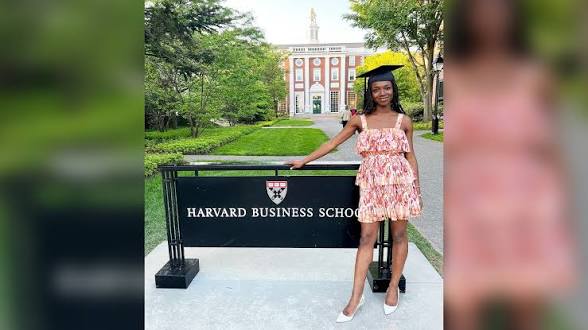
Revolutionise Hair Braiding With RoboticsA Nigerian-American engineer and Harvard graduate, Yinka Ogunbiyi, is attracting international attention after raising $7 million in seed funding to commercialise HaloBraid, a robotic technology designed to assist professional hairstylists with hair braiding.
The breakthrough has drawn praise from the United States Mission in Nigeria, which highlighted Ogunbiyi’s achievement as an example of innovation with global potential. The development places a Nigerian-born entrepreneur at the centre of an emerging beauty-technology market, where robotics and artificial intelligence are being used to address one of the most time-consuming and physically demanding services in the beauty industry.
HaloBraid is being described as the world’s first braid-assist robot, although its purpose is not to completely replace human hairstylists. Instead, the technology is designed to work alongside professionals, allowing them to begin a braid manually before the machine takes over some of the repetitive work involved in completing the length of the braid.
The distinction is important because hair braiding is not simply a mechanical process. It involves technique, judgement, creativity and an understanding of the client’s hair. Ogunbiyi’s approach therefore seeks to combine the expertise of a professional stylist with the speed and consistency that technology can provide.

According to reports, the United States Mission in Nigeria celebrated Ogunbiyi’s accomplishment in a social media post, noting that she had raised $7 million and that more than 7,000 salons had already joined the waiting list for the technology. The mission described the development as an example of American innovation with global impact.
The story behind HaloBraid began during the COVID-19 pandemic, when lockdown restrictions made it difficult for people to access salons. Ogunbiyi attempted to braid her own hair and spent about four days working on the protective style. What could have remained a frustrating personal experience eventually became the foundation for a technology company.
The experience pushed Ogunbiyi to look at braiding differently. Rather than accepting the lengthy process as unavoidable, she began thinking about it as an engineering problem that could be redesigned.
That thinking eventually led to HaloBraid, which she developed with fellow Harvard graduate David Afolabi. The founders spent months experimenting with prototypes and working with hairstylists to understand the challenges faced during professional braiding sessions. Reports indicate that the team developed hundreds of prototypes before settling on a design capable of supporting professional salon use.
Ogunbiyi’s academic background also played an important role in the development of the company. She has training in engineering and business from Harvard University, giving her both the technical knowledge required to develop the device and the business understanding needed to take the product into a competitive commercial market.
The need HaloBraid is addressing is significant. Professional braiding can require several hours, depending on the style, length and density of the client’s hair. For hairstylists, repeatedly performing the same hand movements for long periods can also create physical strain. The company’s technology is intended to reduce that repetitive workload while helping salons complete appointments more efficiently.
HaloBraid reportedly aims to reduce lengthy braiding sessions substantially. The company has positioned the device as a tool that could help transform salon productivity by allowing stylists to spend less time performing repetitive movements and more time managing clients, preparing hair and delivering the creative aspects of the service.
The technology could also have implications for the economics of the beauty industry. A salon that can complete braiding services faster could potentially serve more customers in a day. For customers, shorter appointments could make protective hairstyles more convenient and accessible. For stylists, reducing repetitive hand movements could potentially lessen some of the physical burden associated with the profession.
The company has reportedly attracted strong investor confidence. The $7 million seed round was led by Seven Seven Six, the venture capital firm founded by Reddit co-founder Alexis Ohanian, with additional participation from AlleyCorp and Bling Capital. The funding is expected to support further product development, manufacturing and partnerships with salons ahead of its commercial rollout.
The large investment also demonstrates that investors are beginning to see opportunities beyond traditional technology categories. Beauty, haircare and personal services are increasingly becoming areas where engineering and artificial intelligence can create new businesses.
For Nigeria and the wider African technology ecosystem, Ogunbiyi’s story carries another significance. It shows how everyday experiences can inspire technological solutions when entrepreneurs are willing to question established processes. Hair braiding is deeply connected to African and Black identity, yet the commercial infrastructure surrounding it has historically remained highly dependent on manual labour.
Instead of trying to remove people from the process entirely, HaloBraid is attempting to modernise the industry while preserving the role of the stylist. That could prove particularly important in an industry where customers value personal interaction and craftsmanship.
The company says its technology can assist with styles such as knotless and box braids, while its design is intended to minimise unnecessary pulling and tension on the hair. The device therefore represents an attempt to improve not only speed but also the physical experience of braiding.
The business opportunity is potentially substantial. With thousands of salons already expressing interest, HaloBraid enters the market with evidence that professionals are willing to consider technological assistance. More than 7,000 salons have reportedly joined its waiting list, creating an early customer base as the company prepares for commercial deployment. (Arise News)
For DDM News, the development is also a reminder that innovation does not always begin with a problem that appears highly technical. Sometimes, it starts with a common frustration that millions of people experience but have simply accepted as normal.
Ogunbiyi saw the long hours associated with braiding and asked a simple but powerful question: why should a process that has remained largely manual for thousands of years not benefit from modern engineering?
That question has now produced a multimillion-dollar startup and attracted attention from investors, salons and the United States government.
The success of HaloBraid could eventually encourage more entrepreneurs to look at other labour-intensive industries and consider how technology can support workers rather than simply replace them. From tailoring and manufacturing to agriculture, food processing and beauty services, there are countless sectors where repetitive manual tasks consume time and energy.
The company’s approach could therefore become bigger than hair braiding. If the technology proves successful, it may help establish a broader category of robotics designed specifically for skilled service industries, where humans remain responsible for creativity and customer relationships while machines handle repetitive physical tasks.
Ogunbiyi’s journey ultimately reflects a growing intersection between African talent, advanced technology and global entrepreneurship. A personal experience during a pandemic lockdown became an engineering challenge, the engineering challenge became a startup, and the startup has now attracted $7 million in investment and thousands of potential customers.
As HaloBraid moves toward commercial launch, attention will increasingly shift from the excitement surrounding the invention to whether it can deliver consistent results at scale, work comfortably within real salon environments and gain the trust of professional stylists.
If it succeeds, the implications could extend well beyond shorter salon appointments. It could change how one of the world’s most labour-intensive beauty services is delivered, creating a new relationship between human craftsmanship and robotics.
For a Nigerian-American engineer to be leading that transformation makes the story even more significant. Ogunbiyi has demonstrated that innovation can emerge from cultural familiarity, personal experience and a willingness to challenge old systems. Her $7 million funding milestone is therefore not merely a technology story; it is a story about entrepreneurship, beauty, engineering and the global possibilities that can emerge when an everyday problem is treated as an opportunity for invention.
As the world watches HaloBraid prepare for commercialisation, the biggest question may no longer be whether robots can enter the beauty industry. Instead, the question is how far technology can go in helping skilled professionals work faster, reduce physical strain and serve a growing market without taking away the human creativity that makes their work valuable.
DDM News will continue to monitor the development of HaloBraid and the growing role of Nigerian innovators in global technology and business.




