By Emeka Ugwuonye
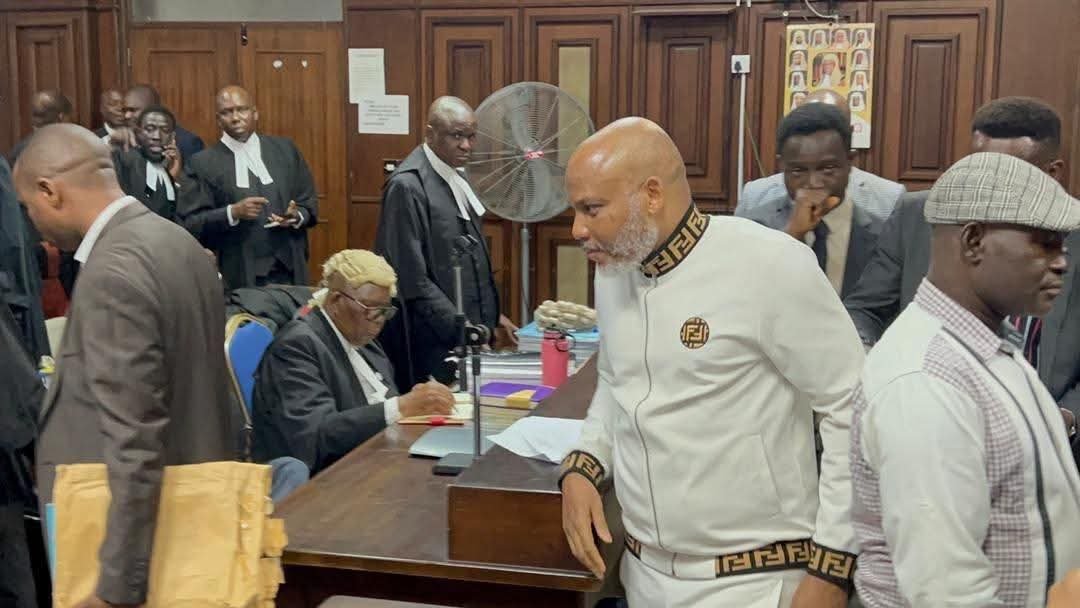
Nnamdi Kanu’s decision to fire his brilliant defense team and represent himself could prove to be a very intelligent gambit. He first allowed his lawyers to handle the technically complex part of the trial: trying to dismantle the prosecution’s case and managing subsequent motions. Then, after dismissing his lawyers, he took on the part of the defense for which he is best suited: explaining his actions in his ill-fated effort to achieve Biafran independence. This is the phase of the case that will be steeped in high drama and theatrics. Only Kanu himself can deliver the kind of performance that will energize and galvanize his base—the millions of Igbo people who dream of their country where they can be sure of justice and dignity.
A SUMMARY OF THE PROCEDURAL HISTORY OF NNAMDI KANU’S CASE

To understand the updates on this case, it is essential to know how it has developed over the past ten years.
Nnamdi Kanu was once a junior associate of Ralph Uwazurike in the Movement for the Actualization of the Sovereign State of Biafra (MASSOB), a precursor to the Indigenous People of Biafra (IPOB). Kanu was responsible for Radio Biafra, which was intended to be MASSOB’s communication arm. However, Kanu recognized the radio station’s immense potential as the ultimate tool for mobilizing Igbo youth. He decided to appropriate Radio Biafra for his own new movement, which became IPOB.
His reasons for separating from Uwazurike were likely twofold. First, he believed he could lead a Biafran movement more effectively. Second, he saw that Uwazurike had already been contained by the Nigerian government and had begun to melow down.
With IPOB established, Kanu used Radio Biafra to mobilize support, quickly gaining a massive following. His communication style was necessarily aggressive, antagonistic, and vitriolic, igniting passion and awakening the brooding sense of injustice many Igbos have felt since 1966. Kanu became a man everyone had to notice. Many Igbos saw him as a hero who spoke their mind. For the same reason, the Nigerian government under President Muhammadu Buhari—a former general in the army that defeated Biafra during the Civil War—saw in Kanu a dangerous resurgence of a cause he thought had been vanquished. Buhari’s government was worried less about what Kanu had already done at the time of his arrest, and more about what he could do if left to continue.
When Kanu was arrested in October 2015, it was not for a crime he had committed, but for crimes he might commit in the future. This was the government’s foundational dilemma. It is always a slippery slope when a state tries to punish a person for future crimes; to do so, it must resort to lies and repressive methods. This is why the government charged Kanu with treason and terrorism. However, after he spent 15 months in Kuje prison on these charges, Justice Binta Nyako dismissed the terrorism charges and granted him bail two months later on health grounds.
Being imprisoned for 15 months on trumped-up charges would naturally radicalize anyone, let alone someone as passionate and radical as Kanu. The government’s heavy-handed treatment won him a massive following, transforming him into a true hero for millions of Igbos. In other words, the paranoia of Buhari’s government is what ultimately made Kanu the figure he is today.
The conditions of his bail were impossible and draconian. It would have been unworkable for him to abide by them and remain the leader he had become. He chose the latter. Events escalated until the Nigerian military raided his family home in Abia State. He subsequently fled Nigeria and resurfaced on Radio Biafra a year later. At this point, Kanu became unhinged; every remaining filter was gone. From abroad, untouchable by the Nigerian government, he tormented it with his broadcasts. After relentless complaints from Nigeria, the UK government began to investigate, forcing Kanu to relocate to Kenya.
In June 2021, with the help of British and Kenyan intelligence services and non-state actors in Kenya, the Nigerian government kidnapped Kanu in Nairobi and smuggled him back to Nigeria. This was a classic case of extraordinary rendition, in clear violation of international and Kenyan law.
Since his rendition, the Nigerian government has failed to proceed with a timely trial, instead opting for his indefinite detention in a DSS facility. Since 2021, Kanu has changed lawyers three times. He first added Chief Mike Ozekhome to lead Ifeanyi Ejiofor, then fired them all and appointed Aloy Ejimakor as lead counsel. More recently, he bolstered his team with Akanu Agabi and other prominent Nigerian lawyers. This team represented him effectively during the prosecution’s case and filed a “no-case” submission, which the court denied, ruling that Kanu must open his defense.
Then, in a dramatic shift, Kanu fired all his lawyers yesterday and decided to take over his own defense—a move with profound implications for the trial’s outcome.
Upon taking over, Kanu requested 90 days to prepare, but the court refused and ordered the defense to open as scheduled on October 24th. Kanu had listed many witnesses he intended to compel to testify. However, at today’s hearing, he could not open his defense, stating he had not received his case file. The court has adjourned until Monday, October 27th. This timeframe is insufficient for proper preparation, making a further adjournment very likely.