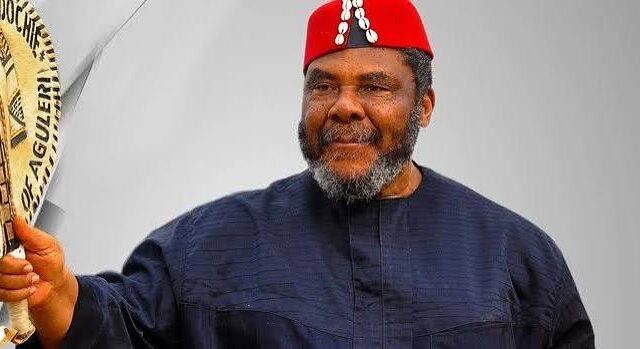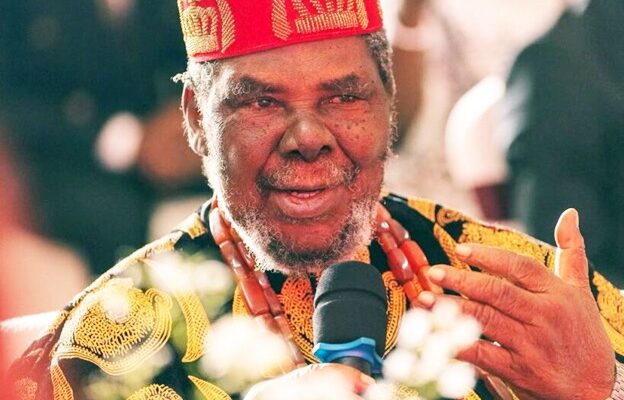
From a young broadcaster in Northern Nigeria to the unforgettable Okonkwo of Things Fall Apart, the story of Chief Pete Edochie is one of talent, discipline, cultural pride, family, friendship and an extraordinary contribution to African entertainment.
There are actors whose names become associated with particular films, characters or moments in the history of entertainment. Then there are those whose presence becomes an institution in itself. Chief Pete Edochie belonged to the latter category.
For generations of Nigerians and African film lovers, his face represented authority, his voice commanded attention, and his delivery of traditional proverbs became a familiar feature of storytelling. Whether he appeared as a powerful traditional ruler, a wealthy businessman, a village elder, a father or a man defending his family, Edochie possessed a screen presence that made it difficult to ignore him.
He was more than an actor who played kings. He became one of the faces through which the world encountered a particular expression of African storytelling.
His journey was not limited to the film industry. Before the cameras made him famous, he had already worked in broadcasting, developed an interest in journalism and television, and occupied important administrative positions within the broadcasting industry. His career also predated the emergence of Nollywood as the home-video industry Nigerians came to know in the 1990s.
Yet, despite his fame, the story of Pete Edochie was also a story of family, long friendships, cultural identity, personal convictions and the passage of time. His final public interview, in which he defended his son Yul Edochie, and his emotional recollection of his friendship with the late Olu Jacobs have added deeply personal dimensions to the memories being shared after his death.
On November 25, 2026, Nigeria lost the veteran actor at the age of 79. But the story of the man whose performances helped shape the country’s entertainment industry remains worth telling.
Pete Edochie was born on March 7, 1947. Several biographical accounts identify Zaria, in present-day Kaduna State, as his birthplace, while some earlier publications have identified Enugu. His family roots, however, were in Akamnato, Ifite Nteje, in Anambra State, southeastern Nigeria. He was an Igbo man whose cultural heritage would later become an important part of his identity as an actor.
Growing up in Northern Nigeria exposed him to a different social and cultural environment from the southeastern community from which his family originated. He spent much of his early life and formative years in the North, particularly Kaduna, where he received his primary and secondary education.
He attended St Patrick’s and St James Primary Schools in Zaria before proceeding to St John’s College in Kaduna. His education and early experiences helped prepare him for the professional journey that would eventually take him into broadcasting and entertainment.
Reports about his younger years also describe an early period of work connected to the Nigerian Railway Corporation and his father’s railway employment. His childhood was therefore not simply a straight path from school into celebrity. Like many Nigerians of his generation, he experienced a society in which education, family responsibilities and the search for a meaningful profession shaped the choices available to young people.
As he grew older, three professional interests became particularly important to him: journalism, broadcasting and acting. In time, he would find a way to practise all three.
His decision to pursue journalism and television training in England reflected an interest in communication that went beyond entertainment. He understood the importance of the spoken word, presentation and the ability to connect with an audience. Those skills would eventually become central to the personality that millions of viewers came to recognise.
In 1967, at approximately 20 years old, Edochie joined the Eastern Nigerian Broadcasting Corporation as a junior programmes assistant. This was the beginning of a broadcasting career that would span several years and establish him as more than an aspiring entertainer.
He worked his way through the broadcasting system, gaining experience in programme presentation, production and administration. He became particularly associated with a classical music programme titled Music from the Masters, which he recalled during an interview with Vanguard.
His career eventually took him to the Anambra Broadcasting Service, where he rose to become Director of Programmes. He also served as Deputy Managing Director and at different times acted as Managing Director.
These were significant positions in an era when broadcasting played an important role in public education, information and cultural development. Radio and television personalities were not merely entertainers; they were among the most recognisable voices in Nigerian homes.
Edochie developed the communication skills, confidence and professional discipline that would later distinguish his acting. His measured speech, clear pronunciation and ability to hold an audience’s attention were qualities that had been developed long before he became a major film star.
He eventually left broadcasting following disagreements surrounding the management and political direction of the broadcasting organisation. Accounts of his departure describe a period of institutional changes that affected the management team.
By then, however, he had already established himself as a respected broadcaster, and an entirely different opportunity was waiting for him.
That opportunity would come through one of the most important literary works in African history.
Chinua Achebe’s Things Fall Apart, first published in 1958, had become an internationally recognised novel. Its exploration of Igbo society, colonialism, tradition, masculinity, family and the consequences of cultural disruption made it one of the most influential African literary works of the twentieth century.
When the Nigerian Television Authority adapted the novel for television, the production required an actor capable of bringing its central character, Okonkwo, to life.
Okonkwo was not an ordinary character. He was a respected wrestler and warrior, a man whose reputation was built on strength, ambition and an uncompromising commitment to the values he believed defined masculinity. Beneath that public image, however, was a troubled individual whose fear of weakness influenced many of his decisions.
The role required an actor who could communicate authority without losing the character’s vulnerability, pride without ignoring his flaws, and strength without turning him into a one-dimensional figure.
Pete Edochie delivered that performance.
His portrayal of Okonkwo became the defining breakthrough of his acting career. The production brought him recognition across Nigeria and beyond, while his interpretation of the character attracted international attention.
The performance was so widely discussed that the British Broadcasting Corporation sent a delegation to interview him about his work. Edochie later recalled that Chinua Achebe was pleased with his interpretation of the character and had expressed appreciation for the way he brought Okonkwo to life.
In an interview with Afia TV in 2023, Edochie explained that he had become internationally recognised before Nollywood emerged as the industry Nigerians now know. He argued that his acting career had begun before the 1992 release of Living in Bondage, which is widely associated with the growth of the Nigerian home-video industry.
He also recalled that Achebe had praised his interpretation of Okonkwo, saying the author had given the character’s role an interpretation that pleased him.
The performance established a relationship between Edochie’s name and one of the most important characters in African literature. For many people, it became difficult to imagine another actor in the role.
His association with Okonkwo also demonstrated something important about his approach to acting: he could inhabit a character whose personality was powerful, complicated and deeply rooted in a particular cultural environment.
Following the success of Things Fall Apart, Edochie continued to develop his career in film and television. His transition into the growing Nigerian movie industry came at a time when home-video productions were becoming increasingly popular.
The industry was expanding rapidly, creating opportunities for actors, producers, directors and writers to tell stories about Nigerian society, family relationships, tradition, religion, wealth, politics and community life.
Edochie’s experience and established screen reputation made him a natural fit for many of the productions being developed during this period.
He appeared in numerous films, including Rituals, Igodo, Billionaire’s Club, Egg of Life, Chain Reaction, Narrow Escape, Lost Kingdom and several other productions.
In Igodo, he was part of a production that became familiar to audiences interested in traditional and adventure-based storytelling. His ability to play influential figures made him particularly suitable for films built around kingdoms, communities and conflicts involving power and tradition.
His performances often placed him in the position of a man whose words carried consequences. He could play a father whose decisions shaped the lives of his children, a king whose authority was challenged, or a wealthy man whose influence determined the direction of a family or community.
The recurring nature of these roles eventually created a recognisable screen identity.
However, it would be unfair to reduce his entire career to the playing of traditional rulers and fathers. His work covered different genres and storylines, and his experience allowed him to contribute to productions that reached audiences across different generations.
One of his notable later appearances came in Genevieve Nnaji’s 2018 film Lionheart, where he played Chief Ernest Obiagu.
The film told the story of a woman navigating the challenges of family responsibility and business leadership. Edochie’s character was central to the family and corporate tensions explored in the production.
Lionheart became particularly significant because it was one of the Nigerian films to receive international attention through Netflix. Its global distribution introduced another generation of viewers to actors whose careers had been built over several decades.
For younger audiences who had not grown up watching his earlier films, the production offered another opportunity to encounter his acting.
His filmography also included appearances in productions such as John and John, Foreigner’s God, Unroyal, King Mabutu, The Rising Sun and Ifediche.
Over the years, Edochie accumulated more than 200 screen credits, according to published film and entertainment profiles. His long career made him one of the most recognisable and experienced actors in the Nigerian entertainment industry.
A major part of his appeal was his voice.
His deep, measured and commanding delivery became one of his most identifiable characteristics. He did not always need to shout to establish authority. A carefully delivered sentence, a pause or a look could communicate more than a lengthy argument.
His use of proverbs also became a signature feature of his performances. Through his characters, he brought traditional expressions and forms of African wisdom into popular entertainment.
These proverbs often addressed human behaviour, family responsibility, pride, betrayal, patience, ambition and the consequences of poor decisions.
For many viewers, his performances became an informal introduction to the power of traditional African storytelling. He helped make the language of elders and the cultural weight of oral expressions familiar to audiences who were growing up in a rapidly changing entertainment environment.
His nickname, Ebubedike, also became closely associated with his public identity. The name carried the image of strength and bravery that many viewers associated with his screen persona.
His contributions did not go unnoticed.
In 2003, former President Olusegun Obasanjo conferred on him the national honour of Member of the Order of the Niger (MON). The recognition acknowledged his contributions beyond individual film performances.
He also received an Industry Merit Award from Africa Magic and a Lifetime Achievement Award from the Africa Film Academy. In 2020, he was honoured with the African Film Legend Award at the African Film Festival.
These honours reflected a career that had crossed the boundaries of broadcasting, television and cinema.
Yet, behind the public personality was a family man whose marriage lasted for more than five decades.
Pete Edochie was married to Barrister Josephine Edochie. Their relationship began during his early years in broadcasting, and the couple eventually built a family together.
In October 2022, the couple celebrated their 53rd wedding anniversary. Edochie marked the occasion publicly, describing Josephine as his queen and expressing gratitude for their years together.
He also acknowledged the role of their children in organising the anniversary celebration.
The couple had six biological children: Leo, Adam, Linc, Jean, Yul and Eva. Their family also included grandchildren, whom Edochie occasionally referenced in his public celebrations.
Their marriage was an important part of his personal history, particularly because it began before the height of his fame. Josephine was part of his life during the years when he was still building his professional career, long before his face became familiar to millions of movie lovers.
His children also developed their own professional interests. Two of his sons, Linc and Yul Edochie, became actors, following a path that connected the family name to the Nigerian entertainment industry in another generation.
Yul, in particular, became one of the most publicly discussed members of the family because of his acting career and his personal life.
The younger Edochie initially built a reputation through his roles in Nollywood productions, appearing in films and eventually developing a significant social-media presence.
His marriage to May Edochie became a subject of intense public attention in April 2022, when he announced that he had welcomed a son with actress Judy Austin and introduced her as his second wife.
The announcement generated widespread debate across Nigeria and beyond. Much of the public reaction focused on May Edochie, who had been married to Yul since 2004 and shared four children with him.
The controversy continued for years, attracting comments from celebrities, social-media users and people who followed the family.
Pete Edochie was sometimes drawn into the discussions because of his position as Yul’s father. However, his most direct public defence of his son came during an interview with Ugo Nwokolo TV shortly before his death.
In the interview, an excerpt of which circulated online days before his passing, the veteran actor described Yul as a strong-willed individual who could not easily be subdued by public criticism.
“Look at my son, Yul. Yul is a very tough guy. You can never subdue him, no matter how much you try,” he said.
Pete also praised Yul for what he described as his restraint towards May, claiming that his son had not publicly insulted or accused his estranged first wife despite the controversy surrounding their marriage.
He further alleged that the public reaction to Yul’s marriage had affected his recognition within the movie industry, claiming that award organisers had repeatedly overlooked him. He did not identify specific award organisers or provide evidence to establish the allegation.
The interview attracted renewed attention following Pete’s death because it showed him speaking openly about his son and the criticism he had faced.
For many admirers, the interview offered a glimpse into the personal relationship between a father and a son whose decisions had become the subject of public debate.
It also became one of the final public records of Pete discussing his family, although there is no established evidence that he intended the interview to serve as a farewell message.
Away from his immediate family, Edochie maintained relationships with several colleagues who belonged to his generation of Nigerian actors.
One of the most significant was his friendship with the late Olu Jacobs.
Both men were respected figures in Nigerian theatre, television and film. Their careers spanned decades, and they belonged to a generation of performers whose work helped establish the foundations upon which the modern Nigerian entertainment industry developed.
Despite their status, rumours occasionally circulated that the two actors had disagreed over money while working on film locations.
Pete addressed those reports in an interview published by The Nation on September 25, 2026, dismissing suggestions that he and Jacobs had ever been involved in a serious disagreement.
He described Jacobs as a senior colleague whom he respected and recalled a personal tradition they observed whenever they met.
According to Pete, Jacobs had grown up in Northern Nigeria, and whenever they met, he would bring a bottle of Campari and allow Jacobs to touch it before opening it. They would then sit together and drink quietly.
It was a small detail, but it revealed the private familiarity that existed between two men whose public careers were often defined by authority and strong personalities.
Pete also recalled their final encounter.
He said they met at the centre of a road while leaving different filming locations. Jacobs looked at him with tears in his eyes and said, “Pete, our mates are gone.”
The words immediately moved Pete to tears. The two men held each other as they reflected on the colleagues they had lost.
Among those he mentioned were Sam Loco, Justice Esiri and Enebeli Elebuwa.
“We were being photographed and we were there mourning ourselves,” he recalled, describing the emotional moment.
He insisted that he had never disagreed with Jacobs and described their relationship as one of mutual respect and friendship.
The recollection became especially poignant after Jacobs died on September 16, 2026, at the age of 84. Pete later paid tribute to him, describing him as a peaceful and humorous colleague who had fought courageously through his final years.
He also praised Jacobs’ wife, actress Joke Silva, for the care she had given her husband during his health challenges.
In his tribute, Pete described Jacobs as a brother and expressed the hope that they might meet again after death.
Barely two months after Jacobs’ passing, Pete himself would be gone.
The emotional weight of their final encounter therefore became part of the story of two veteran actors who had once stood together mourning the loss of their contemporaries.
Pete’s life was not without difficult experiences outside the entertainment industry.
In August 2009, he was kidnapped near Nkpor, close to Onitsha, Anambra State, while travelling with members of his team. The incident attracted considerable attention because of his national profile.
He was released the following day.
In an interview with Vanguard shortly after regaining his freedom, Edochie described the experience and explained that he had not been physically harmed. He said his captors treated him with respect and that they interacted during the period he was held.
He also rejected reports that a ransom of ₦10 million had been demanded or paid, describing such reports as speculation.
His account of the incident attracted attention because it differed from the assumptions that often accompanied reports of high-profile kidnappings. He said he had been able to speak with the young men who held him and hear their complaints about the state of the country.
The experience became another remarkable episode in a life that had included professional success, public recognition and personal challenges.
As his career progressed, Edochie also became an outspoken figure on issues concerning culture, family, morality and the Nigerian entertainment industry. His public comments often reflected the values of an older generation and sometimes generated debate among younger Nigerians.
He was particularly associated with the belief that actors should take their craft seriously and that cultural identity should not be abandoned in the pursuit of popularity.
His screen characters often reflected these themes, although his private opinions and the roles he performed should not be treated as exactly the same thing.
By the time he reached his later years, Pete Edochie had become a familiar figure not only to people who watched his films but also to younger audiences who encountered his scenes through social media.
Clips of his performances, particularly those featuring traditional proverbs, stern warnings and memorable speeches, continued to circulate online.
His voice became a source of humour, admiration and imitation, with many social-media users recreating his expressions and mannerisms.
Yet, the popularity of those clips did not diminish the seriousness of his contribution to the industry. His career had begun before the Nollywood label became popular, and he remained active across several stages of the industry’s development.
On Wednesday, November 25, 2026, the family of Pete Edochie announced that the veteran actor had died at 12:30 a.m. in Enugu, Nigeria, following a prolonged battle with prostate cancer.
The announcement was signed by his son, Chief Leo Pete Edochie, on behalf of the family.
In the statement titled An Iroko Has Fallen, the family described him as a beloved husband, father, brother and kinsman. It confirmed that he was 79 years old and said he was survived by his wife, Josephine, his children, siblings and other relatives.
The family also stated that funeral arrangements would be announced later.
The announcement brought an outpouring of tributes from Nigerians, members of the entertainment industry and admirers who had grown up watching his performances.
For many, his death marked the end of an era. The industry had lost a man whose career connected the early years of Nigerian television drama to the modern era of internationally distributed Nollywood films.
His final interview with Ugo Nwokolo TV added another layer to the tributes. In it, he spoke about Yul, praised his son’s resilience and defended what he considered his son’s restraint in the public controversy surrounding his marriage.
His recollection of Olu Jacobs also returned to public attention. The image of two veteran actors standing together, embracing and mourning the colleagues they had lost became a moving reminder of the friendships formed over decades in the entertainment industry.
Perhaps the most important way to understand Pete Edochie’s life is to recognise that his legacy cannot be reduced to a single character, film or public statement.
He was a broadcaster before he became a celebrated actor. He was a husband and father before the public became interested in his family. He was a colleague and friend to several of the people who helped shape Nigerian entertainment. He was also an actor whose portrayal of Okonkwo brought one of Africa’s most important literary characters to life for television audiences.
His performances gave generations of viewers memorable characters. His voice became part of the sound of Nigerian cinema. His use of traditional expressions helped keep the language and wisdom of older generations visible in popular culture.
The man who once stood with Olu Jacobs and mourned their departed contemporaries eventually joined them in the history of Nigerian entertainment.
And the father who publicly defended his son in one of his final interviews leaves behind a family whose story, like his career, will continue to attract public attention.
Pete Edochie lived through different periods of Nigeria’s history, witnessed the transformation of broadcasting and cinema, and became one of the country’s most recognisable actors.
He was not simply a man who played kings. He became one of the screen figures through whom millions encountered the language, authority, contradictions and emotional complexity of African storytelling.
His name will remain attached to Okonkwo, but his contribution extends far beyond Things Fall Apart.
From the broadcasting studios of the 1960s to the television screens of the 1980s, from the rise of Nollywood in the 1990s to the international reach of modern Nigerian cinema, Pete Edochie left a mark that crossed generations.
The curtain has fallen on his life, but the performances remain.
Rest in peace, Chief Pete Edochie — Ebubedike.