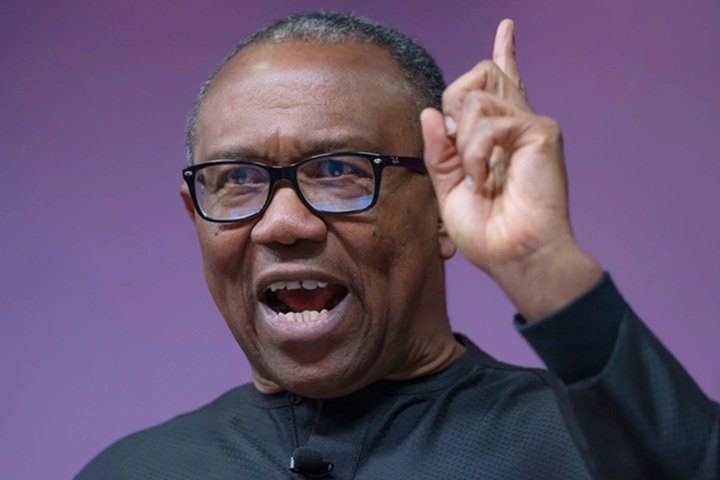
Former presidential candidate of the Labour Party, Peter Obi, has strongly criticised the Federal Government’s intention to borrow ₦20 trillion to finance the 2026 national budget.
Obi issued the warning on Friday, December 12, 2025, describing the plan as “economically dangerous” and a clear sign that Nigeria’s fiscal framework is collapsing under excessive debt dependence.
Obi noted that the country is already struggling under the weight of large-scale borrowing, with debt servicing consuming almost half of national revenue.
He argued that such an approach leaves little room for social investment, infrastructure development, and critical sectors like health and education. According to him, the government’s insistence on further loans without improving productivity is a red flag that Nigeria’s economic trajectory is shifting toward long-term insolvency.
The former Anambra State governor also questioned why the Federal Government continues to pursue record-breaking loans when it has repeatedly claimed that revenue generation has surpassed expectations.
He asked why rising revenue has not reduced the need for massive borrowing, particularly given that the 2025 budget remains largely unimplemented. Obi challenged the administration to explain why key projects are stagnant despite frequent assurances that revenue performance is strong.
Speaking during a policy forum in Lagos, Obi said the trend reflects fiscal indiscipline and an absence of strategic planning within the federal structure.
He insisted that responsible governance requires that loans be tied strictly to productive investments—especially those capable of generating exports, enhancing value chains, or stimulating manufacturing. Borrowing to fund recurrent expenditure, he warned, pushes the nation further into a cycle of debt without growth.
He stressed that every trillion borrowed without a corresponding economic return represents a mortgage on the future of Nigerian youths.
Obi noted that Nigeria’s total debt burden has escalated dramatically within the last decade, yet the nation continues to face repeated budget deficits, infrastructural gaps and declining living standards.
The former Labour Party candidate urged the Federal Government to adopt transparent revenue reforms, block leakages, and prioritise efficiency in public spending.
He emphasised the need for improved tax administration, robust anti-corruption mechanisms and policies that stimulate production rather than consumption. According to him, Nigeria cannot grow by borrowing to pay salaries, fuel subsidies, or administrative overheads.
Obi also called for a comprehensive review of Nigeria’s budget structure, saying the continuous reliance on external and domestic loans is unsustainable. He appealed for policy direction that empowers local industries, increases exports, and creates jobs.
Without these steps, he warned, Nigeria risks becoming trapped in a perpetual loop of debt refinancing and declining fiscal independence.
Economic analysts have echoed his sentiments, noting that the proposed ₦20 trillion loan would be the highest single-year borrowing in Nigeria’s history.
Many economists fear that current debt levels could crowd out private sector borrowing, trigger inflationary pressures and undermine future development.
As debates on the 2026 budget intensify, Obi’s remarks have added renewed scrutiny to the Federal Government’s economic projections. Opposition leaders, civil society groups and financial experts have also called for clarity on how the proposed funds will be used and what long-term benefits they will bring.