



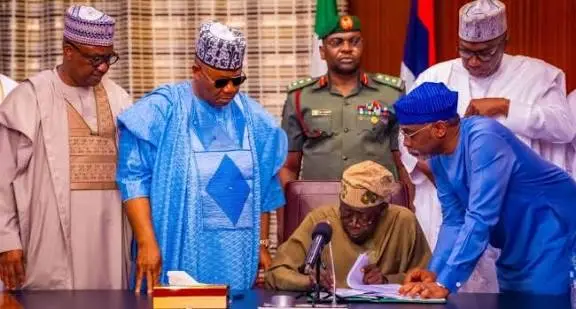
As Nigeria inches closer to the January 1 commencement date for its most ambitious tax reform in decades, a fierce national debate has erupted over allegations that the tax laws signed by President Bola Ahmed Tinubu do not fully reflect what lawmakers debated and approved at the National Assembly. What began as a technical legislative concern has rapidly evolved into a full-blown political and civic controversy, drawing in former Vice President Atiku Abubakar, Labour Party’s 2023 presidential candidate Peter Obi, civil society organisations, lawmakers, and the Presidency itself.
At the heart of the controversy are claims of discrepancies between the tax bills passed by the National Assembly and the versions subsequently gazetted and circulated to the public. Critics argue that if such discrepancies exist, they raise serious constitutional, legal, and democratic concerns, potentially undermining legislative authority, public trust, and the legitimacy of the reforms themselves. The Federal Government, however, insists that the allegations are based on misinformation, incomplete documents, and premature conclusions.
On Monday, the Presidency formally entered the debate, seeking to calm public anxiety and counter claims that the new tax laws had been altered after passage. The intervention came amid mounting calls for the suspension of the reforms’ implementation, with prominent political figures and civic groups warning that proceeding under a cloud of controversy could further erode confidence in governance and fiscal policy.
The controversy was first ignited by Abdulsamad Dasuki, a member of the House of Representatives, who publicly raised alarm over what he described as inconsistencies between the tax bills lawmakers passed and the versions that later appeared in the public domain. Dasuki argued that the alleged discrepancies amounted to a violation of legislative privilege and procedure, insisting that lawmakers had a constitutional right to see the exact texts that were debated, approved, and eventually signed into law.
According to Dasuki, the situation suggested a breakdown in legislative integrity, where documents presented to the public might not accurately reflect the will of elected representatives. His claims resonated widely, especially in a political environment where Nigerians are already sensitive to issues of transparency, accountability, and trust in public institutions.
The concerns gained further traction when opposition figures weighed in. Former Vice President Atiku Abubakar and Peter Obi both called for a suspension of the implementation of the tax laws, arguing that the government must first address the credibility questions surrounding their passage and gazetting. Civil society organisations echoed these sentiments, warning that fiscal reforms of such magnitude must be built on unquestionable legal and procedural foundations.
Against this backdrop of growing suspicion and political tension, Taiwo Oyedele, Chairman of the Presidential Fiscal Policy and Tax Reforms Committee, appeared on Channels Television’s Morning Brief to offer the Federal Government’s most detailed response yet. His remarks sought to dismantle the allegations point by point, while also shedding light on the often opaque process through which bills move from legislative chambers to presidential assent and eventual gazetting.
Oyedele dismissed much of what had been circulating in the media as misleading and, in some cases, outright false. According to him, the central claim that the gazetted tax laws differ from what was passed by the National Assembly rests on a flawed premise: that the public currently has access to the final, harmonised versions of the bills as certified by the National Assembly.
“Before you can say there is a difference between what was gazetted and what was passed, we need to establish what was actually passed,” Oyedele said. “The truth is, we do not have the harmonised bills certified by the Clerk of the National Assembly in the public domain. What we have are drafts, unofficial documents, and interpretations.”
He explained that in Nigeria’s legislative process, the authoritative version of any bill passed by the National Assembly is the harmonised copy certified by the Clerk and transmitted to the President for assent. According to Oyedele, only lawmakers and the legislative bureaucracy can definitively state what was sent to the President, as that document is not automatically made public.
“Even me, I cannot say that I have it,” Oyedele admitted. “The only version I have is what was presented to Mr President to sign. The certified harmonised version remains with the National Assembly.”
This admission, while intended to clarify procedural realities, has paradoxically fueled further debate. Critics argue that the lack of public access to harmonised bills creates fertile ground for suspicion and misinformation, particularly when the laws in question have far-reaching implications for citizens, businesses, and subnational governments.
Oyedele also addressed a specific flashpoint in the controversy: Section 41, which reportedly contained a provision requiring a 20 percent deposit under certain tax circumstances. This provision became a rallying point for critics who claimed it was smuggled into the law without proper legislative approval.
According to Oyedele, that provision never made it into the final gazetted version of the law. He explained that it appeared in an early draft and was subsequently circulated prematurely, even before the relevant House committee had concluded its deliberations.
“I reached out to the House of Representatives committee on this issue,” Oyedele said. “Their response was that they had not even met on the matter. What circulated widely did not come from the committee. Someone wrote a report before the committee met, and it spread everywhere.”
He stressed that the draft containing the controversial provision was not an official document and should not be conflated with the final law. In his view, the media and the public must exercise caution and allow the National Assembly to complete its own internal review before drawing conclusions.
“I know that particular provision is not in the final gazette,” he added. “We should allow the House of Representatives to conduct its investigation and clarify matters authoritatively.”
Despite these assurances, the controversy underscores deeper structural issues in Nigeria’s lawmaking and communication processes. Analysts note that the absence of timely, transparent access to final legislative texts creates a vacuum that is easily filled by speculation, leaks, and conflicting narratives. In an era of heightened public skepticism, even procedural technicalities can quickly escalate into political crises.
President Bola Tinubu signed the four tax reform bills into law amid both applause and resistance, describing them as the most significant overhaul of Nigeria’s tax system in decades. The laws include the Nigeria Tax Act, the Nigeria Tax Administration Act, the Nigeria Revenue Service (Establishment) Act, and the Joint Revenue Board (Establishment) Act. Together, they consolidate tax administration under a single authority, the Nigeria Revenue Service, replacing the existing Federal Inland Revenue Service framework.
According to the Federal Government, the reforms are designed to simplify tax compliance, reduce duplication across federal, state, and local governments, broaden the tax base, and modernise revenue collection in line with global best practices. Officials argue that Nigeria’s historically low tax-to-GDP ratio makes reform unavoidable if the country is to sustainably fund development, infrastructure, and social services.
However, the bills faced stiff opposition during their passage, particularly from lawmakers from northern Nigeria, who raised concerns about equity, regional impact, and potential burdens on already struggling populations. Those tensions have not fully dissipated, and the current controversy has reopened fault lines that many assumed had been settled once presidential assent was secured.
The reforms are scheduled to take effect on January 1, 2026, giving government agencies, businesses, and citizens time to adjust. Yet calls for suspension suggest that political consensus around the reforms remains fragile. For critics, the issue is not merely about tax policy but about process, trust, and democratic accountability.
Civil society organisations argue that even the perception of discrepancies between passed and gazetted laws is damaging. They contend that fiscal reforms require broad public buy-in, which can only be achieved through transparency and clear communication. Without this, they warn, implementation could face resistance, legal challenges, and non-compliance.
Supporters of the reforms, on the other hand, caution against allowing misinformation to derail urgently needed policy changes. They argue that Nigeria cannot afford perpetual delays in reforming its tax system, especially at a time of fiscal strain, rising debt servicing costs, and growing demands on public resources.
The Presidency has sought to strike a balance between these competing pressures, reaffirming its commitment to reform while urging patience and restraint. Government officials maintain that there was no deliberate attempt to alter the laws after passage and that any confusion stems from drafts and unofficial documents circulating outside formal channels.
As the debate continues, attention is likely to shift back to the National Assembly, whose role as the custodian of the harmonised bills places it at the center of the controversy. Lawmakers are under pressure to clarify what exactly was passed, how it was harmonised, and whether the public versions accurately reflect legislative intent.
Ultimately, the controversy over Nigeria’s new tax laws highlights a broader challenge facing democratic governance in the country: bridging the gap between complex institutional processes and public understanding. In a climate of economic hardship and political polarization, even well-intentioned reforms can falter if citizens do not trust the process behind them.
Whether the storm subsides or intensifies in the coming weeks will depend largely on how transparently and decisively the government and the National Assembly address the lingering questions. What is clear, however, is that the tax reforms—hailed by supporters as transformative and condemned by critics as questionable—have already reshaped Nigeria’s political and policy landscape long before their official commencement.

