


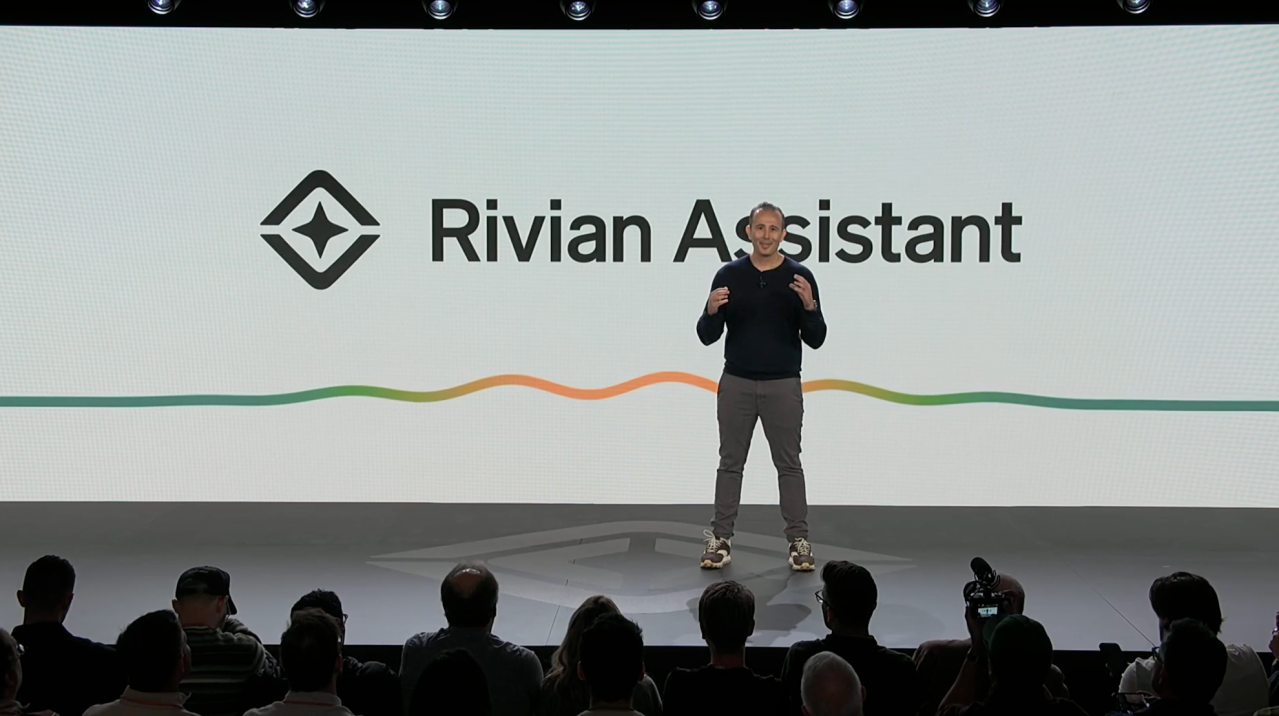
Rivian is licensing elements of its AI voice assistant to Volkswagen through their joint venture. Model plans, terms and timing remain undisclosed
Rivian expanded its technology joint venture with Volkswagen Group to include elements of Rivian’s AI voice assistant. The automaker disclosed the licensing arrangement in its third-quarter investor presentation on October 29, 2026. It did not announce licensing fees, payment terms or which Volkswagen models will receive the technology. The expansion adds a new software component to a partnership already focused on vehicle architecture and software.
Rivian AI assistant joins Volkswagen technology venture
Rivian said it is licensing elements of its AI Voice Assistant technology to Volkswagen Group through the joint venture. TechCrunch reported the disclosure came in Rivian’s third-quarter presentation, alongside the company’s earnings release. The presentation described the move as “a proof point for the extensibility of the platform we’ve built in-house.”
The announcement does not confirm that Volkswagen has selected a specific vehicle for the assistant. TechCrunch noted the ID EVERY1 as a possible future fit, but the company has not named a launch model. It also has not disclosed when Volkswagen vehicles could receive the technology, or how much the licensing agreement may be worth.
The expanded scope sits within a partnership established in 2024. Rivian and Volkswagen created an independent joint venture to develop software and electrical architecture for future vehicles. The companies later increased Volkswagen’s planned investment commitment to as much as $5.8 billion, according to  TechCrunch’s earlier coverage.
What Rivian Assistant does in its vehicles
Rivian describes its assistant as an AI-powered voice tool integrated into the vehicle’s hardware and software. Drivers can summon it with “Hey Rivian” or a steering-wheel control. The company says the assistant can adjust vehicle settings, help with navigation and media, and support voice-powered messaging.
Rivian’s  product description says the assistant can handle context-aware commands, such as changing climate settings or drive modes. It also describes connections to Google Calendar and tools for answering vehicle questions. Rivian notes that cloud features are in English and require a Connect+ subscription or trial for compatible vehicles.
Rivian says its system uses an in-house agentic framework to interpret what a driver wants and direct the request to vehicle software. The assistant therefore connects spoken requests to selected functions, rather than serving only as a general chatbot. However, the company has not detailed which capabilities Volkswagen may license or adapt.
Rivian and Volkswagen joint venture scope
The joint venture, known as Rivian and Volkswagen Group Technologies, works on software-defined vehicle technologies. Its official  joint venture website describes work spanning operating systems, zonal controllers, cloud services and connectivity. The newly disclosed assistant license broadens the collaboration into in-vehicle AI interaction.
Rivian’s third-quarter results show the partnership already contributes materially to its software business. The company reported $605 million in software and services revenue for the quarter, with $354 million attributed to its Volkswagen joint venture. That figure includes more than the newly announced assistant license and should not be read as revenue from AI assistant licensing alone.
The company also reported $2.155 billion in total third-quarter revenue, up 38% year over year. In the same investor presentation, Rivian said its strategy emphasizes vertical integration across hardware and software. Licensing selected technology to a partner could extend the reach of its platform, although Rivian has not disclosed expected financial returns from the assistant agreement.
What the AI assistant deal means next
For Volkswagen, the deal gives it access to elements of a voice system Rivian has built for its own vehicles. The companies have not said whether Volkswagen will adopt the assistant unchanged or combine it with its existing interfaces. Any use in future models will depend on development, vehicle integration and decisions the companies have not yet announced.
Rivian’s own assistant is available in its R1 and R2 vehicles, according to the company’s third-quarter release. Its October software update added Gmail integration. Those updates show that Rivian continues developing the product, but they do not confirm equivalent features for Volkswagen models.
Ultimately, Rivian has confirmed that it is licensing parts of its AI Voice Assistant technology through the Volkswagen venture. Specific Volkswagen models, pricing and deployment timing remain undisclosed. The partnership’s next announcements will clarify how the software fits into future vehicles. For now, the confirmed change is an expanded technology collaboration, not a named Volkswagen launch.




