
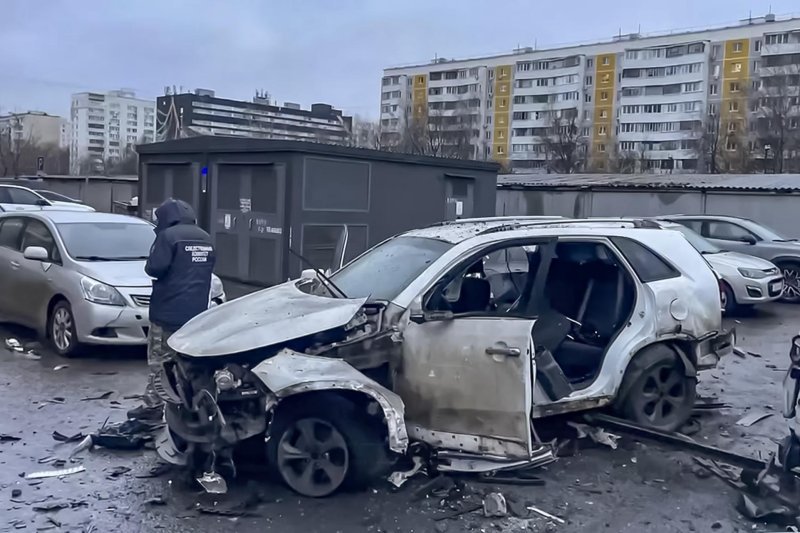
In the grey dawn of a Moscow morning, as commuters prepared for another workday and the sprawling Russian capital stirred to life, a violent explosion shattered the calm of a middle-class residential neighbourhood. Within seconds, twisted metal, shattered glass, and smoke filled a quiet parking area in southern Moscow. When emergency responders arrived, it became clear that the blast was not an accident, nor a random act of violence. It was a targeted assassination.
Lieutenant General Fanil Sarvarov, one of Russia’s most senior military officers and the long-serving head of the Armed Forces’ Operational Training Department, was dead.
Russian authorities quickly confirmed that the 56-year-old general was killed when an explosive device planted beneath his vehicle detonated as he approached or entered the car early Monday morning. Within hours, Moscow’s powerful Investigative Committee issued a statement that sent shockwaves through Russia’s political and security establishment: among the leading theories being pursued was the involvement of Ukrainian special services.
The killing marks yet another dramatic escalation in what analysts increasingly describe as a covert war being fought far beyond the front lines of eastern Ukraine — a shadow conflict of assassinations, sabotage, and psychological warfare carried into the heart of Russia itself.

A Precision Killing in the Heart of the Capital
According to investigators, the bomb was carefully concealed under the chassis of Sarvarov’s car, suggesting detailed surveillance, technical expertise, and precise timing. This was not a crude attack. It bore the hallmarks of a professional operation designed to eliminate a high-value target while sending a clear message.

State media footage released shortly after the blast showed the charred remains of a vehicle parked among others in a residential lot. The force of the explosion had ripped through the underside of the car, leaving debris scattered across the asphalt. Windows in nearby buildings were damaged, and residents described hearing a deafening bang that echoed across the area.
Within minutes, the scene was sealed off by security forces. Bomb disposal units, forensic teams, and counter-intelligence officers combed the area for evidence. Residents were questioned. Surveillance cameras in the vicinity were seized. Mobile phone signals in the area were reportedly monitored as part of a sweeping investigation.
The Kremlin confirmed that President Vladimir Putin was “immediately informed” of Sarvarov’s death through special security channels, underscoring the gravity of the incident. The assassination of a lieutenant general inside Moscow is not merely a criminal act; it is a national security crisis.
Who Was Fanil Sarvarov?
While not a household name internationally, Fanil Sarvarov occupied a critical position within Russia’s military hierarchy. As head of the Armed Forces Operational Training Department for nine years, he was responsible for shaping how Russian troops prepared for combat, coordinated large-scale exercises, and implemented strategic doctrines.
According to Russia’s state news agency TASS, Sarvarov had previously played a key role in organizing and conducting military operations in Syria, where Russian forces intervened to support President Bashar al-Assad’s government. That experience placed him among a cadre of senior officers deeply involved in Russia’s modern expeditionary warfare — the same group that later formed the backbone of military planning during the invasion of Ukraine.
Though he did not command troops at the front, Sarvarov’s role was foundational. He helped design the systems, training regimens, and operational concepts that shaped Russia’s armed forces during one of the most consequential periods in their recent history.
For Ukraine, analysts say, such figures are not peripheral. They are seen as enablers of Russia’s war machine.
Moscow Points the Finger at Kyiv
In its official statement, Russia’s Investigative Committee said it was exploring “various motives” for the killing, but notably added that one of the key theories was that the crime had been “organized by Ukrainian special services.”
While no evidence was immediately presented publicly, the allegation fits a growing pattern in Moscow’s narrative. Since Russia launched its full-scale invasion of Ukraine in February 2022, a string of assassinations, bombings, and targeted killings inside Russia have been blamed on Ukrainian intelligence agencies.
From Moscow’s perspective, these attacks represent a deliberate strategy by Kyiv to weaken Russia’s leadership, sow fear among elites, and demonstrate that no one is beyond reach — not even in the capital.
Ukrainian officials have often responded to such accusations with silence, ambiguity, or carefully worded denials. In some cases, however, Kyiv has openly acknowledged responsibility.
That ambiguity has become part of the psychological dimension of the conflict.
A Pattern of Targeted Killings
Sarvarov’s death is not an isolated incident. Over the past three years, Moscow and other Russian cities have witnessed a series of high-profile killings targeting military officers, nationalist figures, and outspoken supporters of the war in Ukraine.
In April, Lieutenant General Yaroslav Moskalik, deputy head of the General Staff’s main operational department, was killed in a car bomb attack near Moscow. His death, like Sarvarov’s, stunned the military establishment and raised questions about the effectiveness of Russia’s internal security apparatus.
A year earlier, General Igor Kirillov, who headed Russia’s nuclear and chemical weapons protection forces, was killed when an explosive device planted on a scooter detonated near a residential building. In that case, Ukrainian officials swiftly claimed responsibility, marking one of the rare moments of overt acknowledgment.
Beyond the military, other prominent figures have also been targeted. Armen Sarkisyan, the founder of a pro-Russian militia group described by Ukraine as a “criminal mastermind,” died after a bombing in central Moscow earlier this year.
Political and ideological figures have not been spared either. In 2022, Darya Dugina, daughter of nationalist ideologue Alexander Dugin, was killed when her car exploded outside Moscow. While Russian authorities blamed Ukrainian operatives, Kyiv denied direct involvement, though some Ukrainian figures praised the killing as a blow against Kremlin propaganda.
In April 2023, pro-war blogger Vladlen Tatarsky was killed in a café bombing in St. Petersburg, an attack that highlighted how the conflict has seeped into Russia’s cultural and information spheres.
Taken together, these incidents paint a picture of a sustained campaign that has gradually shifted from the battlefield to the streets of Russia’s major cities.
The Shadow War Intensifies
Security analysts describe the current phase of the Russia-Ukraine conflict as a hybrid war, combining conventional military operations with cyberattacks, economic pressure, disinformation, and targeted assassinations.
For Ukraine, faced with a larger and better-resourced adversary, asymmetric tactics have become an essential part of its strategy. Targeted killings, if indeed conducted by Ukrainian services, serve multiple purposes: disrupting command structures, deterring senior officials, and demonstrating operational reach.
For Russia, these attacks strike at the heart of state authority. Moscow has long prided itself on tight internal security, particularly in the capital. Each successful assassination raises uncomfortable questions about intelligence failures, insider leaks, or systemic vulnerabilities.
The fact that Sarvarov’s car could be rigged with an explosive device in a residential area suggests prolonged surveillance and access — conditions that should, in theory, be difficult to achieve in Moscow.
Public Shock and Elite Anxiety
While Russian state media have reported Sarvarov’s death in restrained tones, the impact among military and political elites is profound. Behind closed doors, analysts say, anxiety is growing.
Senior officials are reportedly tightening personal security, altering routines, and limiting public appearances. The once-routine act of driving to work has become fraught with risk for those involved in the war effort.
For ordinary Russians, the assassination reinforces a sense that the war is no longer distant. It is no longer confined to television screens or far-off regions. It has arrived at home, uninvited and unpredictable.
Residents near the blast site told local media they were frightened by the realization that such violence could erupt in their neighbourhood without warning. Some expressed anger that the conflict was spilling into civilian spaces; others blamed Ukraine outright.
Kyiv’s Calculated Silence
As of the time of filing this report, Ukrainian officials had not formally commented on Sarvarov’s killing. This silence is consistent with Kyiv’s approach to many such incidents.
By neither confirming nor denying involvement, Ukraine maintains plausible deniability while allowing the psychological impact of the attack to resonate. The uncertainty itself becomes a weapon, forcing Russian authorities to expend resources on security and investigations while breeding mistrust within elite circles.
When Ukraine has claimed responsibility in the past, it has often framed such actions as legitimate acts of war against those directing or enabling aggression. That framing resonates with many Ukrainians, particularly after years of missile strikes, civilian casualties, and infrastructure destruction.
Implications for the War
The assassination of Fanil Sarvarov comes at a critical moment in the broader conflict. The war in Ukraine has settled into a grinding, attritional phase, with neither side achieving decisive breakthroughs. In such conditions, symbolic victories and psychological operations gain heightened importance.
For Ukraine, demonstrating the ability to strike senior Russian figures inside Moscow may bolster domestic morale and signal resolve to international partners.
For Russia, the killing underscores the challenge of maintaining internal stability while prosecuting a prolonged external war. It may prompt harsher security measures, expanded surveillance, and increased repression — steps that could further strain relations between the state and society.
There is also the risk of escalation. Each assassination raises the stakes, increasing the possibility of retaliatory actions, whether overt or covert. The shadow war, once ignited, is difficult to contain.
An Unanswered Question
Who exactly planned and executed the killing of Fanil Sarvarov? Was it a meticulously planned operation by Ukrainian intelligence, a rogue act by internal actors, or something else entirely?
For now, the truth remains obscured by competing narratives, classified investigations, and geopolitical posturing. What is clear, however, is that the assassination marks another turning point in a conflict that has repeatedly defied expectations.
The war between Russia and Ukraine is no longer defined solely by trenches, drones, and artillery. It is increasingly shaped by covert strikes, targeted killings, and a battle for psychological dominance — a war within a war.
As Moscow mourns yet another fallen general and Kyiv watches closely from across the border, one reality stands out with chilling clarity: in this conflict, no battlefield is fixed, and no city is truly safe.