
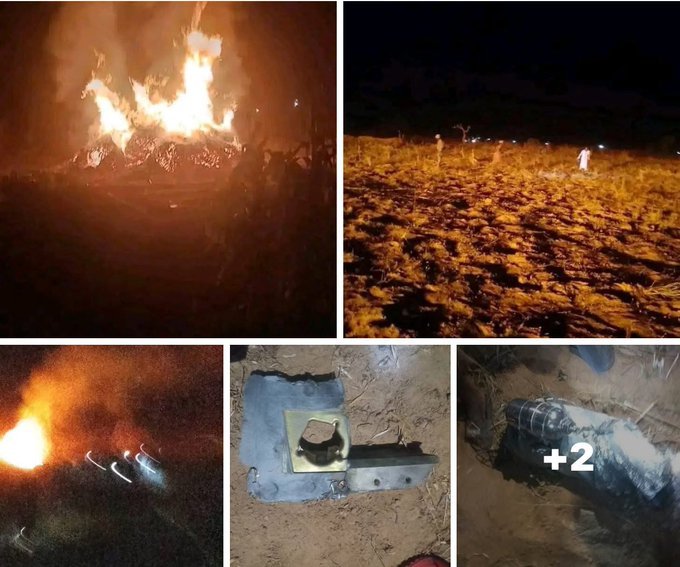
The United States military airstrikes reportedly carried out in parts of Sokoto State on Christmas night have continued to generate intense debate across Nigeria’s security, political, and civic spaces, with fresh concerns emerging over intelligence accuracy, target selection, and the broader implications of foreign military intervention on Nigerian soil. While the strikes initially sparked panic among residents and fueled speculation of a major counterterrorism operation, a respected security analyst has now cast serious doubt on their effectiveness, describing the operation as misdirected and strategically inconsequential.
Security expert and conflict analyst, Zagazola Makama, has openly questioned the value of the airstrikes, asserting that they landed in an area with no known terrorist presence and therefore had no meaningful impact on insurgent or extremist groups operating in Nigeria. His assessment, shared publicly on social media, has added a critical layer of scrutiny to an operation that remains shrouded in official silence.
For DDM NEWS, the unfolding controversy highlights deeper questions about intelligence sharing, regional security dynamics, and the risk of collateral fear—even in the absence of casualties—when military power is deployed without clear, verifiable targets.
Christmas Night Panic in Sokoto
On Christmas night, residents of Jabo community in Tambuwal Local Government Area of Sokoto State were jolted by a sudden explosion that lit up the night sky and sent shockwaves through the rural settlement. In a viral v
ideo that quickly spread across social media platforms, visibly shaken residents could be seen fleeing in panic as flames erupted from the site of the strike.

The footage, which has since been widely circulated, shows villagers shouting and running for safety amid confusion and fear, unsure of what had happened or why their community had been targeted. For many, the incident was their first direct encounter with an airstrike—an experience more commonly associated with Nigeria’s North-East insurgency zones than with relatively calm farming communities in the North-West.
Despite the dramatic visuals, no casualties have been officially reported, and there has been no confirmation of damage to homes or infrastructure beyond the immediate impact site. Nigerian authorities have also remained tight-lipped, offering no detailed briefing on the nature, scope, or objectives of the operation.
US Strike, Limited Information
Initial reports suggested that the strikes were carried out by the United States military as part of broader counterterr
orism efforts, possibly targeting suspected extremist elements believed to be operating in parts of northern Nigeria. However, beyond these broad claims, neither Washington nor Abuja has released concrete operational details.
This lack of transparency has fueled speculation and conflicting narratives—ranging from claims of a decisive blow against terrorist cells to fears of sovereignty violations and intelligence failures.
It is within this information vacuum that Zagazola Makama’s intervention has become particularly significant.
“A Wrong Target With No Impact”
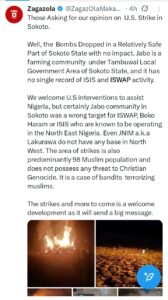
In a detailed post on X (formerly Twitter), Makama responded to growing public requests for his assessment of the strike. His conclusion was blunt: the operation, at least as it relates to Sokoto State, missed its mark.
“Those asking for our opinion on the U.S. strike in Sokoto,” Makama wrote, “well, the bombs dropped in a relatively safe part of Sokoto State with no impact.”
According to the analyst, the specific location of the strike—Jabo community under Tambuwal Local Government Area—has no documented history of hosting extremist groups such as ISIS, ISWAP, or Boko Haram.
“Jabo is a farming community,” Makama explained, “and it has no single record of ISIS and ISWAP activity.”
This assessment directly contradicts narratives suggesting that the strike targeted a terrorist stronghold, raising serious questions about how the location was selected and what intelligence informed the operation.
Understanding the Security Geography
Makama’s critique draws attention to a crucial but often overlooked aspect of Nigeria’s security crisis: the geographic distribution of different armed groups.
According to multiple security assessments reviewed by DDM NEWS, ISIS-linked factions and ISWAP remain primarily concentrated in Nigeria’s North-East, particularly in parts of Borno, Yobe, and Adamawa States. Boko Haram’s operational footprint, while diminished, is also largely confined to the same region.
In contrast, Sokoto State—and the North-West more broadly—has been plagued mainly by banditry, cattle rustling, mass kidnappings, and communal violence, rather than ideologically driven jihadist insurgency.
Makama emphasized this distinction in his analysis, warning against conflating different security threats.
“We welcome U.S. interventions to assist Nigeria,” he wrote, “but certainly Jabo community in Sokoto was a wrong target for ISWAP, Boko Haram, or ISIS, who are known to be operating in the North-East Nigeria.”
What About JNIM and Lakurawa?
Addressing speculation that other extremist groups might have justified the strike, Makama also dismissed the presence of Jama’at Nusrat al-Islam wal-Muslimin (JNIM), sometimes referred to locally as Lakurawa, in the area.
“Even JNIM a.k.a. Lakurawa do not have any base in the North-West,” he stated.
This assertion further narrows the list of potential targets, reinforcing his conclusion that the strike did not align with known threat patterns.
Security experts contacted by DDM NEWS largely agree that while extremist influence from the Sahel has raised concerns about possible spillover into Nigeria’s North-West, there is still no confirmed evidence of established ISIS or ISWAP cells operating in rural Sokoto communities like Jabo.
Religion, Demographics, and Misplaced Narratives
Another sensitive aspect of Makama’s commentary relates to the framing of violence in Nigeria through a religious lens. He pointed out that the strike location is predominantly Muslim, estimating that the area’s population is about 98 percent Muslim.
“The area of strikes,” he wrote, “does not possess any threat to Christian genocide. It is a case of bandits terrorizing Muslims.”
This statement challenges narratives—particularly from international actors—that present Nigeria’s security crisis primarily as a campaign of religious persecution. While acknowledging that religiously motivated violence exists in some contexts, Makama argues that oversimplifying the conflict risks misdiagnosis and misdirected interventions.
For DDM NEWS, this raises broader concerns about how external partners interpret Nigeria’s complex security landscape and whether policy decisions are being shaped by incomplete or politicized information.
Panic Without Casualties: The Human Impact
Even in the absence of reported casualties, the psychological impact of the airstrike on Jabo residents has been profound. Community members who spoke anonymously to local reporters described a night of fear, confusion, and sleeplessness.
“We did not know what was happening,” one resident reportedly said. “We just heard a loud explosion and saw fire. People thought war had come to our village.”
For farming communities already struggling with insecurity, poverty, and displacement caused by bandit attacks in neighboring areas, the experience has only deepened anxiety.
Security analysts warn that such incidents, if repeated, could erode trust between civilians and both domestic and international security actors, especially if communities feel targeted or endangered by operations they do not understand.
Welcoming Intervention, Demanding Precision
Despite his criticism, Makama was careful to stress that he is not opposed to US involvement in Nigeria’s fight against insecurity. On the contrary, he described international support as welcome—provided it is precise, informed, and effective.
“The strikes and more to come is a welcome development,” he wrote, “as it will send a big message.”
However, he implied that the message risks being undermined if operations are based on flawed intelligence or symbolic gestures rather than actionable targets.
Security experts echo this concern, noting that modern counterterrorism relies heavily on accurate, locally informed intelligence. Without it, even the most sophisticated military capabilities can fail to achieve meaningful results.
Silence From Authorities
As of the time of filing this report, neither the Nigerian government nor the United States military has released a comprehensive account of the Sokoto operation. There has been no confirmation of targets, objectives, or coordination mechanisms, leaving analysts and the public to piece together information from unofficial sources.
This silence has further fueled speculation and mistrust, with some Nigerians questioning whether the strike was experimental, symbolic, or based on outdated intelligence.
For DDM NEWS, the lack of official clarity remains one of the most troubling aspects of the incident.
A Cautionary Moment
The Sokoto airstrike episode may ultimately serve as a cautionary tale in Nigeria’s evolving security partnerships. It underscores the risks of acting on incomplete intelligence, the importance of understanding local dynamics, and the need for transparency in operations that have the potential to affect civilian populations.
As Nigeria grapples with multiple security threats across different regions, the challenge for both domestic and international actors will be ensuring that interventions are not only forceful but also precise, context-aware, and accountable.
For now, the flames that briefly lit up Jabo community have died down, but the questions they ignited remain very much alive.
And as DDM NEWS continues to monitor developments, one thing is clear: in the fight against insecurity, power without precision may send a message—but it may not solve the problem.