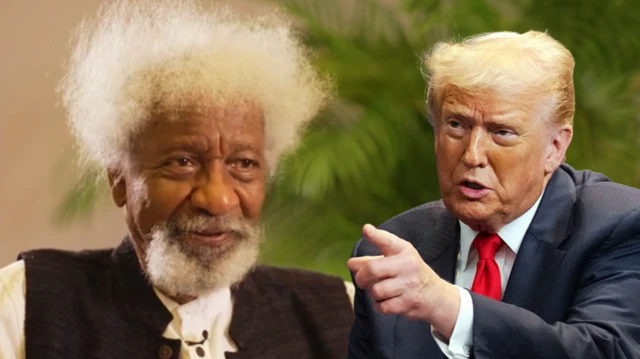
Nobel laureate Wole Soyinka has criticised former United States President Donald Trump over his recent remarks suggesting that American forces could be deployed to Nigeria.
Soyinka, speaking on Friday after a meeting with Benue State Governor Hyacinth Alia in Makurdi, said Trump’s comments reflected a shallow understanding of Nigeria’s long-running security challenges.
According to him, the country’s complex crises cannot be resolved by outsiders who have not studied the underlying factors fueling the violence.
He faulted Trump for repeatedly claiming he would “come to help” Nigeria without any serious engagement with the realities on the ground, describing such rhetoric as reckless and dismissive of those who have been tackling the insecurity for years.

“You don’t just open your mouth and say, ‘I’m coming to help you whether you like it or not… and I’m coming with violence from outside with poor, almost non-existent analysis of the complexities of where the problem is,’” Soyinka said.
He added that bold declarations about arriving “with guns a-blazing” only escalate tension rather than address the root causes of the crisis.
“And when we come in, it’s going to be fast, vicious and swift,” he said, quoting Trump’s remarks.
Soyinka restated his long-standing position that Nigeria’s security problems are driven by violent groups manipulating religion for advantage, and not by religious practice itself.
He argued that government responses must protect citizens while also recognising the suffering of victims.
“Is that the language of somebody whose head is correct? Any government has an obligation to ensure the welfare of its citizens.
But at least have some respect for victims and those trying to find solutions to the unacceptable situation,” he said.
Trump had recently labelled Nigeria a “Country of Particular Concern” over alleged targeted attacks on Christians and suggested that he would consider deploying U.S. troops if the killings continued.
The Federal Government strongly rejected the claim, insisting it does not reflect what is happening in the country.
Meanwhile, U.S. lawmakers, religious leaders and government officials on Thursday presented differing positions at a hearing of the House Foreign Affairs Subcommittee.
The session reviewed Trump’s redesignation of Nigeria as a “Country of Particular Concern” and the broader debate over religious freedom assessments in the country.