


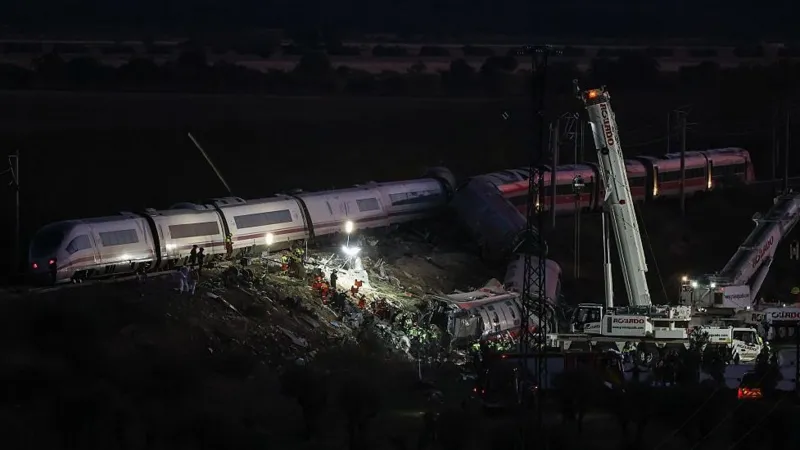
Spain has begun three days of national mourning after a train collision killed at least 68 people and injured dozens more in one of the country’s deadliest rail disasters in recent decades.
Emergency workers continued recovery operations through the night on Wednesday, using powerful floodlights and specialised equipment to cut through damaged carriages and search for victims. Authorities said many of those killed were yet to be identified.
The crash occurred near Urda in Spain’s Toledo region when a high-speed train operated by state-owned railway company Renfe struck an Iryo train that had stopped on the tracks.
Prime Minister Pedro Sánchez expressed condolences to the victims’ families, saying the tragedy had left the country grieving.

“The whole of Spain is grieving,” Sánchez said, adding that families had been torn apart by the disaster.
Spain’s authorities are investigating the circumstances surrounding the collision, including decisions made after the Iryo train reportedly stopped because of a computer failure.
Transport Minister Óscar Puente said the train, which was carrying 147 passengers, had stopped on the tracks following the technical problem.
He explained that a control centre in Madrid was responsible for managing operations during system failures. However, he described the decision to allow the trains to move again without speed restrictions as “inexplicable”.
Audio recordings between train controllers and drivers reportedly appeared to show that a high-speed train had been cleared to proceed despite another train being stationary ahead.
Iryo said its train had been struck from behind by the Renfe train, which was carrying 397 passengers.
The impact caused several carriages to derail, with some tumbling down an embankment.
Witnesses described scenes of confusion and distress, with passengers trapped inside carriages as smoke filled parts of the wreckage. One carriage reportedly caught fire.
Hundreds of emergency personnel were deployed to the scene, supported by drones and helicopters, according to Spain’s Interior Ministry.
As rescue and recovery operations continued, relatives struggled to obtain information about passengers who had been aboard the two trains.
Spain’s Civil Guard established offices in Madrid, Toledo, Seville and Córdoba to handle reports of missing people and assist with identification.
The agency said its priority was to identify missing passengers and collect DNA samples to help reunite victims with their relatives.
In Toledo, residents observed a minute’s silence during a vigil for those who died. European Union flags were also flown at half-mast in Brussels as a gesture of solidarity with Spain.
The disaster is the country’s deadliest rail accident since 2013, when 80 people died in a train crash near Santiago de Compostela.
The collision has intensified scrutiny of Spain’s railway infrastructure, particularly following another deadly high-speed train crash near Córdoba in January that killed 46 people.
Sánchez described the occurrence of two serious rail disasters within the same year as unacceptable.
Several political parties suspended campaigning for upcoming elections following Wednesday’s tragedy.
However, Vox leader Santiago Abascal said his party would not participate in what he described as efforts to use the mourning period to silence criticism of the country’s railway system.
Protests also took place outside the Transport Ministry in Madrid, where around 1,500 people gathered, according to Spanish broadcaster TVE. Demonstrators called for accountability, including the resignations of Sánchez and Puente.
Police used tear gas after protesters reportedly threw bottles and flares. No injuries or arrests were reported.
Meanwhile, the Spanish Union of Railway Drivers, Semaf, said a planned strike on Thursday would proceed in defence of railway safety.
Alberto Núñez Feijóo, leader of the opposition People’s Party, called for answers about the condition of the country’s transport infrastructure.
“Spain has the right to know what is happening with its infrastructure,” he said.
Investigators are expected to establish the sequence of events that led to the collision, including the role of the reported technical failure and the decisions made by railway controllers.
For now, Spain’s three-day mourning period is taking place alongside an urgent search for answers about how the disaster occurred.




