
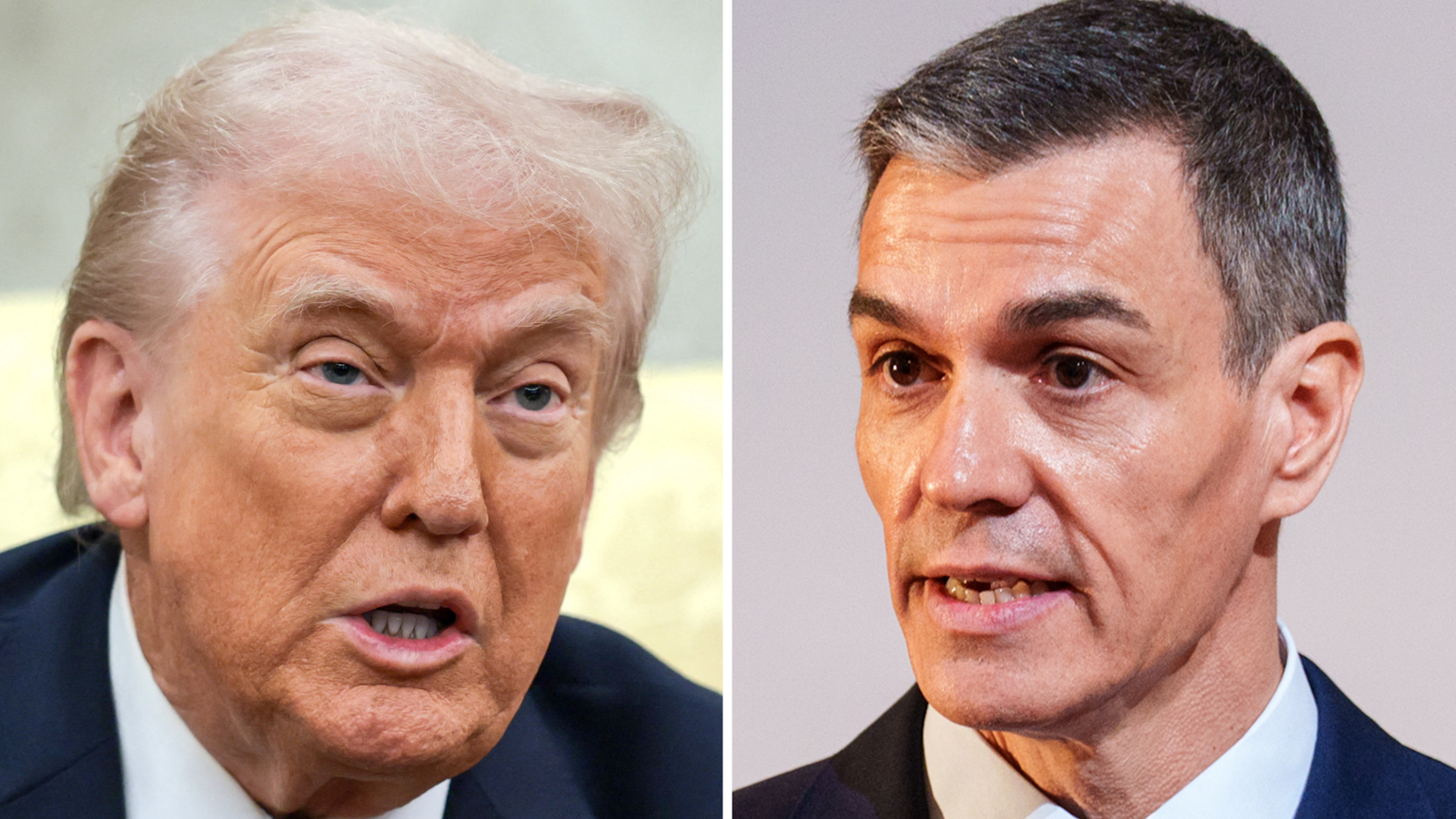
Spain’s Prime Minister, Pedro Sánchez, has drawn significant international attention following a tense diplomatic moment involving former United States President Donald Trump. The incident, which occurred during a high-level international gathering, has been widely interpreted by political observers as a symbolic reflection of Spain’s recent decision to decline a United States request to use Spanish military bases for potential air operations related to escalating tensions with Iran.
According to diplomatic sources and witnesses present at the event, the encounter unfolded when Sánchez stood up as Trump approached during a formal gathering of international leaders. Observers reported that the Spanish leader appeared prepared to greet the American figure, a gesture common in such high-level diplomatic settings. However, the moment quickly took an unexpected turn when Trump reportedly signaled for Sánchez to remain seated and return to his place instead of engaging in a handshake or conversation.
The brief but noticeable exchange immediately captured the attention of those present and later circulated widely across international media platforms and social networks. Many analysts believe the gesture carried deeper diplomatic undertones tied to Spain’s recent refusal to allow U.S. military forces to utilize its strategic bases for operations linked to possible airstrikes targeting Iran.
Spain hosts several military installations that have historically played a crucial role in NATO and United States military operations in Europe and the Mediterranean. Among the most prominent are the naval base in Rota and the air base in Morón, both of which have long served as logistical hubs for American forces operating in Europe, North Africa, and the Middle East.
In recent weeks, rising tensions between the United States and Iran have triggered discussions within NATO circles about potential military scenarios should the crisis escalate further. Washington reportedly explored the possibility of using allied bases across Europe to support operations ranging from reconnaissance to airstrikes. Spain’s installations were believed to be among the locations considered due to their strategic proximity to the Mediterranean and the Middle East.

However, the Spanish government ultimately declined the request, signaling a cautious approach to involvement in any potential military escalation involving Iran. Officials in Madrid emphasized the importance of diplomacy, dialogue, and de-escalation rather than direct participation in military operations that could further destabilize the region.
The decision reflects Spain’s broader foreign policy stance under Sánchez, which has consistently emphasized multilateral cooperation and conflict resolution through diplomatic channels. Spanish officials reportedly expressed concern that allowing the use of national bases for offensive operations could draw the country directly into a wider regional conflict.
DDM News gathered that the Spanish government’s position was also shaped by domestic political considerations. Spain’s political landscape includes strong public sentiment against military involvement in overseas conflicts, particularly in the Middle East. Historical experiences, including controversial participation in past international interventions, have made Spanish leaders cautious about engaging in actions that could trigger domestic backlash.
Political analysts note that Sánchez has sought to maintain a delicate balance between Spain’s commitments as a NATO member and his administration’s commitment to pursuing peaceful solutions to international disputes. By declining the request, Spain signaled that while it remains a cooperative partner within the Western alliance, it is not automatically aligned with every military initiative proposed by Washington.
The encounter between Sánchez and Trump therefore became more than just a fleeting moment of diplomatic awkwardness. For many observers, it symbolized the broader tension between national sovereignty and alliance expectations within international security partnerships.
Some experts believe the gesture directed at Sánchez may have been intended as a subtle message reflecting dissatisfaction with Spain’s decision. Others argue it may simply have been a moment of misunderstanding or protocol confusion during a crowded diplomatic event. Nevertheless, the timing of the interaction has fueled speculation about underlying political tensions.
DDM News understands that discussions between the United States and several European allies regarding potential contingency plans for Iran remain ongoing. While Washington continues to maintain strong defense relationships with many NATO partners, not all European governments share the same appetite for military escalation in the Middle East.
Spain’s stance highlights a broader divide that sometimes emerges within Western alliances when confronting complex geopolitical crises. Some governments prioritize deterrence and military preparedness, while others advocate for diplomatic engagement and conflict prevention.
For Sánchez, the decision to refuse the use of Spanish bases appears consistent with his administration’s emphasis on reducing tensions in global hotspots rather than contributing to military escalation. Spanish officials have repeatedly called for renewed international dialogue with Iran and have supported efforts aimed at restoring diplomatic frameworks that could ease regional hostilities.
Meanwhile, the moment involving Trump and Sánchez continues to circulate widely online, with political commentators interpreting the exchange in different ways. Some see it as a reflection of shifting power dynamics within transatlantic relations, while others view it simply as a small but symbolic episode in the complex theater of international diplomacy.
Regardless of interpretation, the incident underscores how even brief gestures between world leaders can carry significant political meaning in a highly interconnected global environment. As geopolitical tensions continue to shape relations between major powers, the actions and decisions of leaders like Pedro Sánchez remain closely watched by allies and rivals alike.
In the broader context of global security and diplomacy, Spain’s refusal to allow its territory to be used for potential strikes against Iran illustrates the challenges facing international alliances in navigating conflicts that have far-reaching implications. Whether the moment between Sánchez and Trump was intentional or coincidental, it has become emblematic of the delicate balance nations must maintain between cooperation with allies and the protection of their own strategic and political interests.