


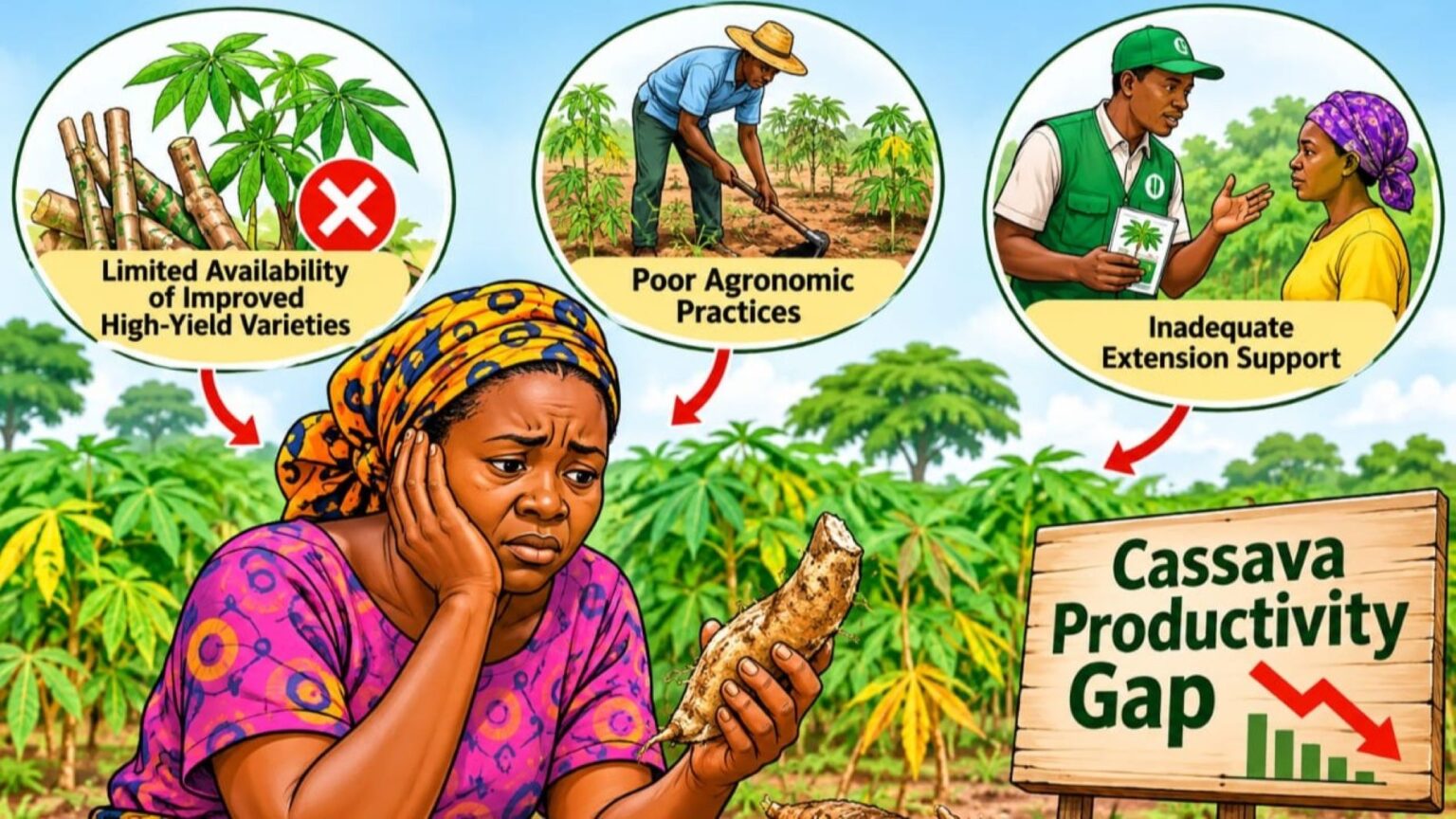
Stakeholders in Nigeria’s cassava industry have identified limited access to improved cassava varieties, poor farming practices and inadequate extension services as major barriers to higher productivity.
The concerns emerged at a roundtable organised by the Nigeria Cassava Investment Accelerator (NCIA). The meeting brought together processors, industrial buyers, regulators and other industry players to examine challenges affecting cassava production.
Limited access to improved varieties
Participants said research institutes had developed high-yield cassava varieties. However, farmers still struggle to access enough planting stems.

They explained that the country lacks the capacity to multiply and distribute improved stems on a large scale. This limits farmers’ ability to increase output.
The World Bank’s 2025 Nigeria Country Private Sector Diagnostic also identified low yields as a major constraint to industrial cassava investment.
It reported that Nigeria recorded an average yield of 8.2 tonnes per hectare in 2020. This compared with the global average of 12.8 tonnes and 24 tonnes in Southeast Asia.
Participants also stressed the need for better farming practices. These include proper crop spacing and stronger extension support to help farmers maximise yields.
Harvesting and transportation challenges
Beyond farm productivity, stakeholders raised concerns about harvesting costs, poor transportation and weak supply networks.
They noted that some farmers leave mature cassava roots unharvested because of high labour costs. One participant estimated that as much as 60 per cent of planted cassava could remain unharvested in some production areas.
Poor roads and weak aggregation systems also make it difficult to move fresh roots to processing factories.
Since cassava deteriorates quickly after harvesting, processors need reliable deliveries within a short period. Delays can affect production schedules and increase operating costs.
Stakeholders also identified high processing and energy costs as barriers to the competitiveness of cassava products.
Industry players seek stronger market links
The roundtable highlighted opportunities in cassava-derived bioethanol, sweeteners, starch and cassava-wheat composite flour.
However, participants said processors must meet buyers’ quality and technical requirements to compete with alternative industrial inputs.
They also called for stronger collaboration between farmers, processors, researchers and regulators. Better testing and certification systems could improve confidence in locally produced cassava derivatives.
The NCIA said its work would focus on improving farm productivity, strengthening market connections, supporting processors and developing products that meet industrial demand.
Stakeholders maintained that higher production alone would not solve the industry’s challenges. Nigeria must also improve harvesting, transportation and processing to build a reliable cassava supply chain.




