



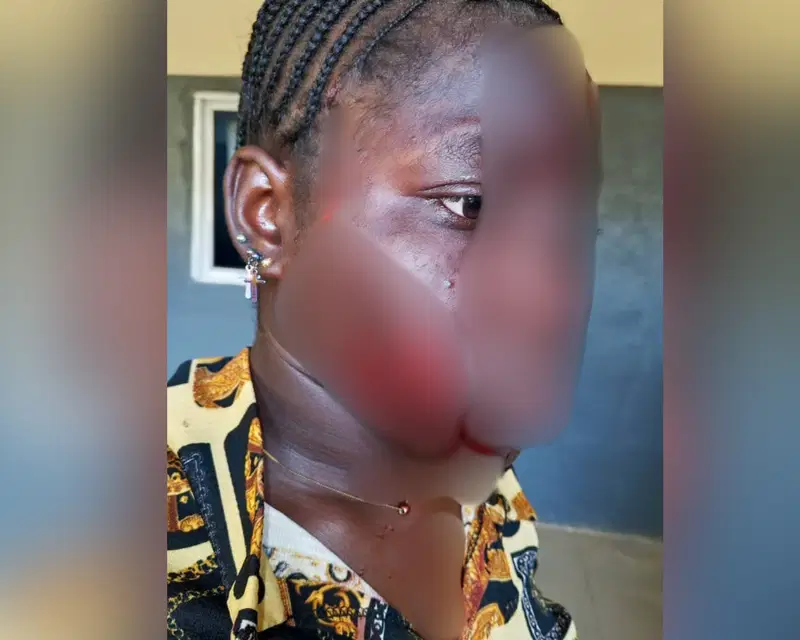
Widespread outrage and deep concern have swept across Taraba State following a disturbing incident in which a teenage girl was allegedly attacked and permanently disfigured by an adult woman driven by suspicion and jealousy. The incident, which occurred in Donga town, headquarters of Donga Local Government Area, has ignited a broader conversation about gender-based violence, child protection, and the growing need for swift justice in cases involving minors.
According to information gathered by DDM NEWS, the suspect, identified as Ramatu Abbas, is accused of using a razor blade to mutilate the face of 17-year-old Iwasen Terhemba. The attack has been linked to Ramatu’s suspicion that her husband had developed an inappropriate interest in the teenager, an allegation that has further complicated public reaction to the case.
Community sources told DDM NEWS that Iwasen Terhemba, who resides with her guardian, Jemila Wanga, had repeatedly rejected alleged advances from the suspect’s husband. Those close to the teenager insist that she consistently made it clear she was not interested and had no intention of engaging in any relationship with a married man. Despite these rejections, suspicion reportedly festered in the mind of the wife, culminating in the violent act that has now left the community in shock.
Residents allege that the incident took place when the teenager’s guardian was not at home. In what witnesses described as a calculated and deliberate act, the suspect allegedly stormed the residence and attacked the young girl, leaving her with serious facial injuries. The brutality of the act, particularly against a minor, has drawn condemnation from across Donga and beyond, with many residents describing it as both inhumane and unjustifiable.

“This is beyond jealousy; this is cruelty,” a resident of Donga told DDM NEWS. “Even if there was suspicion, how do you take it out on a child who did nothing wrong? The anger in this community is real, and people want to see justice done.”

Since news of the incident broke, civil society groups, women’s advocates, and concerned citizens have taken to social media and community forums to express their outrage. Many have pointed out that the victim was not only a minor but also doubly vulnerable, living under guardianship and allegedly targeted in her own home. Calls have intensified for authorities to treat the matter with urgency and transparency to prevent any attempt at compromise or quiet settlement.
Confirming the development, the spokesperson for the Taraba State Police Command, Superintendent Victor Mshelizah, told journalists that the police had taken decisive action. “The issue is being taken care of already,” he said. “The suspect is in custody while the victim is recovering. The case will soon be charged to court.”
The police confirmation has provided some reassurance to residents, but many insist that arrest alone is not enough. According to DDM NEWS investigations, community leaders and youth groups in Donga are demanding that the prosecution be thorough and that the full weight of the law be applied. They argue that cases involving violence against minors often suffer delays or are quietly resolved, leaving victims without justice and perpetrators emboldened.
Beyond the immediate legal process, the incident has sparked a wider debate in Taraba State about domestic tensions, misplaced blame, and the societal tendency to punish young girls for the actions or intentions of adult men. Several women’s rights advocates who spoke to DDM NEWS stressed that the root of the problem lies in patriarchal attitudes that excuse male misconduct while redirecting anger toward females, particularly younger and less powerful ones.
“This case exposes a dangerous pattern,” said a gender rights activist in Jalingo. “If the allegations are true, the teenager rejected advances. Instead of addressing the husband’s behaviour, the anger was turned on a child. That mindset must be challenged.”
The condition of the victim has also become a major concern. While police say she is recovering, sources close to the family told DDM NEWS that the psychological impact of the attack may be long-lasting. There are growing calls for the state government and relevant social welfare agencies to provide medical, psychological, and legal support to the teenager to aid her recovery and reintegration.
Traditional leaders in the area have reportedly held emergency meetings to address the tension generated by the incident. Some have urged calm, while also supporting demands for justice. Religious leaders have similarly condemned the act, describing it as morally reprehensible and contrary to cultural and religious values that emphasize protection of children and peaceful resolution of disputes.
For many residents, the case has become a symbol of a deeper societal failure. Questions are being asked about how domestic suspicions escalate into violence, the lack of early intervention mechanisms, and the limited protection available to young girls in vulnerable living situations. As one resident put it, “If this can happen in broad daylight in someone’s home, then no child is truly safe.”
As the case moves toward the courts, DDM NEWS will continue to follow developments closely. Observers say the outcome will send a strong message either way: that violence against minors will be punished decisively, or that justice remains uncertain for the most vulnerable.
For now, the people of Taraba State wait, watching closely as the legal process unfolds, hoping that accountability, not silence or compromise, will define the resolution of a case that has shaken the conscience of an entire community.

