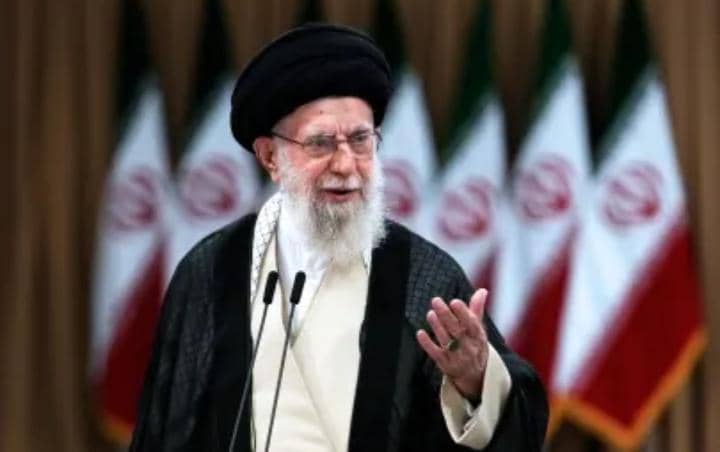
Iran’s Supreme Leader, Ayatollah Ali Khamenei, has died at the age of 86 following a large-scale military operation carried out jointly by the United States and Israel, Iranian state media confirmed early Sunday, March 1, 2026.
His death marks a historic turning point for the Islamic Republic, which he led for more than three decades as its most powerful political and religious authority.
Khamenei, who served as Iran’s supreme leader from 1989 until his death, shaped the country’s domestic and foreign policies through an uncompromising vision of Islamic governance.
Throughout his rule, he maintained firm control over state institutions while steering Iran into repeated confrontations with Western powers and Israel.
From Religious Student to Revolutionary Figure
Born in July 1939 in the northeastern city of Mashhad, Khamenei grew up in a deeply religious family belonging to Iran’s Azeri minority.

He pursued advanced Islamic studies in the holy city of Qom, where he became a devoted student of Ayatollah Ruhollah Khomeini, the cleric who would later lead Iran’s 1979 Islamic Revolution.
Inspired by Khomeini’s teachings, Khamenei joined opposition movements against Shah Mohammad Reza Pahlavi’s monarchy.
His political activism led to multiple arrests before the revolution ultimately overthrew the shah and established the Islamic Republic.
Following the revolution, Khamenei quickly rose within the new political order. He was appointed to key religious and security positions and became a prominent figure within Iran’s revolutionary leadership.
Political Rise and Controversial Leadership
In 1981, Khamenei survived an assassination attempt when a bomb exploded during a speech in a Tehran mosque, leaving his right arm permanently disabled. Later that year, he was elected president of Iran at age 41 and served two terms during the Iran-Iraq war.
After Khomeini’s death in 1989, Iran’s Assembly of Experts selected Khamenei as supreme leader in a controversial succession process. Though not considered among the highest-ranking clerics at the time, constitutional changes strengthened the authority of the position, enabling him to consolidate power.
As supreme leader, Khamenei became commander-in-chief of the armed forces and held ultimate authority over Iran’s judiciary, security institutions, and electoral system. Over time, he centralized decision-making and reinforced the doctrine of velayat-e faqih, or rule by Islamic jurists, cementing clerical dominance over the state.
Domestic Unrest and Crackdowns
Khamenei’s tenure was repeatedly challenged by waves of domestic protests. Demonstrations erupted in 1999, during the disputed 2009 presidential election, and again amid economic crises in 2017 and 2019.
One of the most significant challenges came in 2022 following the death of Mahsa Amini, a young woman detained by Iran’s morality police. Nationwide protests under the slogan “Woman, Life, Freedom” shook the regime, prompting a harsh crackdown by security forces that human rights groups said left hundreds dead.
Despite growing dissent, Khamenei maintained authority through close ties with Iran’s Revolutionary Guards and security apparatus.
Architect of Regional Strategy
On the international stage, Khamenei played a central role in shaping Iran’s nuclear policy and regional alliances. While Tehran denied seeking nuclear weapons, disputes over its nuclear programme led to sweeping sanctions that severely strained Iran’s economy.
He approved the landmark 2015 nuclear agreement between Iran and world powers, though tensions reignited after the United States withdrew from the deal in 2018 and reimposed sanctions.
Under Khamenei’s leadership, Iran expanded influence across the Middle East through allied groups in Lebanon, Iraq, Syria, and Yemen — a network often described as the “axis of resistance.” However, years of conflict gradually weakened these alliances following Israeli military operations against regional militant leaders.
Escalation and Final Conflict
Regional tensions intensified after renewed clashes between Israel and Iran escalated into direct confrontation. Israeli leaders openly stated that eliminating Khamenei could end hostilities, while U.S. President Donald Trump repeatedly warned Tehran over its nuclear ambitions.
On February 28, the United States and Israel launched what they described as preventive air strikes targeting Iranian military and strategic sites, including facilities in Tehran linked to the supreme leader.
Khamenei’s death during the operation brings uncertainty over Iran’s political future, succession leadership, and nuclear programme.
Analysts warn the development could reshape the balance of power across the Middle East while raising the risk of prolonged instability.
After decades at the helm of the Islamic Republic, Khamenei leaves behind a nation deeply divided at home and increasingly isolated abroad facing an uncertain path in the aftermath of its longest-serving leader’s rule.