


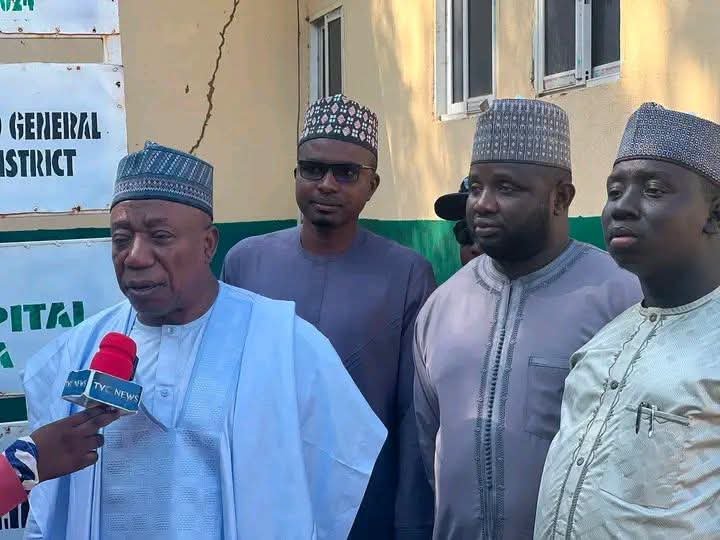
The senator representing Kebbi Central, Adamu Aliero, on Tuesday raised concerns over what he described as the “astronomical” rise in Nigeria’s debt under President Bola Tinubu’s administration, saying the growing borrowing profile has become a source of anxiety for many Nigerians.
Mr Aliero spoke during an interactive session between the Senate and officials of the Ministry of Finance in Abuja, where he questioned the government’s increasing reliance on borrowing despite improved revenue generation.
“We have seen an astronomical rise in borrowing, and this borrowing is of serious concern to Nigerians. What I’m saying is in the public domain; it is not anything hidden,” the senator said.
According to him, the Tinubu administration inherited a debt stock of over N75 trillion but has since added between N75 trillion and N80 trillion.

“When this government came in, it inherited, I think, over N75 trillion, and now it has added almost N75 trillion to N80 trillion in borrowing.
“And despite this, budget implementation is nowhere close to where we want it to be. We have not even started implementing the 2026 budget,” Aliero said.
Responding, Chairman of the Presidential Fiscal Policy and Tax Reforms Committee, Taiwo Oyedele, rejected the claim that the Tinubu administration had borrowed as much as N80 trillion, insisting that the figures circulating in the public space were misleading.
Mr Oyedele explained that approvals granted by the National Assembly for borrowing should not be mistaken for actual loans already obtained.
“For external loans, we always require the approval of the National Assembly. What usually happens is that once the National Assembly approves a borrowing plan, many people interpret that as money already borrowed.
“We have not even taken half of what the National Assembly approved,” he said.
He further clarified that a significant portion of the increase in Nigeria’s debt stock was due to accounting adjustments rather than fresh borrowing.
According to him, more than N40 trillion of the increase resulted from the revaluation of existing foreign debt following the depreciation of the naira after the foreign exchange reforms.
He added that another N33 trillion came from the securitisation of Ways and Means advances inherited from the previous administration, rather than new loans contracted by President Tinubu’s government.
“The actual amount this administration has borrowed is nowhere near what many people believe,” Oyedele said.
He also noted that much of the government’s domestic borrowing was for refinancing maturing obligations rather than taking on new debt.
“Even for domestic borrowing, much of it is refinancing. Debt that was borrowed previously matures, and the government raises new debt to refinance it. That is not new borrowing,” he explained.
Addressing concerns over why improved revenue generation had not significantly reduced borrowing, Mr Oyedele said government expenditure continued to outpace earnings due to rising statutory obligations.
“If our expenditure requirement is N10 and our projected revenue is N6, we borrow N4. If revenue later increases to N7, we still need to borrow N3 because expenditure remains N10,” he said.




