


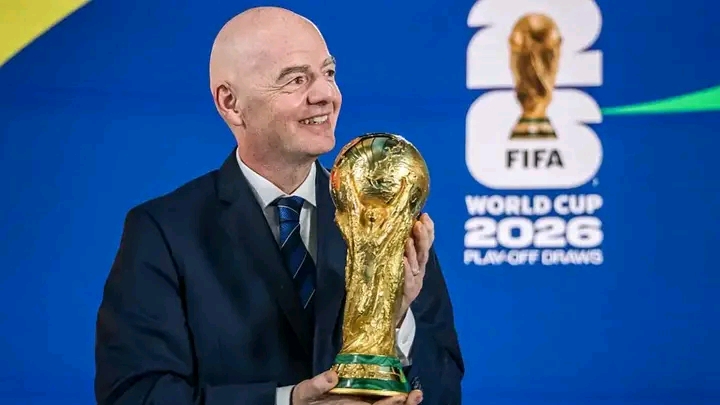
Pressure is mounting on FIFA President Gianni Infantino after three of the world football body’s major confederations openly criticised his leadership and accused FIFA of breaking the trust of its stakeholders.
UEFA, the Asian Football Confederation and Concacaf issued a joint open letter to the global football community, expressing serious concerns about the way FIFA handled a controversial proposal involving the commercial rights of its major competitions.
The development marks one of the strongest challenges yet to Infantino’s leadership and has opened a fresh debate about transparency, accountability and the future direction of world football.

The dispute centres on FIFA Forward Enterprise, a proposed commercial structure that would involve outside investment in FIFA’s competitions. FIFA had explored the possibility of raising billions of dollars through private investment, with reports indicating that the plan could involve selling interests connected to the commercial rights of FIFA tournaments, including the World Cup.
The proposal immediately attracted opposition from several major football stakeholders who said they had not been adequately consulted before details emerged publicly.
UEFA, AFC and Concacaf have now taken their criticism considerably further, arguing that the issue is not simply a disagreement over money or the expansion of FIFA competitions. Instead, they say the central concern is the way decisions were allegedly made and communicated.
In their joint letter, the confederations argued that football does not belong to one person or institution and stressed that its development has historically been achieved through cooperation between FIFA, continental confederations, national associations, clubs, players and supporters.
They also rejected suggestions that their opposition was driven by financial interests.
The confederations said the disagreement was fundamentally about the integrity of football and the responsibilities of those elected to lead the sport.
Their criticism is particularly significant because UEFA, AFC and Concacaf represent some of the most influential football regions in the world. Their combined influence gives the dispute the potential to become a major governance crisis for FIFA if the disagreement continues to escalate.
UEFA had already expressed strong opposition to the proposed plan, saying it had concerns about the lack of consultation and governance surrounding the project. Concacaf also said it was only made aware of the proposal through media reports and a subsequent FIFA announcement.
The controversy became more intense after FIFA acknowledged concerns surrounding the proposal and apologised for what it described as problems with the consultation and communication process.
FIFA has maintained that the organisation remains committed to consultation and democratic decision making. The world governing body has also defended Infantino and rejected what it considers attempts to destabilise his presidency.
Despite that position, the latest joint statement has raised the stakes considerably.
The three confederations are now demanding that Infantino step aside from seeking another term as FIFA president. The next FIFA presidential election is scheduled for March 2027, meaning the dispute could have significant implications for the organisation’s leadership in the months ahead.
There are also concerns that the disagreement could affect FIFA competitions themselves.
Reports indicate that discussions have begun about possible alternative competitions involving the three confederations, while the possibility of boycotting some FIFA events has also been raised.
Such a development would represent an extraordinary escalation in the relationship between FIFA and its continental partners.
For years, the six continental confederations have operated within FIFA’s global football structure, with major decisions involving tournaments, development programmes and competition formats requiring cooperation across the football family.
The current dispute therefore goes beyond Infantino personally. It has raised broader questions about how much power should be concentrated within FIFA’s leadership and how major commercial and sporting decisions should be approved.
The controversy is also significant because FIFA has undergone considerable expansion under Infantino. The organisation has increased the size of major competitions and overseen the expansion of the men’s World Cup to 48 teams.
FIFA has also increased financial distributions to national associations through its development programmes, while the organisation’s commercial revenues have continued to grow.
Supporters of Infantino point to these developments as evidence of progress during his presidency. Critics, however, argue that financial growth must be accompanied by stronger governance and consultation.
The latest dispute has therefore created a clear divide between FIFA’s leadership and some of the continental bodies responsible for running football across major regions.
Africa’s position is also worth watching closely. The Confederation of African Football has not joined UEFA, AFC and Concacaf in their latest criticism of Infantino. CAF has maintained a more supportive relationship with FIFA’s leadership, meaning the current confrontation has not yet become a united challenge from all six confederations.
That distinction could become important as the situation develops.
For now, Infantino remains FIFA president and FIFA has indicated that it continues to support his leadership. However, the coordinated criticism from UEFA, AFC and Concacaf represents a serious political challenge ahead of the next presidential election.
The dispute also comes at a sensitive time for global football, with the sport generating unprecedented commercial revenues and attracting increasing interest from investors.
The question now is whether FIFA can rebuild trust with the confederations and national associations that have expressed concerns or whether the disagreement will develop into a deeper split within world football.
Whatever happens next, the message from UEFA, AFC and Concacaf is clear. They want greater transparency, proper consultation and a governance structure in which major decisions affecting the future of football are not made without the involvement of the wider football family.
For Infantino, the controversy presents one of the biggest tests of his leadership since becoming FIFA president.
The coming months could determine whether the current disagreement is resolved through dialogue or becomes a defining political battle ahead of the 2027 FIFA presidential election




