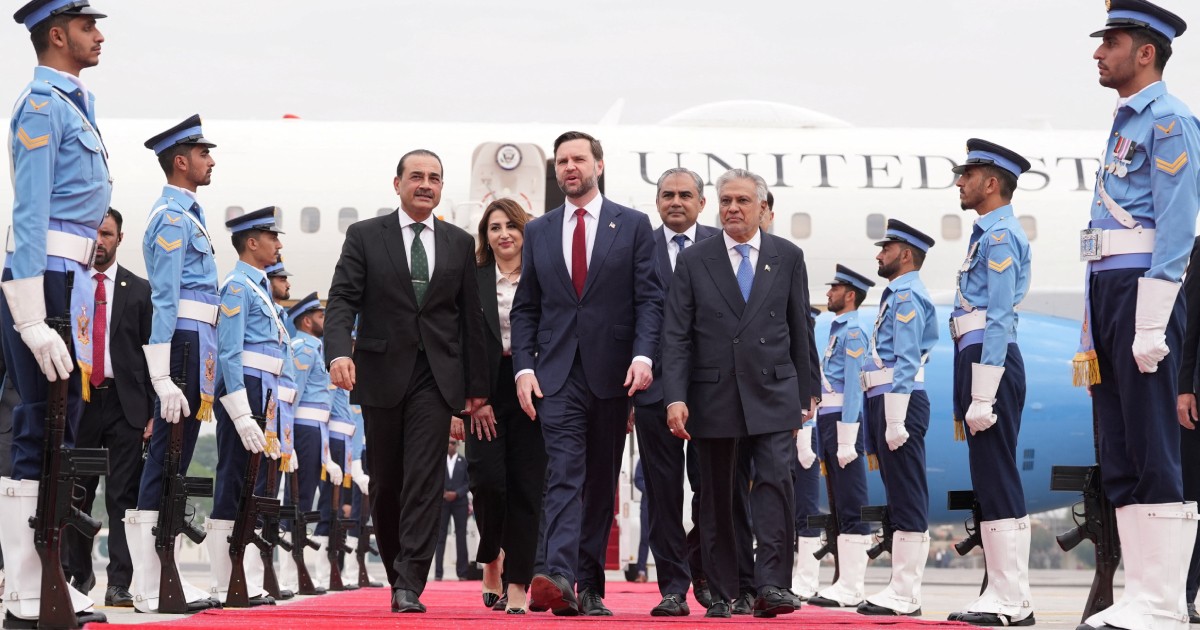
Senior United States and Iranian officials have begun direct talks in Islamabad in a renewed effort to end the six-week conflict between both countries, marking their highest-level engagement in decades.
The meeting brought together top figures from both sides, including U.S. Vice President JD Vance and Iranian Foreign Minister Abbas Araqchi.
The discussions reportedly lasted about two hours before both delegations took a break, according to sources familiar with the talks. Pakistan’s leadership played a mediating role in bringing both sides to the table.
Despite the breakthrough in diplomacy, uncertainty continues to cloud the negotiations. Conflicting accounts have already emerged over developments on the ground.

U.S. President Donald Trump said American forces had begun clearing the Strait of Hormuz and claimed Iranian naval assets involved in laying mines had been destroyed.
Iranian officials, however, disputed aspects of that claim, underscoring the deep mistrust between both sides.
Iran has entered the talks with a list of firm demands. These include the unfreezing of its overseas assets, compensation for war-related damages, and broader guarantees such as a ceasefire in Lebanon, where fighting involving Iran-backed Hezbollah has continued.
Tehran is also seeking recognition of its authority over the Strait of Hormuz, a vital global oil route through which a significant portion of the world’s energy supply passes.
Washington has pushed back on some of these claims, particularly reports suggesting it had already agreed to release frozen Iranian funds. A U.S. official dismissed the report, insisting that no such agreement had been reached and that discussions were still in their early stages.
While the talks signal a possible path toward de-escalation, fighting has not fully subsided across the region.
Reports from Lebanon indicate that air activity and exchanges of fire persisted, highlighting the complexity of a conflict that extends beyond just the U.S. and Iran.
The stakes remain high. Disruptions around the Strait of Hormuz have already affected global energy markets, with ripple effects on fuel prices and economic stability worldwide. Analysts say even if progress is made in Islamabad, reaching a comprehensive agreement will be difficult given the range of issues involved and the lack of trust between both parties.
For now, the talks continue under tight security in Islamabad, with both sides cautiously exploring whether a lasting ceasefire can be achieved.