
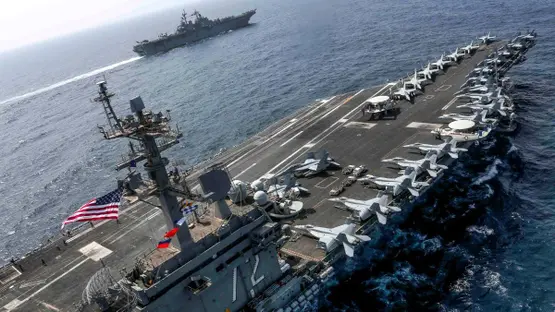
Fresh tensions flared in the already volatile Middle East on Tuesday after the United States military confirmed it had shot down an Iranian unmanned aerial vehicle that flew toward a U.S. aircraft carrier operating in the Arabian Sea. The incident, which American officials described as a threatening and aggressive maneuver, has heightened geopolitical anxieties at a time when Washington and Tehran are tentatively exploring the possibility of reviving stalled nuclear negotiations.
DDM NEWS gathered that the drone, identified by the U.S. military as an Iranian Shahed-139, approached the USS Abraham Lincoln aircraft carrier under circumstances that U.S. officials said left little room for error. According to the U.S. Navy, the drone’s intent was unclear, but its flight path and proximity to the carrier were deemed hostile enough to warrant immediate defensive action.
A U.S. Navy F-35C fighter jet launched from the USS Abraham Lincoln intercepted and shot down the drone before it could pose a direct threat to the carrier or its crew. The action, according to U.S. Central Command, was taken strictly in self-defense and in line with established rules of engagement designed to protect American forces operating in international waters.
Navy Captain Tim Hawkins, spokesperson for U.S. Central Command, told Reuters that the drone had been behaving “aggressively” as it closed in on the carrier strike group. He stressed that no U.S. service members were injured during the encounter and that no American military assets were damaged. “An F-35C fighter jet from Abraham Lincoln shot down the Iranian drone in self-defense and to protect the aircraft carrier and personnel on board,” Hawkins said.

The shootdown immediately sent ripples through global markets. DDM NEWS notes that oil futures rose by more than one dollar per barrel shortly after reports of the incident emerged, reflecting investor concerns over maritime security and the potential for wider conflict in a region critical to global energy supplies. The Arabian Sea and surrounding waterways serve as key corridors for oil shipments, and any disruption there is closely watched by energy traders worldwide.
Iran’s response to the incident was measured but opaque. Iran’s mission to the United Nations declined to issue an official comment when contacted by international media. However, Iran’s semi-official Tasnim news agency reported that contact had been lost with one of its drones operating in international waters. The agency did not specify whether the loss was linked to U.S. military action, stating only that the cause of the incident was not immediately clear.
The drone shootdown comes at a particularly sensitive moment in U.S.-Iran relations. DDM NEWS understands that diplomatic channels have been quietly active in recent weeks, with both sides signaling cautious interest in reviving nuclear talks that have been stalled for years. Despite this, rhetoric from Washington has remained sharp. U.S. President Donald Trump recently warned that failure to reach a nuclear agreement could result in severe consequences for Tehran.
With U.S. naval assets moving closer to Iran’s coastline, President Trump said last week that “bad things” would probably happen if negotiations collapsed. While he stopped short of outlining specific military actions, the message was widely interpreted as a warning that the United States was prepared to escalate pressure if diplomacy failed.
The USS Abraham Lincoln carrier strike group has become the most visible symbol of a broader U.S. military buildup in the Middle East. DDM NEWS reports that the deployment follows weeks of political unrest in Iran, where security forces carried out a violent crackdown on anti-government protests. Observers described the unrest as the deadliest episode of domestic turmoil in the country since the 1979 Islamic Revolution, with significant loss of life and widespread arrests.
Although the Trump administration ultimately refrained from direct military intervention during the crackdown, Washington has since intensified both diplomatic and military pressure on Tehran. Additional naval forces have been ordered into the region, and U.S. officials have repeatedly demanded far-reaching concessions from Iran regarding its nuclear programme.
Despite the rising tensions, there have been mixed signals suggesting possible diplomatic movement. President Trump said recently that Iran was “seriously talking,” a statement echoed by Iran’s top security official, Ali Larijani, who confirmed that arrangements for negotiations were underway. DDM NEWS notes that these parallel tracks of diplomacy and military posturing have created a fragile and unpredictable environment, where miscalculations could quickly spiral into broader confrontation.
Adding to the sense of unease was a separate incident later on Tuesday in the Strait of Hormuz, one of the world’s most strategically vital oil shipping lanes. The U.S. Central Command reported that Iranian forces harassed a U.S.-flagged, U.S.-crewed commercial vessel just hours after the drone shootdown.
According to Captain Hawkins, two boats belonging to Iran’s Islamic Revolutionary Guard Corps (IRGC), along with an Iranian Mohajer drone, approached the commercial tanker M/V Stena Imperative at high speed. The Iranian units allegedly threatened to board and seize the vessel, raising alarm over the safety of commercial shipping in the narrow waterway through which a significant portion of the world’s oil supply passes.
DDM NEWS understands that while no shots were fired during the Strait of Hormuz incident, the encounter further underscored the heightened risk of confrontation in the region. U.S. officials described the actions as harassment and warned that such behavior could lead to serious consequences if it continued.
Analysts say the twin incidents — the drone shootdown near the USS Abraham Lincoln and the harassment of a commercial tanker — illustrate how quickly tensions between the United States and Iran can flare, even as diplomatic efforts continue behind the scenes. The presence of heavily armed forces operating in close proximity increases the risk of misinterpretation and rapid escalation.
For now, U.S. officials insist their actions are defensive and aimed at ensuring the safety of American personnel and maintaining freedom of navigation in international waters. Iran, on its part, has often accused the United States of provocation and militarizing the region, framing its own actions as defensive responses to foreign pressure.
As DDM NEWS observes, the coming weeks will be critical in determining whether diplomacy can gain traction or whether the region edges closer to open confrontation. With oil markets on edge, military assets on high alert, and political rhetoric intensifying, the shootdown of a single drone has once again highlighted how fragile stability remains in the Arabian Sea and the wider Middle East.