By Akin Samuel KAYODE
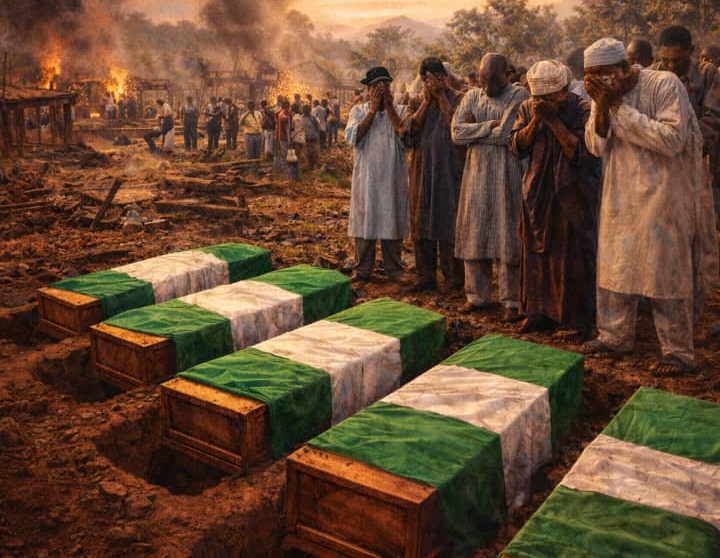
Nigeria has been plunged once again into mourning following the gruesome killing of over one hundred and seventy five innocent citizens in Kwara State. This tragedy is not merely a local calamity, it is a national wound that exposes the fragility of human life under a failing security environment. These were ordinary people whose only crime was to live, work, and hope within the borders of their own country. Their lives were violently taken, and with them, the sense of safety that binds any society together.
Behind the numbers are shattered homes and irreparable loss. Children will grow up without parents, parents will grow old without the comfort of their children, and communities will carry scars that time alone cannot heal. Farms, villages, and neighbourhoods that once echoed with daily life are now marked by silence, grief, and fear. No responsible nation can look upon such devastation without profound sorrow and righteous concern.
As a patriot and a committed citizen, silence in moments like this would amount to complicity. The first and most sacred responsibility of any government is the protection of lives and property. When over one hundred and seventy five people are murdered within their communities, it is no longer acceptable to speak in abstractions. This scale of loss is not an unfortunate accident, it is a glaring failure of governance and security.
This condemnation is not rooted in political antagonism but in moral obligation. The government exists to serve, protect, and preserve life. When it falls short, it must be told plainly, firmly, and respectfully. Expressions of sympathy, while humane, cannot replace decisive action, institutional reform, and accountability. Nigerians are exhausted by condolences that are not followed by consequences.

The tragedy in Kwara State reflects a deeper and more troubling pattern. Across the country, insecurity has become recurrent, predictable, and increasingly deadly. Communities raise alarms, yet protection arrives late or not at all. Criminal elements operate with alarming confidence, suggesting not only operational gaps but a dangerous erosion of deterrence. A state that cannot anticipate, prevent, or respond swiftly to threats is one that has lost its strategic grip.
It is painful to acknowledge that many of these deaths were preventable. Intelligence failures, inadequate surveillance, overstretched security personnel, and poor coordination continue to cost innocent lives. These are not mysteries beyond human solution, they are problems that persist due to neglect, inertia, and lack of political urgency. Each unaddressed weakness becomes an invitation to violence.
The people of Kwara State deserved better. They deserved visible security presence, early intervention, and a government that treats every warning sign as urgent. Instead, they were left exposed. The question that must be asked, soberly and honestly, is this, if the state cannot protect rural and semi urban communities, what protection truly exists for the average citizen.
This moment demands leadership that is courageous enough to accept responsibility. Defensive rhetoric and institutional finger pointing only deepen public anger and grief. True leadership acknowledges failure, corrects course, and reassures citizens through action rather than promises. The credibility of the state depends not on perfection, but on responsiveness and accountability.
Beyond the immediate security lapse lies a broader governance crisis. Persistent poverty, unemployment, weak justice systems, and social dislocation create fertile ground for violence. Security cannot be sustained by force alone. It requires social investment, community trust, effective policing, and a justice system that punishes crime decisively and fairly. Where justice is absent, violence thrives.
The families of the deceased deserve more than sympathy. They deserve truth, justice, and lasting support. Investigations into this massacre must be transparent and thorough. Perpetrators must be identified, prosecuted, and punished without delay or political interference. Justice delayed in moments like this becomes justice denied, and denial compounds grief.
Communities affected by this atrocity must not be abandoned once the news cycle moves on. Rehabilitation, psychological support, reconstruction, and renewed security presence are essential. Healing is not spontaneous, it must be nurtured by deliberate state action and sustained engagement. A nation proves its humanity by how it treats its wounded communities.
To the people of Kwara State, the nation owes solidarity that goes beyond words. Your pain is national pain. Your loss diminishes us all. Nigeria cannot claim unity while allowing any part of the country to bleed unnoticed or unsupported. Every Nigerian life carries equal worth, regardless of geography or status.
Citizens, too, must resist resignation. Patriotism is not passive acceptance of failure, it is the insistence that the country can and must do better. Speaking out against injustice and incompetence is an act of national loyalty, not rebellion. Silence emboldens failure, while principled voices strengthen democracy.
The government must understand that public trust is fragile and easily broken. Each massacre that goes unanswered erodes confidence further. Restoring that trust requires urgency, transparency, and measurable change. Nigerians are not asking for miracles, they are asking for commitment, competence, and protection.
At the heart of this tragedy are human beings whose dreams were cut short. Their laughter, labour, and love mattered. Their absence leaves a void that statistics cannot capture. We must refuse to reduce them to numbers or footnotes in national discourse. Memory itself is a form of justice.
We pray for the souls of the departed, that God grants them eternal rest. We pray for their families, that strength, comfort, and healing will surround them in this dark hour. We pray for the communities affected, that peace will return and fear will not define their future.
Finally, we pray for Nigeria’s leadership, that this tragedy will awaken a renewed sense of responsibility. A nation that fails to protect its people must summon the courage to reform itself. May this moment mark a turning point where life is valued, failure is confronted, and governance rises to meet its most basic duty.
Akin Samuel KAYODE.
Assistant Secretary, Monitoring and Feedback Committee, The Narrative Force.