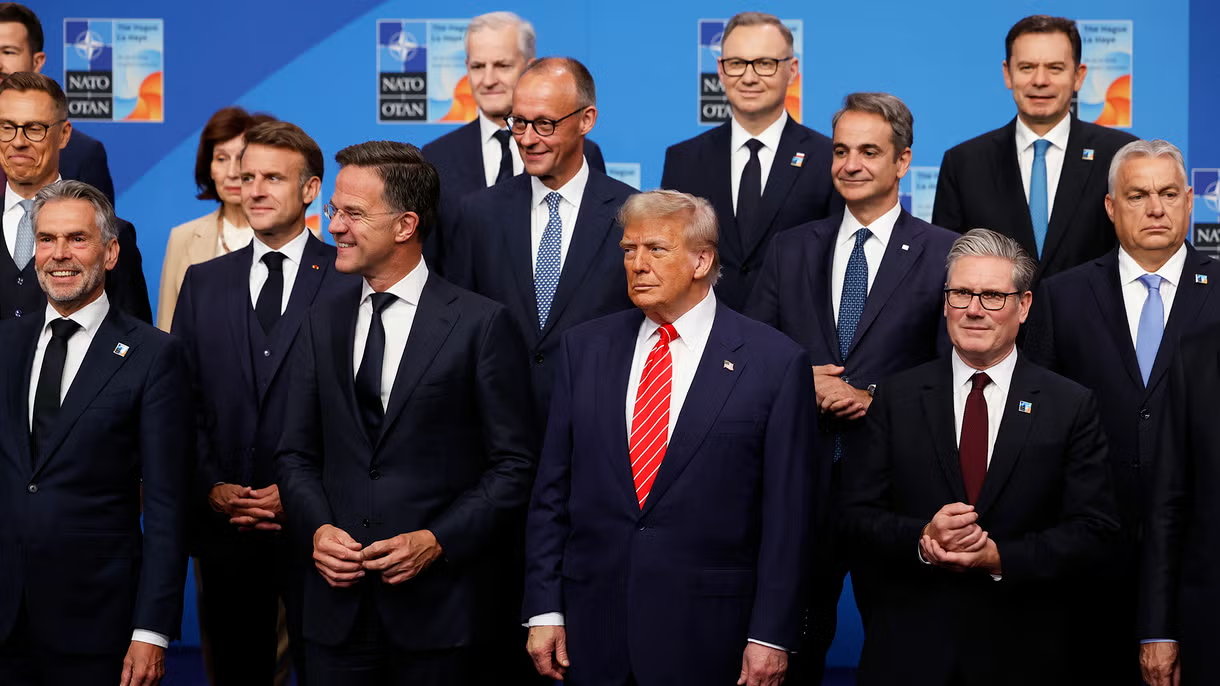
There was a time when a call from Washington carried weight that few dared to question. Allies listened, aligned, and often followed. That rhythm is now changing and nowhere is it more evident than in Europe’s response to Donald Trump and his push for support in the escalating conflict with Iran.
This time, Europe is not rushing in.
Trump’s approach is familiar. He frames the moment as one of obligation: the United States has long provided security guarantees, and now allies should step forward in return.
But alliances are not debts to be collected. They are built on trust, consultation, and shared purpose. In this case, many European leaders feel those elements are missing.

The war itself has already exposed its risks. What began as a show of force has quickly become a costly and uncertain confrontation.
Iran’s response has been swift, targeting U.S. interests and tightening pressure on the Strait of Hormuz, a critical route for global energy supplies.
The disruption has pushed oil prices higher and unsettled markets, with ripple effects far beyond the region.
Against this backdrop, Washington is urging Europe to step in particularly to help secure shipping routes. But across the continent, the reaction has been cautious, even resistant.
Germany has taken a firm stance. Boris Pistorius has made it clear that this is not Europe’s war. The United Kingdom has also drawn a line.
Keir Starmer insists that any military involvement must be backed by international law and a clear, credible plan conditions many believe have not been met.
France, under Emmanuel Macron, has adopted a more measured position.
Paris has not ruled out a role in ensuring stability in the region, but only after tensions ease. For now, it is keeping its distance from active combat operations.
At the European Union level, the message is even more direct.
Kaja Kallas has pointed out that Europe was neither consulted nor involved in initiating the conflict. That fact alone has shaped much of the bloc’s response.
Taken together, these positions reflect more than disagreement over a single war.
They point to a broader shift in how Europe views its relationship with Washington.
Over the past year, tensions have grown. Disputes over trade, security commitments, and foreign policy decisions have strained trust.
Some European leaders feel they have been pressured rather than consulted, expected to follow rather than participate. Now, faced with the prospect of entering a volatile conflict, they are pushing back.
There are also practical concerns. Deploying naval forces to the Strait of Hormuz during an active conflict carries real risks.
Military experts warn that such a move could expose European forces to direct attacks, potentially widening the war.
What is being presented as a stabilizing effort could easily become an escalation.
Europe’s caution is also shaped by its own security priorities. While the Middle East crisis demands attention, Russia remains the more immediate concern for many European governments.
The war in Ukraine, along with ongoing cyber threats and political interference, continues to dominate strategic thinking.
In that context, committing resources to another conflict especially one seen as avoidable raises difficult questions.
Domestic politics further complicate the picture.
Across Europe, governments are already under pressure from rising living costs and economic uncertainty.
Calls for increased defence spending have been met with skepticism in some quarters. Entering a controversial war could erode public support even further.
Public opinion reflects this unease. In several European countries, a majority of citizens oppose involvement in the conflict.
There is a sense of fatigue an unwillingness to repeat past interventions that delivered mixed results at high cost.
Even within security circles, there is recognition that the situation is changing.
Some analysts argue that allies are beginning to reassess their relationship with the United States, weighing the benefits of cooperation against the risks of being drawn into decisions they did not shape.
None of this suggests a breakdown of alliances.
Europe still relies on U.S. support in key areas, including intelligence, military coordination, and the ongoing effort to counter Russia. But the dynamic is evolving.
What is emerging is a more cautious, more independent approach.
European governments are no longer responding automatically to pressure.
Instead, they are making calculated decisions based on their own interests and constraints.
That shift is significant.
Trump’s strategy relies heavily on leverage political, economic, and military.
And while that leverage remains considerable, its effectiveness appears to be diminishing.
Allies are no longer as willing to accept pressure without question.
For Europe, the current stance is not about defiance for its own sake. It is about avoiding a conflict that carries uncertain outcomes and significant risks.
It is also about maintaining focus on priorities closer to home.
As the situation unfolds, the gap between Washington’s expectations and Europe’s response is likely to remain.
The United States may continue to press for support, but European leaders appear determined to proceed with caution.
In the end, this moment may be remembered less for the conflict itself and more for what it revealed about the state of global alliances.
The era of automatic alignment is fading. In its place, a more measured, more selective partnership is taking shape one where saying “no” is no longer unthinkable.
And for now, that is exactly what Europe is doing.