


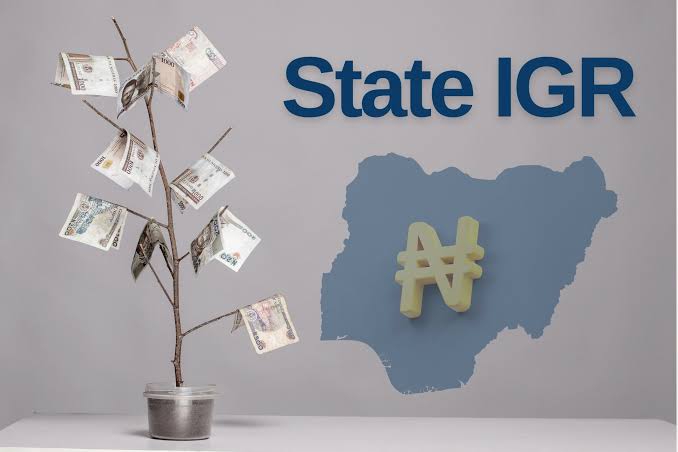
For years, Internally Generated Revenue, commonly known as IGR, has become one of the figures frequently used in Nigeria’s public conversation about which states are performing economically. Whenever a state announces that it has increased its IGR from one level to another, the figure is often presented as evidence that the state’s economy is growing, businesses are thriving and government administration has become more effective.
But there is an important distinction that is often lost in these discussions: IGR measures a government’s ability to generate revenue internally; it does not measure the size or overall strength of the economy producing that revenue.
This distinction matters when comparing states such as Ogun, Enugu, Delta and others. A state can record strong IGR without having the largest economy, while another state can have substantial economic activity but comparatively weak internally generated revenue because a large portion of its economic activity remains informal, tax collection is inefficient or government deliberately maintains lower tax rates.
Therefore, using IGR as a direct ranking of economic performance can produce a very different picture from what is actually happening on the ground.

What IGR Actually Measures
Internally Generated Revenue refers broadly to revenue collected by a state government from sources within the state. These sources can include Pay-As-You-Earn taxes, direct assessment, road taxes, revenue generated by ministries, departments and agencies, fines, levies, rents and other internally collected government revenues.
In Nigeria, IGR figures reported through official statistical processes depend significantly on information provided by state revenue authorities and subsequently collated by the National Bureau of Statistics.
That means IGR is fundamentally a fiscal indicator.
It tells us something about the government’s revenue-generating capacity.
It does not tell us the total amount of economic activity taking place within the state.
This is a critical distinction.
Imagine two states. State A has millions of workers and businesses but a large informal economy, weak tax registration and inefficient collection systems. State B has a smaller economy but has highly effective digital tax collection, stronger compliance and a broader tax base.
State B could potentially report higher IGR even though State A has greater overall economic activity.
That does not mean State B necessarily has a larger economy.
It means State B may simply be better at converting economic activity into government revenue.
The Problem With Turning IGR Into a Political Scorecard
The confusion becomes particularly significant when politicians use IGR increases as evidence of economic transformation.
A governor may announce that a state’s IGR increased from ₦30 billion to ₦51 billion and present the increase as proof that the state’s economy has expanded dramatically.
But an increase in IGR does not automatically mean the underlying economy grew by the same proportion.
Government may have introduced new taxes, improved collection, digitized payment systems, closed loopholes, increased enforcement or changed how certain revenues are recorded.
All of these can increase IGR without necessarily representing equivalent growth in production, household income or business activity.
There have also been instances where political claims about historical IGR figures have been challenged or disputed, demonstrating why headline revenue figures should be examined carefully rather than accepted as unquestionable evidence of economic success.
IGR Can Increase Without Economic Growth
This is perhaps the most important point.
Suppose a state previously collected ₦100 billion in IGR and subsequently begins collecting ₦150 billion.
That is a 50 percent increase in government-generated revenue.
But what caused the increase?
Did factories produce 50 percent more goods?
Did businesses generate 50 percent more revenue?
Did workers’ incomes increase by 50 percent?
Did household consumption rise?
Did productivity improve?
Did investment increase?
Not necessarily.
The government could have improved collection efficiency or introduced additional taxes.
It could also have increased compliance among businesses that were already operating.
Therefore, IGR growth should be interpreted as evidence of changing fiscal performance, not automatically as evidence of equivalent economic growth.
DDM News notes that this distinction is particularly important in Nigeria, where states have dramatically different economic structures, population sizes, levels of formalization and tax administration systems.
The Informal Economy Makes Comparisons Even More Complicated
Nigeria has a large informal economy.
Many businesses operate outside conventional corporate structures. Traders, artisans, small-scale manufacturers, transport operators and numerous service providers may conduct substantial economic activity without appearing fully in formal tax records.
This creates an important measurement challenge.
A state with a large informal economy may produce considerable goods and services while collecting relatively little IGR from those activities.
Meanwhile, a state with a more formalized economy may capture a larger proportion of economic activity through PAYE, company-related taxes and other revenue channels.
Therefore, comparing the two states solely on IGR can be misleading.
The lower IGR state is not necessarily economically weaker.
It may simply have a different economic structure and a different level of tax capture.
Tax Policy Also Matters
Government policy can influence IGR independently of economic size.
A state government that deliberately keeps certain taxes relatively low may collect less revenue while still maintaining an attractive environment for businesses.
Another state may pursue aggressive revenue mobilization and collect more from businesses and residents.
If we judge both states solely by IGR, we could incorrectly conclude that the state collecting more revenue has the stronger economy.
But the economic consequences of taxation need to be considered.
High revenue collection does not automatically mean businesses are thriving. Similarly, lower revenue collection does not automatically mean an economy is weak.
The question is how taxation interacts with investment, employment, productivity and household welfare.
Why States May Have Incentives to Emphasize IGR
There are also practical reasons why IGR attracts political attention.
A strong IGR figure can enhance the image of a state government.
It can be used to demonstrate administrative performance, suggest improved fiscal discipline and support arguments about financial independence.
IGR can also matter when governments seek financing because lenders generally want to understand a government’s ability to generate revenue and service obligations.
This makes IGR a very important number for fiscal analysis.
But its importance to government finance should not be confused with its ability to measure the size of the economy.
A state’s borrowing capacity and its economic output are related but distinct concepts.
Rankings Can Create Another Layer of Confusion
State rankings based on IGR can also generate controversy.
Rankings are attractive because they simplify complicated information into a league table. Citizens can quickly see which states appear to be collecting more revenue and which appear to be collecting less.
However, such rankings need context.
States have different populations, industrial structures, levels of urbanization, natural-resource endowments, business concentrations and tax systems.
Even states with similar populations can have completely different economic profiles.
Ogun, for example, has a strong industrial and manufacturing presence and is closely connected to the Lagos economic corridor. Enugu has a different economic structure, while Delta’s economy has historically been strongly influenced by oil and related activities.
Comparing their IGR figures without considering these structural differences can oversimplify the economic reality.
So What Should Be Used to Measure an Economy?
If the question is “How large is this state’s economy?”, the more appropriate starting point is Gross Domestic Product, or state-level GDP.
GDP measures the value of goods and services produced within an economy during a specified period.
It provides a much broader picture than government revenue because it captures economic production rather than only the amount collected by government.
Gross Value Added is also useful because it helps explain where economic output comes from.
It can show the contribution of sectors such as agriculture, manufacturing, construction, trade and services.
That makes it possible to understand not just how large an economy is, but what is driving it.
Employment and Income Matter Too
Economic strength is not only about how much an economy produces.
It is also about whether people are benefiting from that economic activity.
Employment, unemployment, underemployment, household income and income per capita can provide additional information about the condition of an economy.
A state may have substantial economic output but still face significant unemployment or low household incomes.
That is why GDP should also not be treated as the only measure of economic wellbeing.
Investment and Business Activity Tell Another Story
Investment indicators can provide another dimension.
Business formation, capital investment, industrial production and capital importation can help reveal whether companies are expanding and whether investors consider the state attractive.
The number and quality of new businesses can also tell us something about entrepreneurial activity.
These indicators can be particularly valuable when assessing whether economic growth is sustainable.
Poverty and Human Development Should Not Be Ignored
Ultimately, an economy exists to improve people’s lives.
Poverty levels, access to education, healthcare, housing and other human-development indicators therefore matter.
A state cannot simply be declared economically successful because its government collects more taxes.
If revenue rises while poverty remains widespread, employment opportunities are limited and living standards deteriorate, the IGR figure alone cannot tell the full story.
DDM News argues that Nigerians should therefore become more careful about how economic statistics are presented and interpreted. IGR is important, but it answers a specific question: how much revenue is government generating internally?
It does not answer every economic question.
The Better Way to Compare Nigerian States
Rather than asking which state has the highest IGR and immediately declaring it the strongest economy, analysts should examine several indicators together.
State GDP can provide information about economic size.
GVA can explain sectoral contributions.
Employment and income statistics can reveal labour-market conditions.
Investment and business data can indicate economic dynamism.
Poverty and human-development indicators can provide insight into whether economic activity is translating into improved living standards.
IGR can then be added as an important measure of fiscal capacity and government revenue performance.
That creates a much more balanced picture.
The mistake is not in measuring IGR. The mistake is in asking IGR to answer a question it was never designed to answer.
A state government that significantly improves its internally generated revenue deserves recognition for strengthening its fiscal capacity. But that achievement should not automatically be presented as proof that the state’s entire economy has grown by the same magnitude.
IGR tells us about the government’s revenue engine. GDP tells us more about the economy itself.
Understanding that difference is essential for anyone trying to make meaningful comparisons between Nigerian states.




