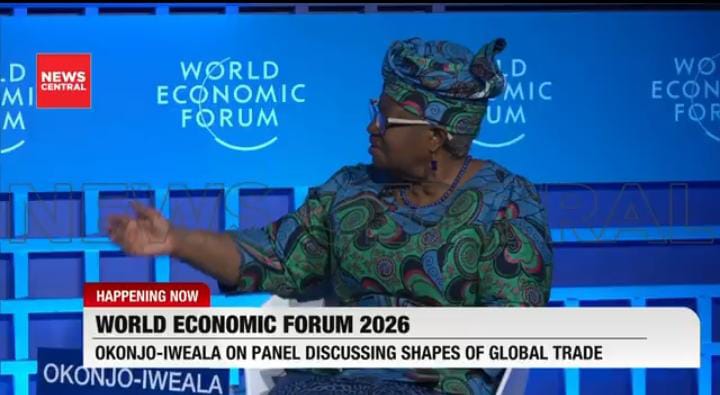
(DDM) – delivered a powerful and candid address at the World Economic Forum Annual Meeting in Davos, Switzerland, on January 22, 2026.
She participated prominently in the high-profile panel discussion titled “Many Shapes of Trade.
“This session brought together key global leaders to examine the evolving landscape of international commerce.
As Director-General of the World Trade Organization, Okonjo-Iweala spoke with authority and optimism.
She directly slammed the surging wave of protectionism gripping many economies worldwide.
The WTO chief described protectionism as a growing threat that undermines collective progress.
She pointed out that even among G20 nations, protectionist measures have become increasingly common.Okonjo-Iweala stressed that the multilateral rules-based trading system remains resilient and far from obsolete.
She firmly rejected claims that the WTO is “dead” or irrelevant in today’s multipolar world.
According to her, approximately 72 percent of global trade still operates under established WTO principles.
This includes core elements like most-favored-nation treatment and non-discrimination.
She acknowledged legitimate national security concerns driving some policy shifts.
However, she warned against excessive or unchecked measures that fragment the global economy.
Okonjo-Iweala called for honest, transparent conversations among nations on balancing security with openness.
She advocated introducing clear guardrails to prevent overreach in tariff policies and restrictions.
The panel highlighted the shift from pure free trade toward a more “managed” system.
This includes friend-shoring, strategic diversification, and regional alignments.
Okonjo-Iweala expressed strong support for supply chain diversification as a path to greater resilience.
She noted that such moves can spread job creation and economic opportunities more broadly.
Particularly, developing countries stand to benefit from investors seeking alternatives to concentrated dependencies.
She highlighted Africa’s potential to attract global capital amid these realignments.Okonjo-Iweala urged reforms to modernize the WTO for contemporary realities.
She pushed for “deep and thorough” changes ahead of the 14th Ministerial Conference in March 2026.Key proposals include greater flexibility through variable geometry and plurilateral agreements.
This approach allows willing members to advance on specific issues without universal consensus.
She emphasized inclusivity, ensuring developing nations are not marginalized in the new paradigm.
Okonjo-Iweala passionately highlighted emerging opportunities that excite her about trade’s future.
Digital trade continues to expand rapidly, driven by e-commerce and fintech innovations.
Services trade grows steadily at around 4.4 percent annually.
Green trade has reached a staggering value of $2 trillion and holds immense promise.
She dreamed aloud about these dynamic sectors transforming economies worldwide.
The WTO leader advised global leaders to remain calm amid uncertainties and policy turbulence.
She encouraged them to “just chill” and “take a deep breath” before reacting hastily.
Okonjo-Iweala reminded the audience of trade’s historic achievements.
The system has lifted over 1.5 billion people out of poverty and created countless jobs.
Yet she candidly admitted globalization’s flaws, including leaving behind vulnerable communities.
Poor people in rich countries and marginalized developing nations felt excluded.
She insisted the evolving trade framework must avoid repeating those mistakes.
In her view, inclusive participation defines true multilateralism in a multipolar era.
Nations do not need full agreement on everything to collaborate effectively.
Okonjo-Iweala also participated in other Davos events, including discussions at Nigeria House.
There, she advised Nigeria’s government to target global investors aggressively.
This strategy could reduce import dependence and generate domestic employment.She praised efforts to convert national scale into bankable infrastructure projects.
At the TIME100 Davos Dinner, she spoke about hope amid turbulence.She described the current disruptions as the greatest in 80 years.
Despite challenges, she reaffirmed faith in the system’s adaptability.Okonjo-Iweala’s message blended realism with bold vision.
She positioned the WTO as essential for navigating AI-driven changes and energy transitions.
Technology and sustainability offer bright spots amid headwinds.Her remarks resonated strongly with calls for reformed, agile multilateralism.
For Nigeria and Africa, her words signal strategic opportunities in diversification.Investors fleeing high-cost or geopolitically risky environments may turn southward.
This could accelerate job creation, digital inclusion, and green growth.Overall, Okonjo-Iweala projected unwavering optimism.She sees immense potential in world trade when guided by inclusive, reformed rules.
Her Davos performance reinforced her stature as a leading voice for balanced globalization.