


By Chris Agbedo
There is something refreshing about a people willing to turn the accusatory finger inward. The video clip captioned “Yoruba Nation, Who Bewitched Us?” does precisely that. Rather than locating every contemporary failure in Abuja, colonialism, northern domination, electoral manipulation or some conveniently assembled external conspiracy, it asks a more uncomfortable question: what happened to a people, whose historical record once projected intellectual confidence, institutional imagination, educational ambition and political sophistication?
It is a question worth engaging. Not because every claim in the video should be accepted uncritically, but because societies incapable of interrogating themselves eventually lose the capacity for renewal. My response, however, comes from a different vantage point. I am not writing as a Yoruba defending the Yoruba, nor as an adversary searching for ammunition against them. I write as a Nigerian, who believes that every serious ethnic self-interrogation should be welcomed, but also subjected to the same intellectual discipline demanded of the Nigerian state itself. And from that standpoint, the video presents both a valuable diagnosis and a conceptual problem.
Who bewitched the Yoruba. Perhaps nobody. That may be the most uncomfortable answer. “Bewitchment” is an alluring metaphor because it relocates agency. If somebody bewitched a people, then the afflicted people become primarily victims of an external force. The diagnosis becomes easier; the cure becomes somebody else’s responsibility. But societies are not usually destroyed by witches. They are weakened by choices, incentives, institutions and habits repeated long enough to acquire the appearance of destiny.

The corrupt politician chooses corruption.
The sycophant chooses sycophancy.
The intellectual, who recognises wrongdoing but remains silent makes a choice.
The citizen, who sells electoral judgment for immediate gratification makes a choice.
The professional, who bends principle to secure access to power makes a choice.
The elite, who denounces a defective system in private while feeding it in public makes a choice.
After enough repetitions, individual choices become institutional habits; institutional habits become political culture; political culture begins to masquerade as fate.
Perhaps, therefore, the more useful question is not “Who bewitched us?”
It is: “What have we repeatedly chosen to become?”
That question has no ethnic escape route.
The Yoruba historical record deserves neither worship nor dismissal.
The historical accomplishments of the old Western Region are real.
Its investment in education, broadcasting, regional development and institutional experimentation belongs legitimately to Nigeria’s political history. The generation associated with that era demonstrated that subnational governance could be ambitious, developmental and socially transformative.
But history becomes dangerous when converted into hereditary entitlement.
The achievements of an earlier generation cannot function indefinitely as a certificate of contemporary excellence. One cannot invoke Awolowo forever without asking what the present generation has built.
One cannot repeatedly celebrate the educational revolution of the old Western Region without asking why contemporary educational outcomes remain so uneven.
One cannot parade the institutional imagination of the past while tolerating the personality-driven politics of the present.
One cannot keep pointing backwards and call it development. A civilisation is not what its ancestors achieved. It is what its descendants succeed in renewing. That is where the Yoruba self-critique becomes useful to the entire Nigerian federation.
Every Nigerian ethnic group has a similar inventory of ancestral achievements.
The Igbo can narrate the commercial ingenuity of their forebears.
The Hausa-Fulani can invoke the intellectual and political heritage of the Sokoto Caliphate.
The Kanuri can point to the antiquity and institutional sophistication of Kanem-Bornu.
The Edo can invoke Benin’s artistic, political and technological achievements.
Others possess their own reservoirs of civilisational memory. But ancestral glory becomes an intellectual liability when it substitutes for contemporary performance.
Nigeria has too many descendants living on the reputational credit of their ancestors.
Where the Yoruba self-indictment becomes especially compelling.
The video’s references to sycophancy, political opportunism, inflated egos, institutional decay and the erosion of civic values deserve serious reflection.
Not because these conditions are uniquely Yoruba. They are not.
They are Nigerian problems, although every society expresses national pathology through its own cultural and political structures. The Nigerian political class has perfected a peculiar talent for condemning in others what it normalises among its own.
We condemn corruption when the beneficiary belongs to another ethnic group. We denounce nepotism when practised by another administration and call it “strategic inclusion” when our own people benefit. We demand electoral integrity until manipulation produces the result we desire.
We condemn political godfatherism while defending the godfather who speaks our language.
We invoke merit until merit threatens our preferred candidate.
This is why ethnic self-examination should not end at the border of ethnicity.
If the Yoruba are asking themselves difficult questions, other Nigerians should not laugh from the gallery. They should take out their own mirrors.
The Obasanjo question requires intellectual honesty.
The video’s treatment of former President Olusegun Obasanjo illustrates another danger in ethnic self-assessment: the temptation to convert political figures into ethnic property.
Obasanjo was Yoruba.
But his presidency belonged to Nigeria. His successes and failures therefore belong to the Nigerian historical record, not to a Yoruba family album. His administration’s handling of judicial corruption, including action following the Eso panel’s investigation, forms part of that complicated record. So do the serious criticisms surrounding his exercise of presidential power and the controversies that accompanied his political career.
The intellectually responsible position is neither canonisation nor demonisation.
A national figure must be judged by national consequences.
The same standard should apply to every Nigerian, irrespective of language, ancestry or political affiliation.
If an Igbo president succeeds, Nigeria succeeds.
If a Yoruba president fails, Nigeria suffers.
If a Hausa-Fulani administrator builds an excellent institution, the institution belongs to Nigeria.
If a politician from any ethnic group loots the treasury, the theft is not culturally sanctified by his ancestry.
Citizenship must eventually become larger than genealogy.
The Jonathan paradox.
The reference to Goodluck Jonathan introduces another useful complication.
Whatever one’s assessment of his administration, his acceptance of electoral defeat in 2015 remains an important episode in Nigeria’s democratic history.
Jonathan was not Yoruba.
Nonetheless, his political conduct can become part of a Yoruba conversation about leadership.
This is precisely how a mature national conversation should work.
Virtue has no ethnic passport.
Neither does failure.
Nigeria’s problem becomes almost insoluble when every community develops its own moral accounting system, one for its heroes and another for everybody else’s.
The real test of patriotism is not whether we can defend our own when they are wrong.
It is whether we can recognise right when it comes from outside our own camp and condemn wrongdoing when it comes from within it.
The seduction of the golden age.
There is another issue that deserves scrutiny.
The video occasionally appears to construct a neat historical contrast: a glorious Yoruba past confronting a diminished Yoruba present.
History is rarely so obedient.
The old Western Region had achievements, but it also had political rivalries, class interests, ethnic tensions, institutional weaknesses and the imperfections characteristic of every human political project.
The contemporary Yoruba world has failures, but it also contains scholars, entrepreneurs, professionals, innovators, public servants, artists, reformers and young Nigerians doing extraordinary things under difficult circumstances.
The past was not Eden.
The present is not wasteland.
Between both lies the unfinished business of civilisation.
Nostalgia can become a subtle form of intellectual laziness because it permits a generation to admire what it did not build.
The harder question is not:
“Why are we no longer like our fathers?”
It is: “What have we done with what our fathers handed us?”
From Yoruba introspection to Nigerian introspection.
This is where the video can become much larger than its title. If the Yoruba ask, Who bewitched us?, Nigeria should ask the same question of itself.
Who weakened our schools?
Who made public office attractive primarily as an avenue for accumulation?
Who rewarded mediocrity?
Who converted political parties into personal franchises?
Who taught young Nigerians that proximity to power is more valuable than competence?
Who reduced intellectual independence to partisan loyalty?
Who made ethnic solidarity a shield against accountability?
Who turned public criticism into betrayal?
Who taught citizens to celebrate the ethnic identity of an office-holder before examining the consequences of his decisions?
The answer is not simply Yoruba.
It is not Igbo.
It is not Hausa-Fulani.
It is not North.
It is not South.
It is not Christianity.
It is not Islam.
The deeper culprit is a political culture that repeatedly rewards behaviour capable of reproducing national failure.
And that culture has beneficiaries in every part of Nigeria.
A Nigerian rejoinder.
For that reason, the Yoruba self-critique should neither be mocked nor romanticised.
It should be extended.
Let the Yoruba examine themselves.
Let the Igbo examine themselves.
Let the Hausa-Fulani examine themselves.
Let every Nigerian community interrogate the distance between the values it celebrates and the behaviours it rewards.
But let the final destination be Nigeria.
Otherwise, self-introspection can become another form of ethnic exceptionalism: we once were great, therefore somebody must have ruined us.
No.
Perhaps, the harder truth is that greatness, like failure, requires continuous production.
Institutions decay when citizens stop defending them.
Standards collapse when professionals stop enforcing them.
Democracy weakens when voters exchange judgment for patronage.
Intellectual life withers when scholars become courtiers.
And societies decline when memory becomes more important than responsibility.
The Yoruba do not need to abandon their history.
They need to stop using history as evidence that their future is guaranteed.
The rest of Nigeria should do the same.
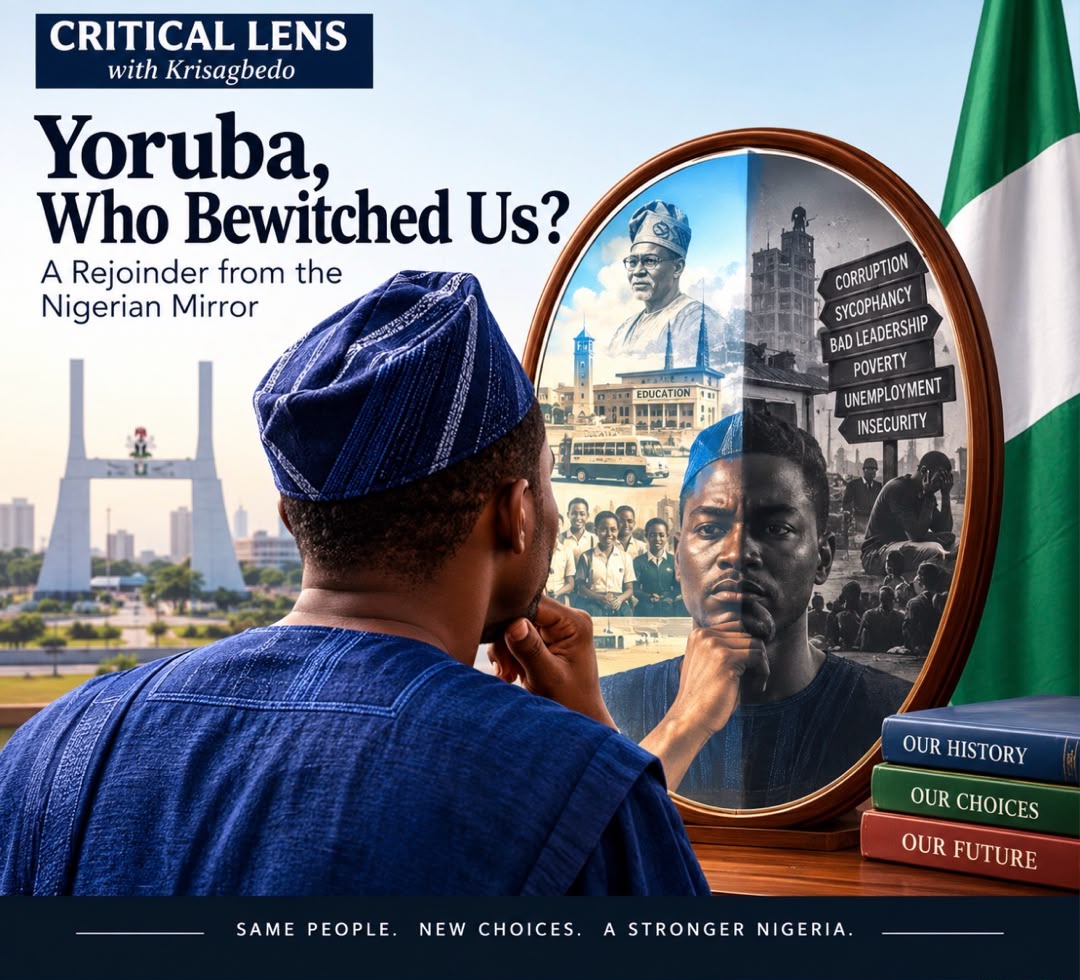
The mirror and the nation
So, Yoruba, who bewitched us?
Perhaps, the question itself needs exorcising.
There may be no witch to hunt.
There may be no ethnic enemy capable of explaining everything.
There may be no external conspiracy sufficiently powerful to absolve a people of every internal failure.
There are only choices, consequences and the institutional habits produced by both.
That is a harder diagnosis because it removes the comfort of victimhood.
It also contains the possibility of recovery.
A people who can accuse themselves honestly have already taken the first step towards reform.
But self-criticism must not terminate in lamentation.
It must produce standards.
It must produce institutions.
It must produce accountability.
It must produce a new generation capable of converting inherited memory into contemporary achievement.
And Nigeria must learn the same lesson.
The real enemy is not the ethnic group next door.
The real enemy is the national habit of demanding accountability from others while negotiating exemptions for ourselves.
That is the Nigerian mirror.
And it reflects every face.
Perhaps, nobody bewitched us. Perhaps we simply became too comfortable admiring the greatness we inherited to notice the institutions we were allowing to decay. The task now is not to find the witch. It is to recover the will to rebuild.
My two kobo!




