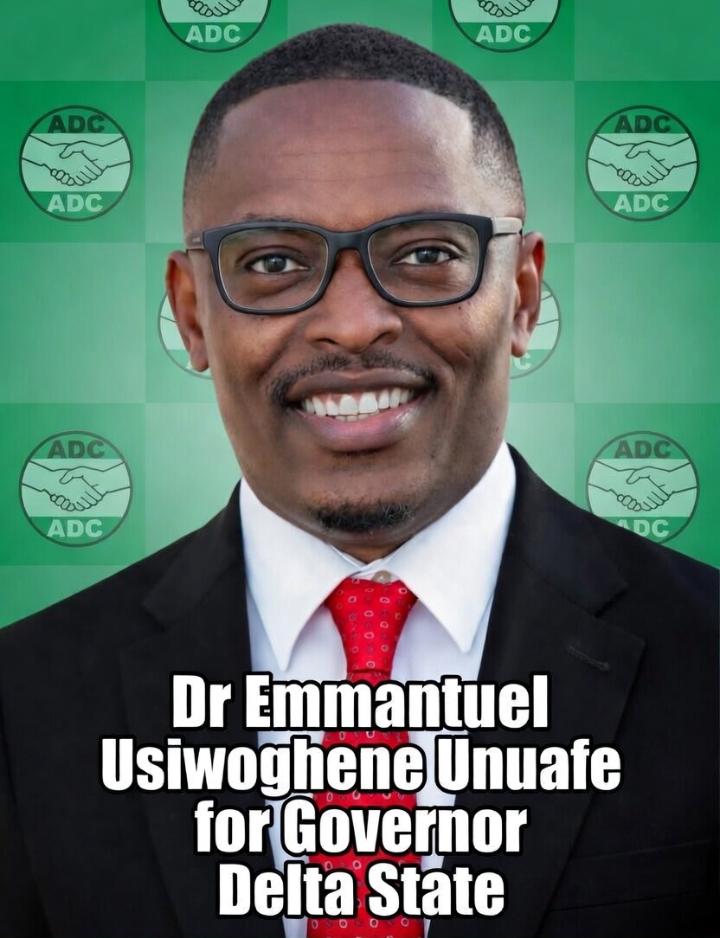
ASABA — A new wave of political debate has swept across Delta State following the formal declaration of Dr Emmanuel Usiwoghene Unuafe to contest the 2027 governorship election, a move that has intensified conversations around power rotation, governance direction, and emerging opposition dynamics in the oil-rich state.
The declaration, made public in Asaba on Monday, the capital of Delta State, has been accompanied by the unveiling of a detailed policy blueprint titled “A New Delta: United, Peaceful, Industrial, Healthy, and Globally Competitive,” which outlines an ambitious restructuring agenda for the state’s economic, social, and political future.
The entry of Dr Unuafe into the race under the platform of the African Democratic Congress (ADC) comes at a politically sensitive time in Nigeria, where states are already witnessing early alignments ahead of the 2027 general elections. Analysts say the declaration has introduced a new layer of competition into an already complex political environment shaped by zoning expectations and internal party calculations.
Dr Unuafe, an academic and PhD holder with a background in project management and public sector reform, positioned himself as a reform-driven candidate committed to transforming Delta State from a resource-dependent economy into a diversified industrial powerhouse. His manifesto, spanning twelve governance pillars, has been described by observers as one of the most detailed policy documents yet seen in the early phase of the 2027 race.

The announcement has triggered what political observers describe as “early tension” in Delta politics, as stakeholders begin to assess the implications of a candidate who combines academic credentials, international exposure, and a structured development blueprint. While it remains early in the electoral cycle, analysts say the document has already begun shaping political conversations across party lines.
At the heart of Unuafe’s vision is a call for economic diversification away from oil dependence. His proposed agenda includes industrial revival, agricultural transformation, maritime development, tourism expansion, and a renewed focus on manufacturing and innovation-driven growth. The blueprint also emphasises infrastructure development, digital economy expansion, and investment-friendly governance reforms.
In the manifesto, Dr Unuafe presents Delta State as a region with untapped potential that can be repositioned as a globally competitive economy if structural inefficiencies are addressed. He argues that decades of oil wealth have not translated into broad-based prosperity, citing unemployment, underdeveloped infrastructure, and persistent youth frustration as key challenges.
A significant portion of the document focuses on peacebuilding and ethnic unity, reflecting Delta’s diverse demographic composition, which includes major groups such as Urhobo, Itsekiri, Ijaw, Isoko, and Anioma communities. The candidate proposes structured dialogue mechanisms and inclusive governance frameworks aimed at reducing historical tensions and promoting equitable development.
Security reform is also a central pillar of his proposal. Dr Unuafe advocates for intelligence-led policing, community engagement, and youth empowerment strategies designed to reduce crime and improve stability. He argues that insecurity remains a major barrier to investment and development across several parts of the state.
Education and healthcare reforms are prominently featured in the blueprint. The proposal outlines plans to modernise schools, strengthen technical and vocational training, expand access to digital learning, and improve teacher welfare. In the health sector, he calls for upgraded hospitals, improved emergency response systems, expanded insurance coverage, and better medical infrastructure to address current gaps in service delivery.
Observers note that the depth of the manifesto sets Unuafe apart from typical early-stage political declarations, which often rely on broad promises rather than structured governance plans. His document reportedly includes measurable targets across multiple sectors, signalling an attempt to frame his campaign around policy credibility rather than political rhetoric alone.
The declaration has, however, also intensified discussions around the political balance of power in Delta State, where zoning arrangements between senatorial districts have historically influenced electoral outcomes. Some political actors view his emergence as a potential disruption to established political calculations, particularly within dominant party structures.
Within ruling and opposition circles, reactions have been mixed. Supporters describe his entry as a refreshing alternative that introduces intellectual depth into the race, while critics argue that early declarations in Nigeria’s political climate often face challenges related to political machinery, grassroots mobilisation, and party structure strength.
Political analysts say Delta State remains one of Nigeria’s most strategically important political environments due to its economic significance, ethnic diversity, and history of competitive elections. As such, any credible new entrant tends to reshape early political narratives, even before formal party primaries begin.
Dr Unuafe’s background also plays a key role in shaping perceptions of his candidacy. Having built an academic and professional career abroad before returning to Nigeria, he presents himself as a bridge between global best practices and local governance challenges. His supporters argue that this international exposure could help modernise governance systems in the state if translated into policy execution.
The candidate’s call for a “New Delta” has also begun circulating in political and social circles, particularly among youth groups and civil society actors who are increasingly vocal about governance reform and economic opportunity. His emphasis on industrialisation and job creation appears to resonate with younger demographics seeking alternatives to traditional political structures.
Despite the growing attention, analysts caution that the race remains in its early stages, with major party primaries and alliances yet to be formed. They note that while policy-driven campaigns can influence public discourse, electoral success in Nigeria often depends on grassroots networks, party structures, and political negotiations.
Nevertheless, the emergence of Dr Emmanuel Usiwoghene Unuafe has undeniably injected new energy into the 2027 Delta governorship conversation. His structured blueprint, reform-oriented messaging, and early mobilisation efforts are already reshaping expectations about what the upcoming political contest could look like.
As political alignments continue to evolve, observers say the coming months will determine whether his candidacy grows into a major statewide movement or remains a disruptive but influential early declaration in what is expected to be a highly competitive election cycle.