


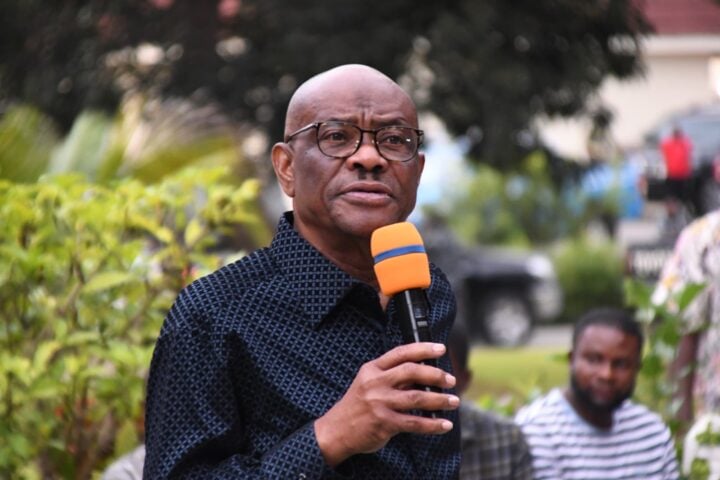
Nigeria’s media landscape has been thrust into a fresh wave of tension and debate following a strong reaction from the Independent Broadcast Association of Nigeria (IBAN), which has demanded a public apology from the Minister of the Federal Capital Territory, Nyesom Wike, over his controversial remark directed at television journalist Seun Okinbaloye. The development marks a significant escalation in the ongoing discourse surrounding press freedom, political accountability, and the tone of engagement between public officials and the media in Nigeria.
IBAN, the umbrella body representing independent broadcast stations across the country, issued a firm and unequivocal statement expressing deep concern over the minister’s comments, which were made during a routine media chat and subsequently broadcast widely. The remark, in which Wike suggested that he would have “shot” Okinbaloye while reacting to the journalist’s commentary on Nigeria’s democratic trajectory during a programme on Channels Television, has sparked widespread criticism from journalists, civil society actors, and members of the public.
Although Nyesom Wike quickly clarified that his statement was not meant to be taken literally, describing it as an expression of frustration rather than a genuine threat, the explanation has done little to quell the backlash. His aide, Lere Olayinka, later described the comment as “hyperbolic,” suggesting that it had been misinterpreted and amplified by critics. However, IBAN maintains that the issue goes beyond intent, emphasizing the potential impact of such language when used by individuals in positions of authority.
DDM News gathered that IBAN’s statement, signed by its chairman Ahmed Ramalan and acting general secretary Fidelis Duker, underscores the broader implications of the minister’s remark. The association argued that expressions suggesting violence, even when figurative, can be perceived as intimidation, particularly in a country where journalists already operate under challenging conditions. By invoking imagery associated with harm, the statement noted, public officials risk creating an environment in which media practitioners may feel unsafe or discouraged from performing their duties.

The association highlighted Nigeria’s current standing on global press freedom indices, where the country ranks relatively low, reflecting ongoing concerns about the safety and independence of journalists. According to IBAN, media professionals in Nigeria frequently contend with issues such as surveillance, harassment, physical attacks, and arbitrary arrests, especially during politically sensitive periods. In this context, the association argued, remarks like the one attributed to Wike can exacerbate existing tensions and contribute to a climate of fear.
DDM News understands that IBAN’s response is not limited to criticism but also includes a set of clear demands. The association has called on Nyesom Wike to formally retract his statement and issue a public apology not only to Seun Okinbaloye but also to the broader media community. Additionally, IBAN has urged the minister to reaffirm his commitment to press freedom, referencing Sections 22 and 39 of the 1999 Constitution of Nigeria, which guarantee the role of the media in holding government accountable and protect the right to freedom of expression.
Perhaps most significantly, the association has issued a warning that failure to meet these demands could result in a coordinated boycott by independent broadcast stations. Such a move would involve the suspension of coverage of all press briefings, media chats, and official engagements hosted by the FCT minister. IBAN described this potential action as a necessary step to protect journalists and to send a strong message against the use of rhetoric that could be construed as threatening or hostile.
The prospect of a media boycott has raised questions about the potential impact on public communication and governance. As a key figure in Nigeria’s political landscape, the activities and policies of the FCT minister are of considerable public interest. A reduction in media coverage could limit the flow of information to citizens, while also signaling a breakdown in the relationship between government officials and the press.
At the same time, the situation has reignited broader discussions about the responsibilities of public office holders in a الديمقراطية setting. Analysts note that while political leaders are entitled to express their views, they must do so in a manner that upholds the principles of respect, accountability, and constructive engagement. The use of language that can be interpreted as threatening, even in a figurative sense, is widely seen as incompatible with these principles.
For many observers, the incident serves as a reminder of the delicate balance that must be maintained between robust political discourse and the protection of fundamental freedoms. The media plays a critical role in this balance, acting as both a platform for public debate and a watchdog over those in power. Ensuring that journalists can operate without fear or intimidation is therefore essential to the health of Nigeria’s democracy.
As the situation continues to unfold, attention will be focused on how Nyesom Wike responds to IBAN’s demands. Whether he chooses to issue an apology or maintain his current position will likely influence the next phase of this controversy. In the meantime, IBAN has reiterated its willingness to engage constructively with public officials, expressing hope that the matter can be resolved in a way that reinforces mutual respect and preserves the integrity of Nigeria’s media environment.
Ultimately, the outcome of this episode will have implications not only for the individuals directly involved but also for the broader relationship between the government and the press. In a nation striving to strengthen its democratic institutions, the manner in which such disputes are handled will serve as a test of its commitment to the values of openness, accountability, and freedom of expression.




