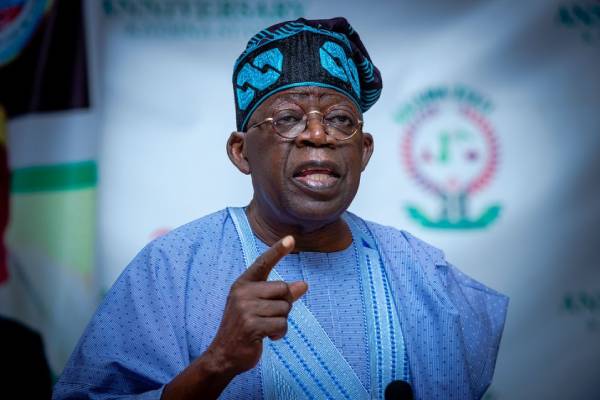
In a time when democracy continues to be celebrated globally as the most viable system of governance, its practical application—particularly across parts of Africa—raises increasingly troubling questions. While democracy, in principle, remains the best framework for ensuring representation and accountability, the reality is that political actors have steadily mastered the art of bending its rules to serve their interests. What is unfolding ahead of Nigeria’s 2027 presidential election appears to be a striking example of this manipulation, one that suggests a scenario where incumbent President Bola Ahmed Tinubu could, in effect, find himself contesting against no real opposition—almost as though he were running against himself.
This notion, though seemingly absurd at first glance, begins to take shape when examined against the backdrop of Nigeria’s political structure. On paper, the country operates a multi-party democracy, boasting over a dozen registered political parties. In reality, however, the political space is dominated by two major forces: the All Progressives Congress (APC) and the People’s Democratic Party (PDP). The rest, often numbering up to 18 or more, exist largely as symbolic entities—political placeholders with little to no real capacity to challenge for power. These smaller parties frequently function as extensions or fallback platforms for disgruntled members of the dominant parties, rather than as genuine alternatives driven by ideology or policy.
DDM News has consistently observed that what Nigerians often interpret as opposition politics is, in many cases, merely an extension of internal power struggles within the same political elite. When factions within the ruling class feel sidelined or deprived of their share of influence, they break away temporarily, adopting the label of “opposition.” Yet, beneath the surface, they remain connected by shared interests, alliances, and ambitions. This dynamic creates a political environment where competition is less about ideology and more about access to power and resources.
President Tinubu, a seasoned political strategist, appears to fully understand the fragility and fluidity of this system. Rather than confronting opposition forces head-on, there are growing indications that his approach is far more calculated—quiet, systematic, and designed to weaken potential challengers before they can even gain momentum. Observers have drawn parallels between this method and tactics employed by several long-serving global leaders, including Paul Kagame, Abdel Fattah el-Sisi, Robert Mugabe, Yoweri Museveni, Paul Biya, and Vladimir Putin—figures often criticized for consolidating power by systematically neutralizing opposition.

The case of Egypt under Sisi offers a particularly relevant comparison. In the lead-up to the 2018 presidential election, the political landscape was effectively cleared of viable contenders, leaving Sisi to face Moussa Mostafa Moussa, a relatively unknown figure widely perceived as a placeholder candidate. The election concluded with an overwhelming victory for Sisi, though it drew significant criticism from international observers who questioned its credibility. Similarly, during Mugabe’s rule in Zimbabwe, opposition leader Morgan Tsvangirai faced arrests, harassment, and violence, further illustrating how state machinery can be leveraged to stifle dissent.
In Nigeria’s case, however, the approach appears less overt and more refined. Tinubu, who places considerable importance on maintaining a favorable international image, seems to be pursuing a subtler path—one that operates within the boundaries of legality while achieving similar outcomes. This has led to increasing scrutiny of key institutions, particularly the Independent National Electoral Commission (INEC). Rumors have circulated suggesting that its leadership may not be entirely neutral, with allegations—though unverified—linking certain officials to the ruling party. Such perceptions, whether accurate or not, contribute to a growing sense of unease about the integrity of the electoral process.
DDM News notes that another critical dimension of this unfolding scenario is the apparent weakening of the PDP, traditionally Nigeria’s main opposition party. Central to this narrative is the role of Nyesom Wike, the Minister of the Federal Capital Territory. Once a key stabilizing figure within the PDP, Wike now operates in close alignment with the ruling APC, despite maintaining his formal ties to the opposition party. This unusual political positioning has fueled speculation about strategic efforts to fragment and neutralize the PDP from within.
Compounding these challenges are reports that several state governors have either defected to the APC or aligned themselves with the president, further consolidating his influence across the federation. With control extending to a majority of state governments, the ruling party’s dominance becomes increasingly difficult to challenge. Meanwhile, internal crises within other parties, such as the African Democratic Congress (ADC), have further weakened the opposition landscape. Allegations by figures like Atiku Abubakar suggest that external interference may be exacerbating these divisions, though such claims remain contested.
Adding another layer of complexity are ongoing legal battles involving prominent opposition figures, including Nasir El-Rufai and Abubakar Malami. While anti-corruption efforts are essential for good governance, the timing and focus of these cases have led some observers to question whether they may also serve political purposes, particularly in a highly charged pre-election environment.
Even legislative dynamics appear to play a role. The National Assembly, largely aligned with the president, has shown reluctance in advancing electoral reforms such as mandatory real-time transmission of results—measures widely regarded as crucial for ensuring transparency. This resistance further fuels concerns about the robustness of Nigeria’s democratic institutions.
At the heart of this unfolding story lies a simple but profound question: if the opposition continues to fragment and weaken, who will truly stand against Tinubu in 2027? Should the ADC falter and the PDP remain entangled in internal conflicts, the election could become little more than a formality. The presence of numerous minor parties—lacking both structure and electoral strength—would do little to alter this reality.
In such a scenario, Nigeria risks witnessing one of the least competitive presidential elections in its history, where the incumbent faces no meaningful challenge. It is a development that underscores a broader concern about the future of democracy—not just in Nigeria, but in systems where the appearance of competition masks an underlying consolidation of power.