

Nigeria’s banking sector has entered a new phase of financial stability and regulatory transformation after the Central Bank of Nigeria confirmed that 30 commercial and merchant banks successfully met the newly introduced minimum capital requirements ahead of the regulatory deadline. The development marks a significant milestone in the country’s ongoing efforts to strengthen its financial institutions, improve resilience against economic shocks, and position the banking industry for greater competitiveness in Africa and the global financial system.
The announcement was made by the Central Bank of Nigeria, the nation’s apex monetary authority, which has in recent years intensified its supervision of financial institutions as part of broader reforms aimed at strengthening the Nigerian economy. According to officials familiar with the process, the recapitalisation exercise was designed to ensure that banks operating within Nigeria maintain strong capital buffers capable of supporting economic growth, financing large infrastructure projects, and absorbing potential financial risks.
Recapitalisation is a regulatory requirement that compels banks to increase their capital base, usually through equity injections, mergers, acquisitions, or retained earnings. By raising capital thresholds, regulators aim to ensure that banks have enough financial strength to withstand economic volatility and continue lending to businesses and households even during periods of uncertainty. In the Nigerian context, the move is widely viewed as part of a long-term strategy to build a stronger and more stable banking system that can compete with larger international financial institutions.
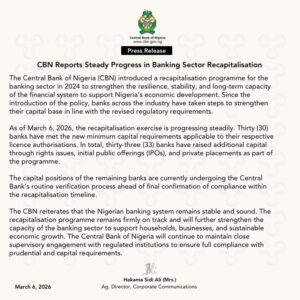
According to sources within the banking sector, the 30 banks that successfully met the requirement did so through a combination of capital raising initiatives. Some institutions turned to the Nigerian capital market, issuing new shares to investors through public offerings or private placements. Others relied on retained profits accumulated over several years, while a number of banks explored strategic partnerships and capital injections from foreign investors eager to expand their presence in Africa’s largest economy.

The recapitalisation program is also seen as a continuation of reforms that have historically shaped Nigeria’s banking sector. In the mid-2000s, the Central Bank implemented a major consolidation exercise that reduced the number of banks but significantly strengthened the sector by forcing institutions to merge and increase their capital base. Analysts say the current initiative builds upon that earlier reform by adapting capital requirements to the realities of a much larger and more complex economy.
Nigeria’s financial system has expanded significantly in recent years as the country’s population, businesses, and digital economy continue to grow. With millions of Nigerians gaining access to banking services through mobile platforms and digital payment systems, financial institutions now handle far larger transaction volumes than they did a decade ago. As a result, regulators have increasingly emphasized the need for banks to maintain stronger financial foundations capable of supporting this rapid growth.
In addition to strengthening banks themselves, the recapitalisation policy is expected to boost investor confidence in Nigeria’s financial markets. International investors and development finance institutions often evaluate the capital strength of banks before committing funds to projects in emerging economies. By ensuring that Nigerian banks meet higher capital standards, the Central Bank hopes to attract more foreign investment into sectors such as infrastructure, manufacturing, energy, and agriculture.
Industry experts say the successful completion of the recapitalisation exercise by 30 banks demonstrates the resilience and adaptability of Nigeria’s financial institutions. Despite challenges such as currency fluctuations, inflationary pressures, and global economic uncertainty, the banks managed to mobilize the resources required to meet the new standards. Financial analysts also note that the process has encouraged greater transparency and accountability within the sector, as banks were required to disclose detailed financial information to regulators and investors during the capital-raising process.
However, the recapitalisation program has not been without its challenges. Some smaller financial institutions reportedly struggled to raise sufficient capital within the timeframe, prompting discussions about potential mergers or acquisitions. In many cases, regulators prefer consolidation rather than allowing weaker institutions to operate with inadequate financial backing. Such consolidation could ultimately lead to fewer but stronger banks within the Nigerian financial system.
According to financial observers, the Central Bank’s decision to push for higher capital requirements reflects a broader global trend among financial regulators. In the aftermath of the global financial crisis, many countries strengthened banking regulations to prevent systemic failures that could threaten national economies. By aligning Nigeria’s banking standards with international best practices, the Central Bank hopes to ensure that the country’s financial institutions remain stable even during periods of global economic turbulence.
The recapitalisation effort also comes at a time when Nigeria is pursuing ambitious economic development goals. The government has repeatedly emphasized the importance of strong financial institutions in supporting industrial growth, job creation, and infrastructure development. Banks with larger capital bases are better positioned to finance major projects such as highways, power plants, railways, and technology hubs that require substantial long-term funding.
Financial analysts believe that the strengthened banking sector could also play a critical role in supporting small and medium-sized enterprises across the country. These businesses are widely regarded as the backbone of Nigeria’s economy, yet they often face significant challenges in accessing credit. With stronger capital positions, banks may be able to expand lending programs that support entrepreneurship and economic diversification.
For many industry stakeholders, the successful recapitalisation of 30 banks represents a clear signal that Nigeria’s financial sector is moving in the right direction. According to DDM News, banking executives have welcomed the development, noting that stronger capital structures will enable institutions to invest more confidently in technology, expand their branch networks, and improve customer services across the country.
The Central Bank, meanwhile, has reaffirmed its commitment to maintaining strict oversight of the financial system. Officials say the recapitalisation exercise is only one part of a broader regulatory framework designed to ensure that Nigerian banks operate responsibly and remain financially sound. The apex bank is expected to continue monitoring compliance with capital requirements while also introducing additional measures aimed at improving risk management and corporate governance within the sector.
Looking ahead, experts say the recapitalisation program could reshape the competitive landscape of Nigeria’s banking industry. Institutions that successfully raised new capital may pursue expansion strategies, including cross-border operations within Africa, investments in financial technology, and partnerships with international financial institutions. At the same time, banks that struggled to meet the requirements may seek strategic alliances or mergers to strengthen their financial position.
As Nigeria continues its journey toward economic growth and financial modernization, the recapitalisation of its banking sector represents a critical step in building a resilient financial system capable of supporting national development. Observers say the coming years will reveal how effectively these stronger banks can translate their expanded capital bases into real economic impact.
For now, the Central Bank’s announcement that 30 banks have successfully met the recapitalisation deadline stands as a major milestone for the industry. As DDM News reports, the move not only strengthens the financial sector but also signals Nigeria’s determination to build a banking system that can compete on the global stage while supporting the aspirations of Africa’s largest economy.