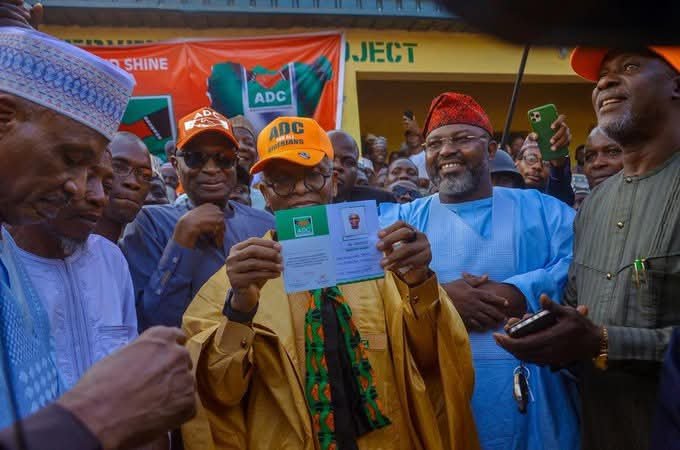
(DDM) – Former Kaduna State Governor, Mallam Nasir Ahmad El-Rufai, has formally aligned with the African Democratic Congress after months of speculation about his next political destination.
The development, Diaspora Digital Media (DDM) gathered, has triggered intense debate within northern political circles and across Nigeria’s wider political establishment.
El-Rufai’s decision follows a prolonged period of political tension that began after he exited the All Progressives Congress, the party that powered him to national prominence.
His move comes at a time when several political blocs are repositioning ahead of the 2027 general elections.

Political observers say the former governor’s entry into ADC marks a radical shift in the party’s strength and national visibility.
The African Democratic Congress, once regarded as a fringe party with modest influence, has been quietly restructuring and courting high-value political figures.
El-Rufai’s arrival is widely seen as the strategic breakthrough the party had been working toward.
Before now, ADC’s leadership had repeatedly emphasized its goal of becoming a major contender in national politics rather than an alternative protest platform.
Sources close to the former governor describe his new affiliation as a calculated realignment meant to provide him “a platform free from internal sabotage and political hostility.”
El-Rufai has long been considered one of northern Nigeria’s most outspoken and influential political voices.
His tenure as Kaduna governor was marked by sweeping reforms, controversial policy decisions, and an assertive leadership style that often attracted admiration and criticism in equal measure.
El-Rufai previously served as Minister of the Federal Capital Territory, where he earned a reputation for strict urban reforms and uncompromising governance principles.
His political rise within the APC positioned him as one of the party’s most powerful figures prior to internal conflicts that eventually strained his relationship with its national leadership.
Analysts note that the friction intensified after the 2023 transition, where differences emerged between El-Rufai and key federal actors.
The ADC, on the other hand, has been attempting to project itself as the next viable reformist platform capable of challenging the dominance of Nigeria’s traditional political blocs.
The party has embraced a message centred on youth inclusion, anti-corruption values, and decentralization of political power.
El-Rufai’s entry gives ADC a formidable figure capable of mobilizing northern political structures, donors, technocrats, and grassroots networks.
The news has already generated viral reactions across social media, with commentators divided over whether the move strengthens democracy or deepens political fragmentation.
Some critics argue that El-Rufai’s political history may generate internal friction within ADC.
Others believe he has the administrative experience and national recognition to elevate the party’s electoral ambitions.
There is also speculation that his defection may inspire additional high-ranking figures dissatisfied with Nigeria’s dominant parties to consider alternative platforms.
For now, ADC leaders have welcomed El-Rufai with optimism, describing his decision as “the beginning of a new political chapter for Nigeria.”
As 2027 approaches, his move signals a fresh wave of realignments that may reshape alliances across the north and beyond.
The political class will be watching closely to see whether his entry transforms the African Democratic Congress into a major national force or fuels new controversies in Nigeria’s already heated political space.
What remains certain is that the former governor’s decision has reignited debates about loyalty, party ideology, and the future direction of Nigeria’s democracy.