


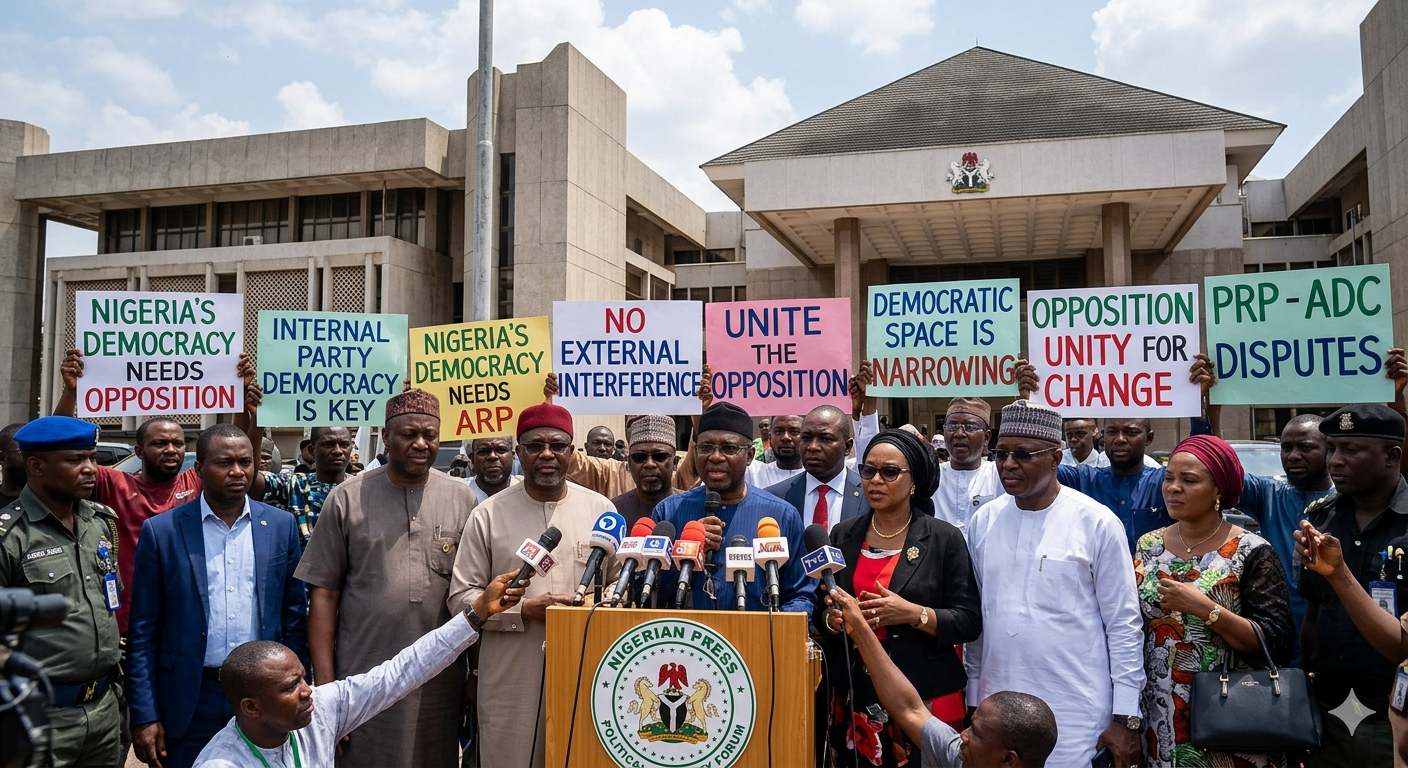
ABUJA, NIGERIA — Growing internal disputes within opposition parties have sparked fresh concerns about the state of Nigeria’s democratic environment, with analysts warning that persistent instability could weaken political competition.
Recent developments within the Peoples Redemption Party (PRP) have drawn attention after a leadership visit to the African Democratic Congress (ADC) was followed by speculation about possible coalition talks.
Although party officials denied any formal alignment discussions, the rumours reportedly triggered the sudden emergence of a faction challenging the leadership of PRP National Chairman, Hakeem Baba-Ahmed.
Observers say the speed at which the internal dispute developed has raised questions about the vulnerability of smaller parties to external pressure and internal fragmentation.

Critics argue that Nigeria’s political space appears to be narrowing, with opposition parties increasingly struggling to maintain cohesion and independence.
However, the ruling All Progressives Congress has consistently denied allegations of interference in opposition affairs, maintaining that such crises are the result of internal disagreements within those parties.
Political analysts note that factional conflicts are not new in Nigeria’s party system, often driven by leadership disputes, ideological differences, and competition for control ahead of elections.
Despite this, some stakeholders warn that repeated instability across multiple opposition platforms could have broader implications for democratic balance.
They argue that a healthy democracy depends on strong and functional opposition parties capable of offering credible alternatives to voters.
Concerns have also been raised about the long-term consequences of weakening opposition structures, with experts cautioning that limited political choices could reduce public confidence in the electoral process.
Some analysts further suggest that if political competition becomes constrained, it may increase political tension and reduce opportunities for peaceful power transitions.
Others, however, insist that opposition parties must take responsibility for internal discipline, transparency, and conflict resolution, rather than attributing crises to external forces.
The situation has renewed debate about the need for stronger democratic institutions, internal party reforms, and safeguards to protect political pluralism in Nigeria.
As political activities gradually intensify ahead of future elections, the ability of parties to manage internal disagreements and maintain stability will remain a key factor in shaping Nigeria’s democratic trajectory.




