


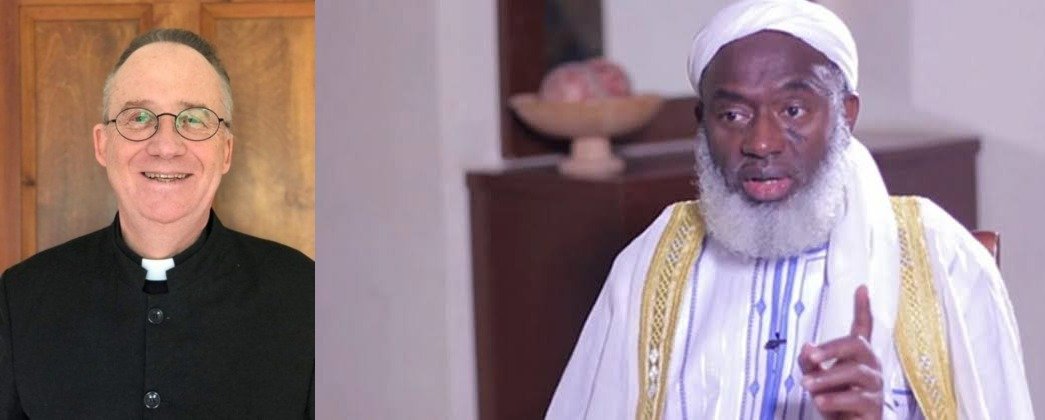
The controversy ignited by the United States’ Christmas Day airstrikes in parts of Sokoto State has rapidly evolved from a security and diplomatic issue into a fierce moral, political, and ideological confrontation that now threatens to further polarise Nigeria’s already fragile national cohesion. At the centre of this storm is the outspoken Islamic cleric, Sheikh Ahmad Gumi, whose reaction to the American military action has provoked outrage from religious leaders, security analysts, and international observers, culminating in a dramatic call by a prominent Catholic author and cleric, Deacon Nick Donnelly, for Gumi’s immediate arrest and prosecution for what he describes as crimes against humanity. DDM NEWS reports that the unfolding saga has exposed deep fault lines in Nigeria’s handling of terrorism, religious violence, and accountability, while placing President Bola Ahmed Tinubu under mounting pressure to publicly distance himself from rhetoric perceived as sympathetic to extremist violence.
The spark for the controversy was the announcement by the United States that it had conducted targeted airstrikes against suspected terrorist elements operating in parts of northwestern Nigeria, including areas of Sokoto State. The strikes, which reportedly occurred on Christmas Day, were presented by US officials as part of a broader counterterrorism effort aimed at degrading the operational capacity of extremist groups accused of orchestrating mass killings, kidnappings, and attacks on civilian populations. Although details of the operation remained limited, the timing of the strikes, coinciding with Christmas, and the justification offered by American officials, including references to protecting vulnerable communities, particularly Christians, immediately drew intense reactions across Nigeria.
While some Nigerians cautiously welcomed the intervention as a sign that the international community was finally taking decisive action against armed groups that have terrorised vast swathes of the country for years, others expressed concern about sovereignty, civilian casualties, and the long-term implications of foreign military involvement. However, it was Sheikh Ahmad Gumi’s response that transformed the debate into a national and international controversy. In a statement reported by DAILY POST and widely circulated on social media, Gumi urged the Federal Government of Nigeria to immediately halt any form of collaboration with the United States in targeting those responsible for what has been described by some international actors as a genocide against Christians in parts of the country.
Gumi’s intervention was not merely a call for caution; it was framed in language that many critics interpreted as sympathetic to the very groups accused of mass atrocities. His remarks, coming in the wake of US airstrikes aimed at insurgents linked to extremist ideologies, were seen by opponents as undermining counterterrorism efforts and legitimising violence under the guise of communal defence. DDM NEWS understands that this perception was reinforced by Gumi’s history of controversial engagements with armed groups, including past comments in which he appeared to rationalise or contextualise the actions of bandits and insurgents, often framing them as victims of state neglect rather than perpetrators of crimes.

It was against this backdrop that Deacon Nick Donnelly, a renowned Catholic author and outspoken advocate for persecuted Christians, entered the fray with a searing condemnation of Sheikh Gumi. In a series of posts on X, formerly Twitter, Donnelly did not mince words, accusing the Islamic cleric of effectively endorsing the actions of what he described as “bestial Islamist terrorists” and calling for his immediate arrest and prosecution. Donnelly’s intervention has since reverberated far beyond social media, drawing attention from international religious freedom advocates, human rights groups, and political commentators.
“Sheikh Gumi protests President Trump’s Christmas military strikes against the bestial Islamist terrorists,” Donnelly wrote. “Calling the terrorists conducting the genocide against Christians ‘our warriors’. Gumi must be arrested and put on trial for crimes against humanity. Tinubu must publicly condemn Gumi or else he is declaring his complicity in his crimes.” The language was stark, accusatory, and deliberately provocative, reflecting the depth of anger felt by many who believe that Nigeria’s failure to confront extremist violence decisively has emboldened perpetrators and their apologists.
DDM NEWS analysis shows that Donnelly’s call is significant not only because of its content but also because of who is making it. As a Catholic cleric with an international audience and a track record of advocacy on issues of religious persecution, Donnelly’s words carry weight beyond Nigeria’s borders. His framing of the issue as one involving potential crimes against humanity elevates the debate from domestic politics to the realm of international law and moral responsibility. Crimes against humanity, under international legal frameworks, encompass acts such as murder, extermination, persecution, and other inhumane acts committed as part of a widespread or systematic attack against civilian populations. By invoking this language, Donnelly is effectively arguing that rhetoric which appears to defend or justify such acts should itself be subject to legal scrutiny.
Supporters of Donnelly’s position argue that Sheikh Gumi’s comments, when viewed in the context of Nigeria’s prolonged crisis of violence, amount to more than mere free speech. They contend that public figures who describe armed groups accused of massacres as “our warriors” risk inciting further violence, legitimising atrocities, and obstructing efforts to hold perpetrators accountable. From this perspective, the call for arrest is framed not as an attack on religious freedom but as a necessary step to uphold the rule of law and protect vulnerable communities.
However, defenders of Gumi argue that his remarks have been misinterpreted or deliberately taken out of context. They claim that the cleric’s long-standing engagement with armed groups has been motivated by a desire to promote dialogue and reduce violence, rather than to endorse terrorism. According to this view, Gumi’s opposition to foreign military intervention reflects concerns about civilian casualties, sovereignty, and the risk of exacerbating conflicts rather than any sympathy for extremist ideology. These defenders warn that calls for his arrest risk inflaming religious tensions and could be perceived as targeting a Muslim cleric for expressing dissenting views.
Yet, as DDM NEWS has observed, the debate cannot be divorced from Nigeria’s grim realities. Over the past decade, the country has witnessed thousands of deaths attributed to insurgency, banditry, and communal violence, with entire communities displaced and livelihoods destroyed. While the violence has affected Nigerians of all faiths, numerous reports by local and international organisations have documented targeted attacks on Christian communities in parts of the Middle Belt and northern regions, including church burnings, mass killings, and forced displacement. It is these patterns that have led some international actors, including voices within the United States, to frame the crisis in terms of religious persecution.
The US airstrikes themselves have become a symbol of this framing. According to statements attributed to American officials, the strikes were aimed at ISIS-linked elements and other extremist groups accused of orchestrating attacks against civilians. US Defence officials have suggested that the operation was conducted in coordination with Nigerian authorities, although details remain sparse. The Nigerian government has been cautious in its public response, neither fully endorsing nor outright rejecting the American action, a stance that reflects the delicate balance Abuja seeks to maintain between asserting sovereignty and benefiting from international security cooperation.
It is within this context of ambiguity that Donnelly’s challenge to President Tinubu assumes heightened significance. By stating that Tinubu must publicly condemn Gumi or risk being seen as complicit, Donnelly has effectively placed the Nigerian president at a crossroads. A public condemnation could signal a firm stance against rhetoric perceived as justifying extremist violence, potentially reassuring affected communities and international partners. However, such a move could also provoke backlash from segments of the population that view Gumi as a legitimate religious leader and fear marginalisation.
DDM NEWS investigations indicate that the presidency is acutely aware of the sensitivities involved. Tinubu’s administration has sought to project an image of inclusivity and national unity while grappling with severe security challenges and economic pressures. Taking a hard public stance against a figure like Gumi could be interpreted by some as politicising religion or favouring one faith community over another. Conversely, silence or perceived inaction risks reinforcing narratives that the government is unwilling to confront extremist sympathisers, thereby undermining confidence in its commitment to justice and security.
Beyond the immediate personalities involved, the controversy raises deeper questions about the boundaries of free speech, religious authority, and accountability in a democracy facing existential security threats. At what point does rhetoric cross the line from expression to incitement? How should states respond when influential figures appear to legitimise or excuse violence? And what role should international actors play when domestic responses are seen as inadequate? These are questions that Nigeria, and indeed many countries grappling with extremism, continue to struggle with.
As the debate rages on, reactions within Nigeria remain deeply divided. Christian leaders and advocacy groups have largely welcomed Donnelly’s intervention, seeing it as validation of their long-standing complaints about impunity and selective justice. Muslim leaders, meanwhile, have urged caution, warning against broad-brush accusations that could stigmatise entire communities. Civil society organisations have called for an independent investigation into both the impact of the US airstrikes and the broader issue of extremist violence, arguing that transparency and accountability are essential to preventing further escalation.
DDM NEWS will continue to monitor developments closely, including any official response from the presidency, security agencies, or the judiciary. Whether Sheikh Ahmad Gumi will face any form of legal scrutiny remains uncertain, but what is clear is that the controversy has once again exposed the fragile interplay of religion, politics, and security in Nigeria. As international attention intensifies and domestic pressures mount, the choices made in the coming days could have far-reaching implications for national unity, the fight against terrorism, and Nigeria’s standing on the global stage.




