


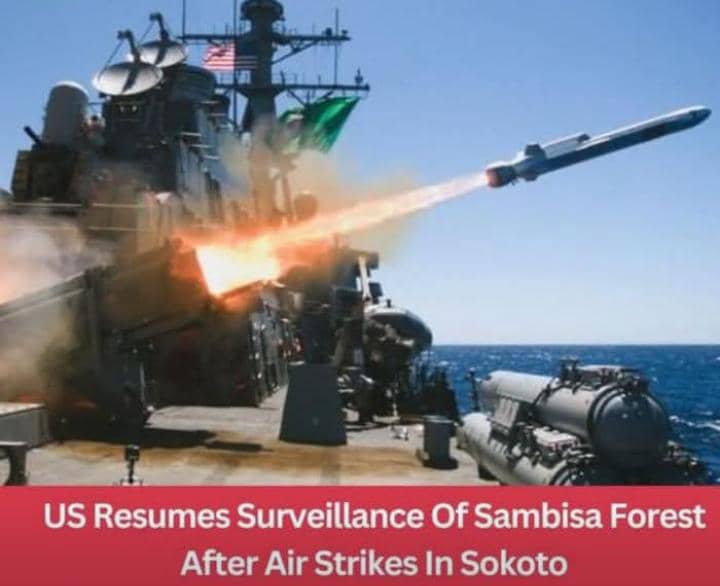
Fresh reports of United States airstrikes on suspected terrorist targets in northern Nigeria have sparked national debate over why Sokoto State was selected as the first point of attack instead of regions with higher levels of extremist violence.
DDM gathered that the explanation was offered by Emmanuel Ogebe, an international human rights lawyer and expert in bilateral relations, who argued that the choice of Sokoto was driven more by past operational familiarity than by the intensity of terrorist activities.
Ogebe explained that Sokoto had previously hosted a successful U.S. military operation in 2020 during the first term of former President Donald Trump, when American special forces rescued U.S. citizen Philip Walton from kidnappers.
That operation, carried out by U.S. Navy SEALs, resulted in the killing of six terrorists and left behind what Ogebe described as institutional memory and confidence within the U.S. military regarding the terrain.

He described Sokoto as an unusual opening target, noting that it is neither the epicentre of jihadist violence in Nigeria’s North-East nor the North-Central region, where armed herdsmen attacks have caused large-scale civilian deaths.
Ogebe pointed out that a recent suicide bombing in Borno State underscored the continued dominance of the North-East as Nigeria’s primary terror hotspot.
He also referenced Benue State in the Middle Belt, where repeated attacks by armed groups have led to widespread killings and displacement, particularly among Christian farming communities.
According to him, the North-West, including Sokoto, represents a safer operational environment for the U.S. due to previous boots-on-ground experience and established intelligence structures.
He added that Sokoto’s proximity to Niger Republic may have played a role, as the U.S. until recently operated military bases in Niger and retains familiarity with cross-border movement patterns.
The Nigerian government has since confirmed that the airstrikes were carried out jointly with the United States and other international partners.
Ogebe said this claim was credible, recalling that the 2020 Walton rescue mission nearly failed because Nigerian airspace clearance had not been secured in advance.
He cited revelations from former U.S. Defence Secretary Mark Esper’s memoir, which detailed how American aircraft were already airborne before approval was obtained, creating the risk of interception or hostile engagement.
Based on that experience, Ogebe argued it would be highly unlikely for the U.S. to conduct any current military operation on Nigerian soil without full coordination with Nigerian authorities.
He also linked Washington’s evolving strategy to the loss of U.S. military bases in Niger following a pro-Russia military coup, which forced the U.S. to rethink its surveillance and strike capabilities across the Sahel.
Despite this, Ogebe questioned the broader impact of the Sokoto strikes, arguing that the region is not responsible for the majority of mass civilian killings in Nigeria.
He cited data suggesting that more than 600,000 Christians have been displaced in parts of Benue State alone, a figure he said rivals displacement across several North-Western states combined.
Ogebe further raised the possibility that the strikes may be connected to concerns over the abduction of American missionary pilot Dan Rideout in neighbouring Niger.
He warned that there were fears the abducted pilot could be trafficked to terrorist groups operating around the Sokoto axis, similar to the circumstances surrounding the Walton kidnapping.
From a strategic perspective, Ogebe concluded that Sokoto’s selection only makes sense if a specific American security interest is at stake.
Ogebe, who is based in Washington, D.C., is widely known for influencing U.S. foreign policy on Nigeria and played a key role in Boko Haram’s designation as a foreign terrorist organisation in 2013.
His advocacy also contributed to Nigeria being designated a Country of Particular Concern by the United States in 2020, highlighting ongoing international concern over insecurity and religious freedom in the country.




