


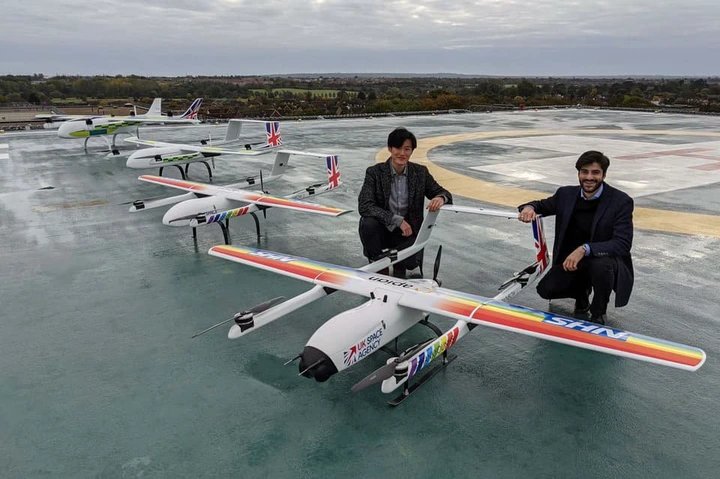
(DDM) – The National Health Service is expanding medical drone deliveries to move urgent pathology samples across parts of London.
DDM Diaspora Digital Media gathered that the new phase will connect Nelson Health Centre in Merton with St George’s Hospital in Tooting.
Health officials say the drones will begin routine flights in the spring after regulatory approvals.
The programme follows earlier trials that tested whether drones could outperform traditional courier vans.
The NHS previously flew blood samples between Guy’s and St Thomas’ hospitals during pilot operations.
Those early tests showed that drones completed some deliveries within minutes instead of hours.
Project managers reported improved reliability during periods of heavy traffic congestion in central London.
The trial phase moved more than 6,000 pathology samples between participating hospitals.
Operators recorded average cost savings of about 28 percent compared with urgent van dispatches.
Environmental data showed that each drone trip sharply reduced carbon emissions versus road transport.
Healthcare logistics company Apian manages the delivery network for participating hospitals.
Apian now works with Swiss drone firm Matternet to widen the service across London.
Executives expect the expanded system to cut delivery times by as much as 85 percent.
Great Ormond Street Hospital has also joined the network to support faster diagnostics.
Hospital administrators believe rapid sample movement can help doctors make quicker clinical decisions.
Faster laboratory processing can influence treatment timelines for critical patients.
Apian has explored robotic support systems to complement aerial deliveries.
Engineers have tested autonomous ground robots to receive drones and carry samples indoors.
Some of these machines resemble robotic dogs that can navigate hospital corridors.
Developers say the robots can reduce delays at busy receiving points.
Hospital managers hope automation will free staff for direct patient care duties.
Supporters argue that London’s traffic problems make drone logistics increasingly attractive.
Southwest London roads often experience delays that disrupt time-sensitive medical transport.
Pathology leaders say reliable logistics strengthen overall healthcare resilience.
They add that quicker turnaround times can support world-class clinical standards.
Some observers still raise concerns about safety oversight and urban airspace regulation.
Aviation authorities continue to review flight paths and operational safeguards.
Community members also debate privacy and noise issues linked to low-flying drones.
NHS managers insist that strict rules guide every medical drone flight.
They say patient safety and sample integrity remain the top priorities.
Industry data increasingly links drone logistics with clinical and environmental gains.
Technology analysts view London as a testing ground for future medical delivery models.
The NHS plans to study performance data before wider national adoption.
Healthcare innovators believe drones could transform how hospitals share critical resources.
The expansion signals a growing shift toward automation in public health logistics.
Medical leaders say innovation must balance efficiency with strong public trust.
The coming months will reveal how well drone medicine fits into everyday healthcare.
Post Views: 409




