United States lawmakers have criticised the administration of President Bola Tinubu over a reported $9 million lobbying contract in Washington, alleging that it was aimed at downplaying the scale of religious violence in Nigeria, particularly against Christian communities.
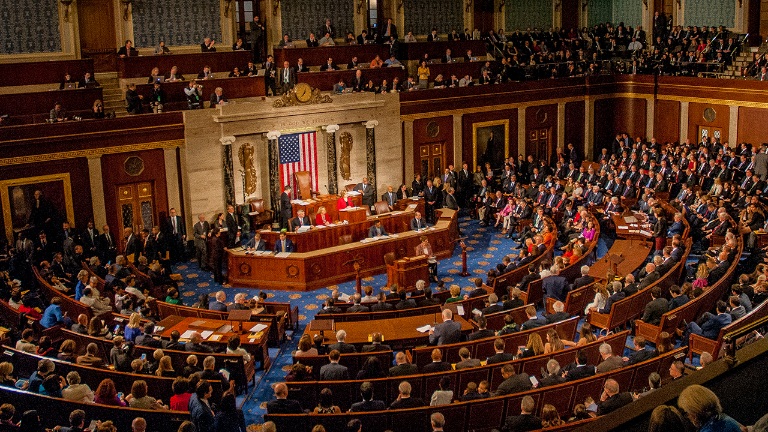
The criticism emerged on Wednesday during a joint congressional hearing of the House Subcommittee on Africa and the Subcommittee on the Western Hemisphere, titled “Defending Religious Freedom Around the World.”
The hearing focused on global threats to religious freedom, with Nigeria featuring prominently in the discussions.
Testimony was taken from former US Ambassador-at-Large for International Religious Freedom, Sam Brownback, and a former chair of the US Commission on International Religious Freedom (USCIRF), Dr Stephen Schneck.

Lawmakers expressed concern over what they described as persistent violence in Nigeria and questioned the federal government’s response to the crisis.
Chairman of the House Foreign Affairs Subcommittee on Africa, Rep. Chris Smith, defended the United States’ October 2025 decision to designate Nigeria as a Country of Particular Concern (CPC) under the International Religious Freedom Act, describing the move as “long overdue.”
Smith said he was disturbed by reports that the Nigerian government had hired Washington-based lobbying firm DCI Group at a cost of $9 million, reportedly paid at $750,000 per month, to counter the CPC designation.
He also raised concerns about a separate $120,000-per-month contract allegedly entered into by a Nigerian billionaire with consulting firm Valcour to influence the US Congress and Executive Branch.
“I am deeply concerned that Nigeria has hired the lobbying firm, DCI Group, to the tune of $9 million,” Smith said, adding that such efforts appeared designed to present the crisis as less severe than it is.
He argued that the lobbying campaigns risked obscuring the realities faced by communities affected by religious violence.
During the hearing, lawmakers also discussed the broader implications of US policy toward Nigeria.
One lawmaker noted that despite stated concerns about religious freedom, the United States had reduced hundreds of millions of dollars in foreign assistance to Nigeria, including programmes supporting faith leaders and conflict-affected communities.
Questions were also raised about the effectiveness of recent US military actions in Nigeria.
One representative argued that airstrikes carried out in Sokoto State around Christmas had not produced tangible improvements for affected communities, despite repeated claims by US President Donald Trump that Christians in Nigeria were facing genocide.
In his testimony, Dr Schneck described Nigeria’s security crisis as complex and multifaceted, citing terrorism by Boko Haram and the Islamic State West Africa Province (ISWAP), farmer-herder conflicts, banditry, organised crime and mass displacement.
He also criticised what he described as weak governance, saying the state had struggled to provide basic security and justice to its citizens.
The hearing also examined whether the CPC designation alone was sufficient. Rep. Jefferson Shreve questioned its practical impact, prompting Brownback to argue that such a designation must be supported by sanctions and other concrete measures to be effective.
“This government has not given us any reason to trust them,” Brownback said, reflecting the scepticism expressed by several lawmakers during the session.
President Trump has repeatedly claimed that Christians in Nigeria are facing genocide and has previously threatened military action in response.
The Nigerian government has consistently rejected those claims, acknowledging serious security challenges but maintaining that the violence does not amount to genocide and is not targeted at any single religious group.
The hearing underscored growing scrutiny in Washington over Nigeria’s handling of insecurity and religious violence, as well as renewed debate over the role of lobbying, diplomacy and sanctions in shaping US policy toward Africa’s most populous nation.