



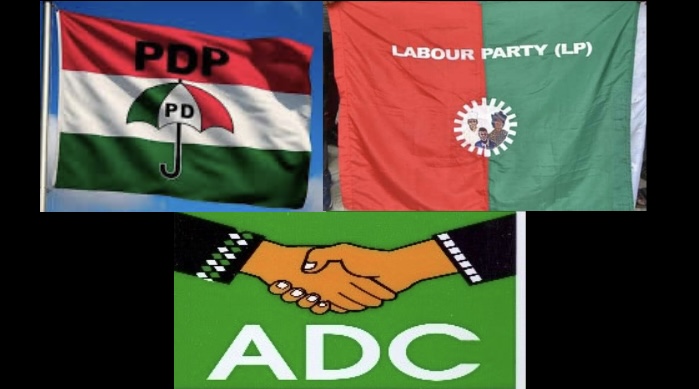
With less than two years to Nigeria’s next general elections, the country’s major opposition parties are caught in a storm of their own making.
Like ships without rudders, they drift in waters where ambition, ego, and factional squabbles threaten to dash their chances against the well-oiled machinery of the ruling All Progressives Congress (APC).
From the fractious corridors of the People’s Democratic Party (PDP) to the still-fledgling Labour Party (LP), internal crises have become both the symptom and the disease, weakening their credibility, fracturing their unity, and raising the uncomfortable question: can they ever mount a credible challenge to incumbency?
The PDP, Nigeria’s erstwhile ruling party, seems trapped in a loop of political déjà vu. The presidential primary of 2022 marked the beginning of a slow, painful unraveling that the party has yet to recover from.

Disputes over zoning, the control of state structures, and unresolved grievances from the G-5 governors’ rebellion have festered like an untreated wound.
Parallel executives operate in shadow, convening meetings that contradict one another and issuing directives that confuse rather than guide. One is left to wonder whether the PDP is a party of politicians or a theater troupe rehearsing a never-ending drama of internal betrayal.
Some argue that external interference by the ruling party has fanned the flames, turning cracks into chasms.
Others admit that poor internal conflict management, combined with a judiciary that often appears to swing like a pendulum, has worsened the situation.
The recent failed attempt by the Seyi Makinde faction to hold a national convention is a case in point, where court rulings, perceived biases, and INEC recognition of rival factions have created an almost Kafkaesque labyrinth of legitimacy.
As one insider noted, “Knowing the kind of politicians we have, they lack integrity, especially when money is involved. They are working together with him [Wike] to destroy the party.”
Yet, even amid the chaos, political analysts caution against assuming the PDP is doomed.
Temitope Musowo observes that crises, though destabilizing, are not necessarily fatal.
“This is a phase,” he insists. “External factors may fuel it, but these people cannot remain in power forever.”
True as this may be, the party’s current trajectory resembles a train hurtling toward a cliff unless course correction comes swiftly, the 2027 elections may see the PDP as little more than a collection of squabbling factions rather than a unified alternative to the APC.
The Labour Party, which surged to national prominence during the 2023 elections, faces a parallel set of challenges.
Once seen as the torchbearer for young Nigerians and urban voters hungry for a political alternative, the LP has since been entangled in leadership disputes and court battles over the legitimacy of its national executive.
Peter Obi, the party’s presidential candidate in 2023, has defected, and other prominent figures have drifted away, leaving a vacuum at the top. Competing factions operate in silos, issuing directives and convening meetings in a manner that undermines cohesion.
The recent Supreme Court ruling affirming Nenadi Usman’s leadership and the formal handover of the party’s secretariat in Abuja marked a symbolic fresh start.
Yet many party members remain unconvinced, viewing the ruling as a bandage on a fractured foundation.
Analysts warn that unless the LP resolves its structural instability and reconciles its warring factions, it risks losing the very momentum that catapulted it into the national spotlight in 2023.
The LP’s internal woes illustrate a larger truth about Nigerian politics: momentum and popularity, no matter how promising, cannot survive the corrosive effects of internal division.
Across opposition platforms, a recurring refrain is the allegation that the APC is exploiting these internal weaknesses.
Opposition chieftains accuse the ruling party of encouraging defections, sponsoring parallel executives, and leveraging state institutions to tilt the political landscape in its favor.
One anonymous source notes, “People are being coerced to join the APC with promises of automatic tickets and money. They may not tell you, but that is what is happening.”
Yet, in many cases, the opposition’s misfortunes are self-inflicted. Leaders’ ambitions, ego clashes, and a lack of strategic foresight have created fertile ground for the ruling party to consolidate power.
As Sunday Oloko, an APC chieftain, pointed out, “They cannot blame us for their inability to manage their internal affairs. If people are defecting, it is because they see direction and stability here.”
Indeed, in politics as in life, neglect of internal housekeeping is often punished more severely than the maneuvers of an opponent.
The question of coalition-building looms large as the 2027 elections approach. While the African Democratic Congress (ADC) emerged from a coalition of opposition forces, the party’s unity and national reach remain uncertain.
Only a broad-based alliance can realistically challenge the APC’s entrenched incumbency advantage.
Yet, the quest for the presidential ticket among figures such as Atiku Abubakar, Peter Obi, and Rotimi Amaechi threatens to deepen divisions, potentially scuttling the coalition before it has the chance to consolidate.
Ambition, once a spark for political action, risks becoming a wildfire that consumes the opposition from within.
In Nigeria, where politics is both a theatre of dreams and a battlefield of ambitions, timing and cohesion matter as much as ideology.
The opposition must reconcile its differences, streamline leadership structures, and articulate a vision that resonates with the electorate.
Otherwise, the 2027 elections could see them as little more than spectators to the APC’s march toward political dominance.
Without decisive action, what could have been a credible alternative may instead dissolve into a cautionary tale of missed opportunities and self-inflicted wounds.
The stakes are not merely partisan; they are national. Nigeria’s democracy thrives on competition, debate, and the presence of viable alternatives.
When the opposition falters, citizens are left with limited choices, and the risk of one-party dominance looms a situation that threatens to erode democratic accountability and dilute the principles of representation.
Internal strife, personal ambition, and factionalism must not be allowed to overshadow the urgent need for credible, issue-based campaigns that address the real challenges facing Nigerians: economic hardship, insecurity, and governance deficits.
Ultimately, the opposition’s current predicament is a reflection of the broader challenges of Nigerian politics: talent undermined by division, promise diminished by self-interest, and opportunity squandered by internal bickering.
The opposition must recognize that the window for action is narrowing. As the clock ticks toward 2027, there is no time for indecision, delay, or internal politicking masquerading as strategy. The electorate demands coherence, clarity, and a sense of purpose—qualities that have been in short supply.
The narrative is clear: ambition and ego cannot substitute for organization and foresight. Nigerian voters are watching closely, and history has shown that political parties who fail to reconcile and unify pay a steep price.
The opposition must rise above personal rivalries, embrace genuine reconciliation, and commit to building a sustainable national platform if they hope to be more than a footnote in Nigeria’s electoral story.
In the theatre of Nigerian politics, the opposition stands at a crossroads. Will it find the courage to act decisively, heal its internal rifts, and present a united front, or will it continue to sabotage itself, allowing the APC to dominate unchallenged?
The answer will define not only the fortunes of parties but the very health of the nation’s democracy.
Time, as always, is both a tyrant and a test. The opposition must decide whether it will rise to the occasion or succumb to the familiar temptations of division and ego.
Nigeria cannot afford another election in which the opposition fails itself, and by extension, fails the people it claims to serve.
In 2027, the country will remember not just who governed, but who could have offered an alternative and chose not to.




