Leaders of the African Democratic Congress (ADC) and the New Nigeria Peoples Party (NNPP) have called on the National Assembly to commence a fresh amendment of the Electoral Act 2026, describing certain provisions of the law as anti-democratic.
Speaking at a press conference in Abuja on Thursday, NNPP National Chairman, Ajuji Ahmed, who addressed journalists on behalf of opposition leaders, urged lawmakers to expunge what he termed “objectionable provisions” in the newly enacted law.
The Electoral Act 2026, recently passed by the National Assembly and signed into law by Bola Tinubu on February 18, restricts political parties to direct primaries and consensus arrangements for the nomination of candidates.
Under the previous Electoral Act 2022, parties were allowed to adopt direct primaries, indirect primaries through delegates, or consensus methods. The new law also shortens campaign periods and timelines for party primaries. In addition, funding for the Independent National Electoral Commission (INEC) will now be released six months before elections instead of 12 months as previously provided.

Concerns Over Electronic Transmission
Ahmed criticised the inclusion of a proviso in Section 60(3) of the Act, which grants discretionary powers to presiding officers in cases of network failure during the transmission of results. He alleged that the clause could undermine electronic transmission of results from polling units.
He cited statements previously made by former INEC Chairman, Mahmud Yakubu, and ex-INEC Commissioner, Festus Okoye, who had indicated that the Bimodal Voter Accreditation System (BVAS) operates offline and has recorded a high success rate nationwide.
According to Ahmed, available data from the Nigerian Communications Commission shows that over 95 per cent of Nigeria had 2G coverage as of 2023, which he said is sufficient for the transmission of election results.
He argued that restricting mandatory real-time transmission based on network concerns was not supported by evidence and accused the ruling party of attempting to weaken electoral transparency ahead of the 2027 general elections.
Party Primaries Debate
On party primaries, the opposition leaders faulted the amendment to Section 84 of the Act, which limits parties to direct primaries and consensus options. They argued that this infringes on the constitutional autonomy of political parties to determine their internal processes.
“There is nothing undemocratic about indirect primaries,” Ahmed said, insisting that the method creates an orderly and transparent electoral college system for candidate selection.
He maintained that the mode of nomination should remain an internal affair of political parties and not be dictated by legislation.
Stakeholders in Attendance
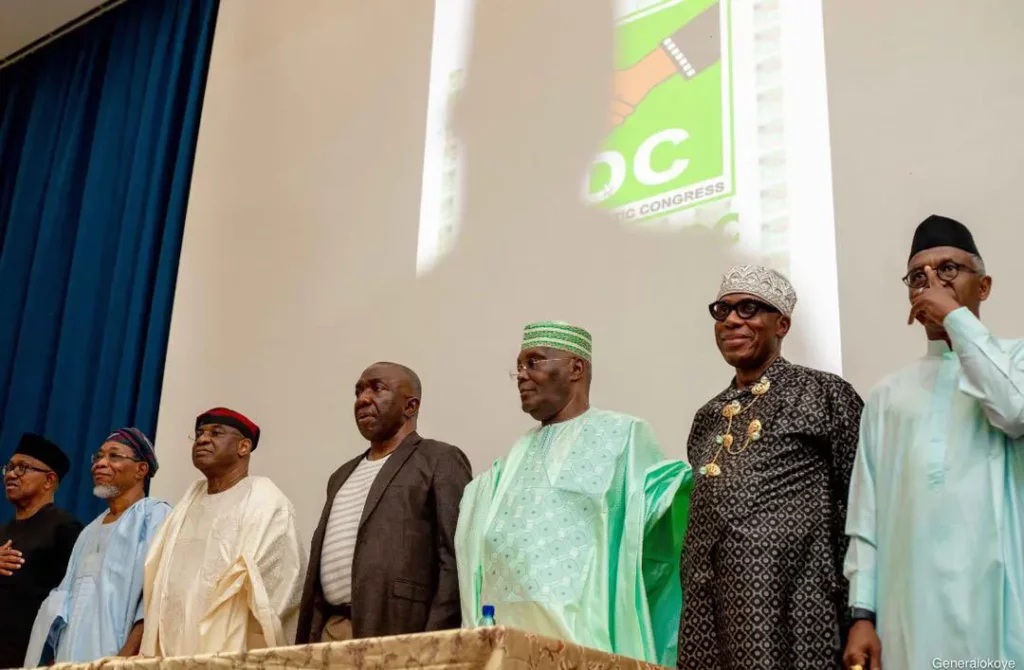
Prominent opposition figures present at the press conference included ADC National Chairman David Mark; former Vice-President Atiku Abubakar; and the 2023 presidential candidate of the Labour Party, Peter Obi.
Others in attendance were NNPP chieftain Buba Galadima; former Rivers State Governor Rotimi Amaechi; ADC National Secretary Rauf Aregbesola; Senator Dino Melaye; former ADC National Chairman Ralph Nwosu; and former Cross River State Governor Liyel Imoke, among other stakeholders.
The opposition leaders insisted that the National Assembly must urgently revisit the Act to ensure it reflects the aspirations of Nigerians for free, fair, and credible elections.