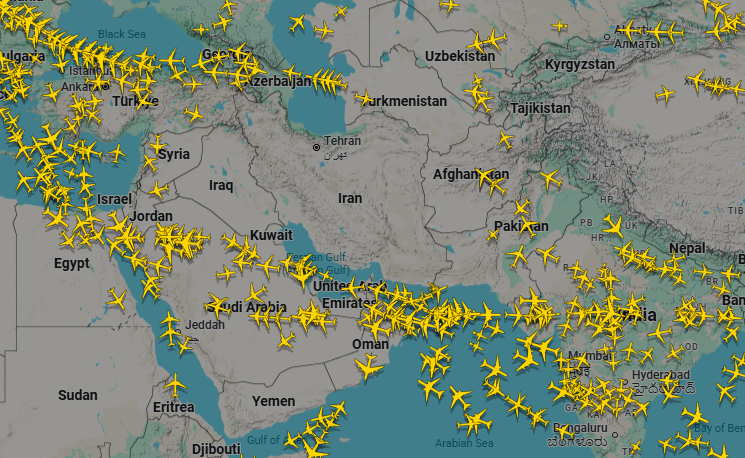
Airlines worldwide have suspended flights across the Middle East after the United States and Israel launched coordinated strikes on Iran, escalating regional tensions and creating major disruptions for international air travel.
Flight tracking data shows that airspace over Iran is virtually empty, following Israel’s pre-emptive strikes and the U.S. military targeting strategic sites in Iran.
Tehran retaliated with a salvo of missiles, raising fears of a wider regional conflict.
The military escalation has dimmed hopes for a diplomatic solution to Iran’s nuclear dispute with the West.
Weeks of U.S. military buildup in the region preceded the strikes, heightening concern over the stability of the Middle East.

Airspace Closures and Flight Suspensions
Several countries have closed their airspace in response to the strikes:
Israel, Iran, Iraq, and Jordan have suspended civilian flights.
Gulf nations including Qatar, Kuwait, and the UAE followed suit.
Russian authorities ordered Russian carriers to halt flights to Iran and Israel.
Major airlines have taken additional precautionary measures:
Lufthansa suspended flights to and from Dubai and temporarily halted services to Tel Aviv, Beirut, and Oman until March 7.
Air France cancelled flights to Tel Aviv and Beirut.
Wizz Air suspended flights to Israel, Dubai, Abu Dhabi, and Amman immediately.
KLM moved forward the suspension of its Amsterdam–Tel Aviv route.
Virgin Atlantic re-routed flights to avoid Iraqi airspace.
Qatar Airways reported temporary suspension of flights, with planes circling over Kuwait or Saudi airspace before returning to Doha.
Kuwait’s aviation authority confirmed a halt to all flights to Iran, while Oman Air suspended flights to Baghdad.
The UAE partially and temporarily closed its airspace as a precaution.
Conflict zones in the Middle East have become a growing operational burden for airlines.
Aerial attacks raise concerns about accidental or deliberate shoot-downs of commercial aircraft. In addition, longer flight routes to avoid closed airspace require additional fuel and increase operational costs.
With Russian and Ukrainian airspace largely closed due to years of war, Middle Eastern routes have become critical for flights between Europe and Asia.
The current disruptions add further complexity to global aviation logistics.
As the situation unfolds, airlines and passengers are being urged to monitor official notices from authorities and carriers for updates on flight schedules and airspace restrictions.