


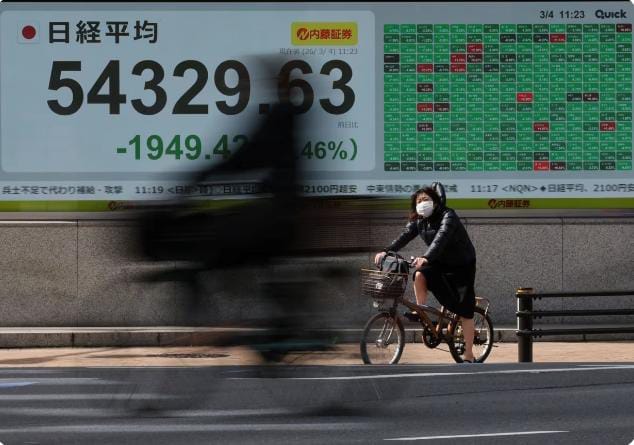
(DDM) – Asian stock markets plunged sharply on Wednesday morning as the expanding conflict in the Middle East intensified investor fears over energy supply disruptions and economic instability.
The selloff swept across major regional exchanges, reflecting deep anxiety that prolonged hostilities could choke vital oil and gas shipments to energy-hungry Asian economies.
South Korea’s benchmark KOSPI index recorded the steepest losses, plunging 12.3 percent by late morning trading after already closing 7.2 percent lower on Tuesday.
Japan’s Nikkei 225 index also suffered significant declines, dropping 4.7 percent as investors rushed to safer assets.

In Hong Kong, the Hang Seng index fell 3.1 percent, extending losses amid heightened geopolitical uncertainty.
Taiwan’s TAIEX index slid 3.9 percent, mirroring the broader regional downturn as concerns about supply chain stability and energy security mounted.
Diaspora Digital Media (DDM) gathered that analysts attribute the widespread losses to fears that the widening Middle East conflict could disrupt oil flows through critical maritime routes, particularly the Strait of Hormuz.
Asian economies remain especially vulnerable to energy supply interruptions because many of them rely heavily on crude oil and natural gas imports from Gulf states.
Countries such as Japan, South Korea, and Taiwan import the majority of their oil needs, making them highly sensitive to price spikes and shipping disruptions.
About 46 percent of crude oil destined for Asia passes through the Strait of Hormuz, a narrow but strategically vital waterway that connects the Persian Gulf to global markets.
According to global oil monitoring service Kpler, traffic through the strait has already faced limitations, raising alarm among traders and policymakers.
Any sustained disruption along this chokepoint could trigger further oil price surges, compounding inflationary pressures in economies already grappling with currency volatility and slowing growth.
Market strategists warn that rising energy costs could squeeze manufacturing sectors across Asia, particularly export-driven industries that depend on stable fuel prices and predictable logistics.
Investors have increasingly shifted toward safe-haven assets such as gold and government bonds, signaling reduced appetite for risk amid uncertainty.
Economists caution that if the conflict drags on, central banks across Asia may face difficult policy choices between controlling inflation driven by higher energy prices and supporting fragile economic recoveries.
The unfolding crisis underscores Asia’s structural dependence on Middle Eastern energy supplies and highlights the strategic importance of diversified sourcing and alternative energy investments.
As markets continue to react to geopolitical developments, traders and policymakers alike are closely monitoring the Strait of Hormuz and diplomatic efforts aimed at preventing further escalation.
Financial experts say sustained volatility is likely in the near term, with investor sentiment closely tied to developments in the conflict zone and signals regarding global oil supply stability.
For now, Asian markets remain under intense pressure, reflecting the far-reaching economic consequences of geopolitical instability thousands of miles away.




