


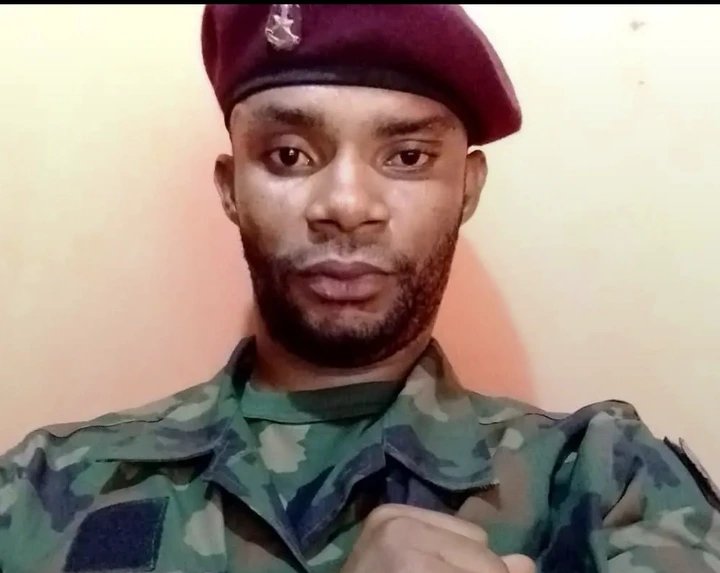
(DDM) – A former Nigerian soldier has recounted a chilling encounter with Boko Haram insurgents during a deadly ambush on Damboa Road in Borno State, describing how a tipper truck unexpectedly saved the lives of several troops during the attack.
The former soldier, Temple Ahunanya, shared the experience during an interview on the Lucky Udu Experience platform, where he narrated how the ambush occurred while soldiers were traveling for deployment in northeastern Nigeria.
Ahunanya explained that the number of troops heading to the operation area that day was unusually large, forcing military logistics teams to transport some soldiers in unconventional vehicles.
He said that while many troops were placed inside Hilux military pickup trucks commonly used for patrols and combat movements, others—including himself—were transported inside tipper trucks due to the shortage of vehicles.

According to him, the convoy was moving along the Damboa axis in Borno State when Boko Haram fighters launched a surprise attack.
The insurgents reportedly laid siege along the road and opened fire on the military convoy without warning.
Ahunanya said the sudden assault created confusion among the soldiers as they tried to respond to the attack while under heavy gunfire from multiple directions.
He recalled that the insurgents appeared to have prior knowledge of the troop movement, raising suspicions about how the attackers knew the convoy would be passing through that route.
“It was an ambush. How did the terrorists know we were coming?” Ahunanya said during the interview.
He explained that the insurgents unleashed intense gunfire on the vehicles carrying the soldiers, targeting the Hilux trucks that were more exposed to direct bullets.
According to him, the soldiers inside the tipper truck had an unexpected advantage because the heavy metal structure of the vehicle provided some protection from the bullets fired by the attackers.
“That was when I realized that a tipper truck could resist bullets,” Ahunanya said.
He added that several soldiers traveling inside Hilux vehicles were killed during the ambush, while those inside the tipper truck managed to survive the initial attack.
Despite the surprise assault, Ahunanya said the soldiers attempted to fight back against the insurgents using their weapons.
However, he acknowledged that the military still suffered significant casualties during the confrontation.
Boko Haram is a militant extremist group that has carried out a violent insurgency in Nigeria’s northeast for more than a decade.
The group emerged in the early 2000s but escalated its campaign of violence around 2009, targeting government institutions, security forces, and civilians.
Borno State, where Damboa is located, has long been considered the epicenter of the insurgency.
The conflict has led to thousands of deaths and displaced millions of people across northeastern Nigeria and neighboring countries.
Military convoys traveling through rural highways in conflict zones are often vulnerable to ambushes, a tactic commonly used by insurgent groups to attack security forces.
Such ambushes typically involve fighters hiding along roadsides or forest areas before opening fire or detonating explosives when military vehicles approach.
Security analysts say the experience described by Ahunanya highlights the dangers faced by Nigerian soldiers deployed in insurgency-hit regions.
The incident also reflects the logistical challenges the military sometimes faces when transporting large numbers of troops to operational areas.
Observers note that unconventional vehicles have occasionally been used during deployments when standard military transport options are limited.
Armored military vehicles are specifically designed to withstand gunfire and explosive attacks, but civilian vehicles such as pickup trucks or tipper trucks are generally not built for combat protection.
However, certain heavy-duty trucks with thick metal frames may offer temporary shielding from small-arms fire under specific conditions.
Ahunanya’s testimony adds to a growing body of firsthand accounts from soldiers who have served on the front lines of Nigeria’s counterinsurgency campaign.
These narratives often reveal the unpredictable realities of warfare in regions where insurgent groups rely on surprise attacks and knowledge of local terrain.
The former soldier said the memory of that ambush remains one of the most intense experiences of his military career.




