


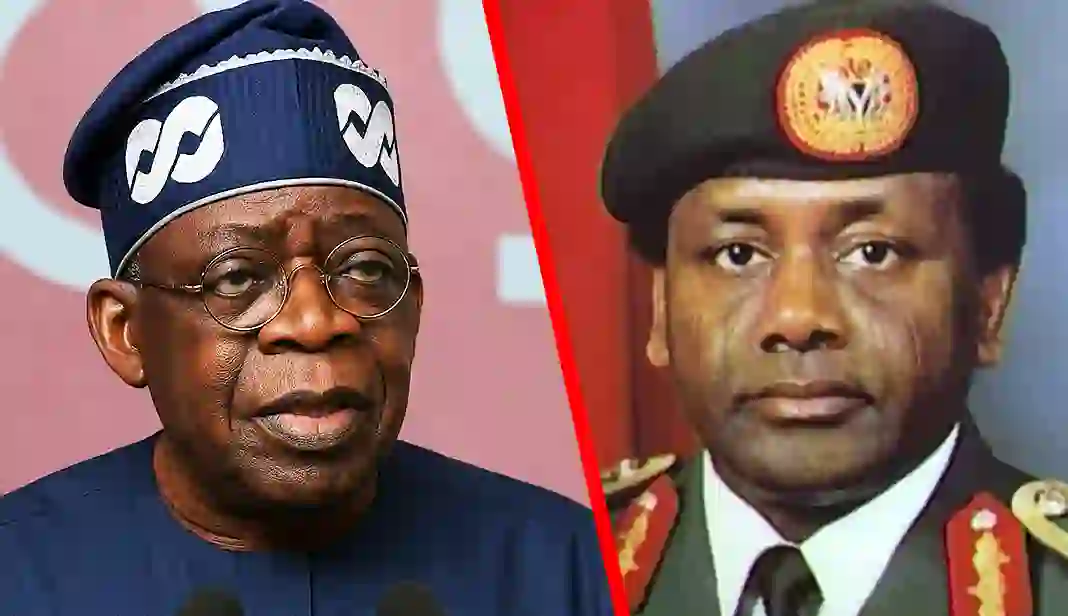
History, they say, does not repeat itself but in Nigeria, it often rehearses.
Nearly three decades after the death of Sani Abacha, the spectre of his iron-fisted rule has returned to haunt the nation’s political discourse.
Not as memory alone, but as metaphor invoked in whispers, hurled in accusations, and increasingly echoed in the unfolding drama ahead of 2027.
At the centre of this storm is President Bola Ahmed Tinubu, a man whose democratic credentials were forged in resistance to military tyranny and who now finds himself accused of flirting with its ghosts.

The irony is as thick as Lagos traffic.
A Democracy Under Strain
What should be a season of political contestation is fast becoming a theatre of fragmentation.
The opposition once hopeful of presenting a united front now resembles a house divided against itself.
The African Democratic Congress (ADC), adopted as a coalition platform by heavyweights like Atiku Abubakar and Peter Obi, is already buckling under the weight of internal disputes and legal entanglements.
The decision by the Independent National Electoral Commission (INEC) to delist key figures such as David Mark and Rauf Aregbesola has only deepened suspicion.
To the opposition, this is no coincidence. It is choreography.
A carefully orchestrated weakening of political rivals, designed to ensure that by the time the curtain rises on 2027, the stage is already cleared.
The ruling camp, of course, denies this. But in politics, perception often outweighs denial and right now, perception is turning dangerous.
The Abacha Parallel: Lazy Rhetoric or Living Reality?
To invoke Abacha is no small thing.
Under his rule, Nigeria witnessed the systematic dismantling of opposition, the co-opting of institutions, and the eerie emergence of a “consensus” political order where five parties famously adopted a single man as their sole candidate.
Today, critics argue that echoes of that era are growing louder.
When opposition parties are riddled with crises…
When court cases linger just long enough to paralyse momentum…
When electoral bodies make decisions that disproportionately weaken challengers…
The question inevitably arises: coincidence, or design?
For figures like Atiku and Obi, the answer is clear. They see a patternone that mirrors the slow suffocation of political plurality.
Even voices outside partisan politics, such as Femi Falana, have raised alarms about the creeping possibility of a one-party state.
But let us be honest: invoking Abacha is also a political weapon.
It is meant to provoke, to alarm, to mobilise.
And yet, the fact that such a comparison resonates at all should worry anyone invested in Nigeria’s democratic health.
Tinubu’s Dilemma
For President Tinubu, this moment presents a paradox.
On one hand, political dominance is the ultimate prize.
Every incumbent seeks advantage; every ruling party consolidates power where it can. This is not unique to Nigeria.
On the other hand, democracy is not merely about winning it is about being seen to win fairly.
That perception is now under threat.
Tinubu’s past as a pro-democracy activist, shaped during the struggle against Abacha under groups like NADECO, once gave him moral authority.
But moral authority, like political capital, is not permanent. It must be constantly renewed.
And today, critics argue that the very tactics once resisted are now being replicated if not in form, then in effect.
Ironically, the greatest risk to Nigeria’s democracy may not be an overbearing presidency, but a dysfunctional opposition.
A fractured opposition does not merely weaken electoral competition it weakens accountability itself.
Without a credible challenger, elections risk becoming rituals rather than real contests. Governance becomes insulated. Power becomes comfortable.
And comfortable power, history teaches us, is rarely accountable power.
Even more dangerously, suppressing or weakening opposition can backfire.
As journalist Jaafar Jaafar suggests, perceived injustice often breeds political sympathy.
Voters who might otherwise remain indifferent can be stirred by the sense that the game is rigged.
In trying to silence opposition, the system may inadvertently amplify it.
The Judiciary and INEC: Guardians or Gatekeepers?
At the heart of this unfolding drama are Nigeria’s institutions particularly the courts and INEC.
Their role is pivotal. Their credibility, non-negotiable.
Yet, every controversial ruling, every disputed decision, chips away at public trust.
When legal processes appear to shape political outcomes, rather than merely adjudicate them, suspicion thrives.
And in a country with Nigeria’s history, suspicion is never benign.
It festers. It spreads. It destabilises.
The Road to 2027
The 2027 election is still some distance away, but its shadow is already long.
What is at stake is not merely who wins, but how the game is played.
Will Nigeria witness a robust contest of ideas and candidates?
Or will it drift towards a managed democracy, where outcomes are shaped long before ballots are cast?
The answer depends not only on Tinubu, but on the opposition, the judiciary, electoral institutions and ultimately, the Nigerian people.
The ghost of Abacha does not return because history is repeating itself exactly.
It returns because something in the present feels familiar enough to awaken old fears.
Nigeria stands at a delicate crossroads.
The lesson of history is not that dictators always return but that democracies can erode slowly, quietly, and sometimes with the consent of those who should defend them.
If 2027 is to mean anything, it must be more than an election.
It must be proof that Nigeria has learned from its past not merely survived it.




