


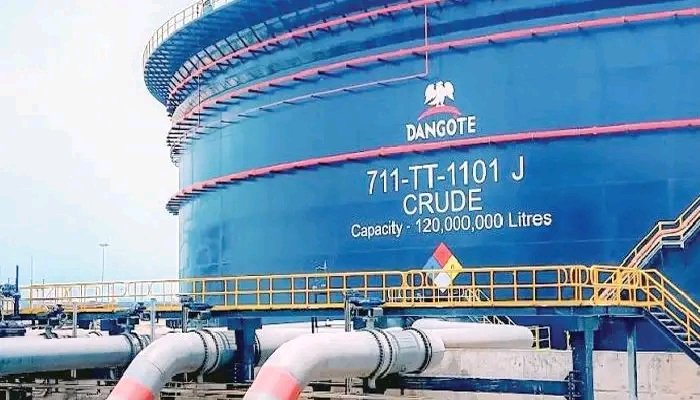
Nigeria’s downstream petroleum sector has recorded a major commercial milestone as the Dangote Refinery exported approximately 1.66 billion litres of refined petroleum products in April 2026, benefiting from rising global demand triggered by geopolitical tensions in key oil producing regions.
The latest figures, released by the Nigerian Midstream and Downstream Petroleum Regulatory Authority, indicate that the exports were made up of petrol, diesel, and aviation fuel supplied to international markets during the period under review. The development underscores Nigeria’s growing emergence as a significant player in global refined petroleum supply chains.
According to the data, the refinery exported about 513 million litres of Premium Motor Spirit, commonly known as petrol, alongside 534 million litres of diesel and approximately 615 million litres of aviation fuel. The volumes represent one of the strongest monthly export performances since the commencement of large scale operations at the facility.

Energy analysts attribute the surge in exports partly to heightened uncertainty in global oil markets, particularly due to rising tensions between the United States and Iran, which have continued to raise concerns over the stability of crude oil shipping routes and global fuel supply chains.
The Strait of Hormuz, a critical passage for global oil transportation, has remained a major point of concern for international traders and energy security experts. Any disruption in the region has historically led to sharp fluctuations in global oil prices and increased demand for alternative supply sources from more stable regions.
Against this backdrop, Nigeria’s Dangote Refinery has increasingly positioned itself as a reliable alternative supplier of refined petroleum products. Located in the Lekki Free Zone in Lagos State, the refinery has rapidly expanded its operational footprint since beginning production, transforming Nigeria from a largely import dependent fuel market into a growing exporter.
Industry observers note that the refinery’s performance is reshaping Africa’s downstream petroleum landscape. Several African countries, including Ghana, Kenya, Cameroon, South Africa, and Tanzania, are reportedly exploring or expanding import arrangements with Nigeria as regional demand for refined fuel continues to rise.
The regulatory authority also revealed that local refinery operations in Nigeria maintained an average utilisation rate exceeding 99 percent during April, with the Dangote facility accounting for the vast majority of production output across the country. This high level of operational efficiency has been described as a key driver of the export surge.
For decades, Nigeria, despite being Africa’s largest crude oil producer, relied heavily on imported refined petroleum products to meet domestic demand. The operational expansion of the Dangote Refinery is now beginning to reverse that long standing trend, positioning the country as both a regional supplier and an emerging exporter of refined fuels.
The refinery’s growing output has also contributed to increased foreign exchange earnings for Nigeria. Economic experts believe that sustained export activity could help strengthen the country’s external reserves, improve trade balances, and reduce pressure on foreign exchange demand linked to fuel imports.
In addition to exports, domestic fuel consumption remains substantial. Regulatory figures show that Nigerians consumed an average of 51.1 million litres of petrol per day in April, slightly above projected benchmarks. Diesel consumption averaged 17.3 million litres daily, while aviation fuel demand stood at approximately 2.5 million litres per day.
Despite strong domestic demand, the refinery has maintained its ability to supply both local and international markets simultaneously, a development analysts describe as a significant structural shift in Nigeria’s petroleum sector.
The Dangote Refinery, which is currently the largest single train refinery in the world, has a refining capacity estimated at 650,000 barrels per day. Since its commissioning, the facility has played a central role in improving local refining capacity, reducing import dependency, and stabilising fuel availability in the Nigerian market.
Recent months have also seen Nigeria transition into a net exporter of petrol, a development largely attributed to increased production capacity at the refinery. This marks a major shift in the country’s energy profile after decades of dependence on imported refined products despite its vast crude oil reserves.
However, analysts caution that while rising exports present economic opportunities, they also expose Nigeria to fluctuations in global geopolitical conditions. Continued instability in international oil producing regions may create short term gains but could also introduce volatility into export revenues.
Energy experts have therefore called for sustained investment in domestic refining infrastructure, energy diversification, and long term policy stability to ensure that Nigeria fully maximises the benefits of its emerging position in the global refined petroleum market.
There is also growing expectation that increased availability of locally refined products will help stabilise fuel prices within Nigeria over time, although market adjustments driven by global crude oil trends and exchange rate movements are likely to continue influencing pricing dynamics.
As global energy markets remain under pressure from geopolitical tensions, Nigeria’s expanding refining capacity places it in a stronger strategic position than in previous decades. The Dangote Refinery’s latest export performance is widely seen as a signal of the country’s evolving role in global energy supply chains and its potential to become a major refining hub in Africa.




