



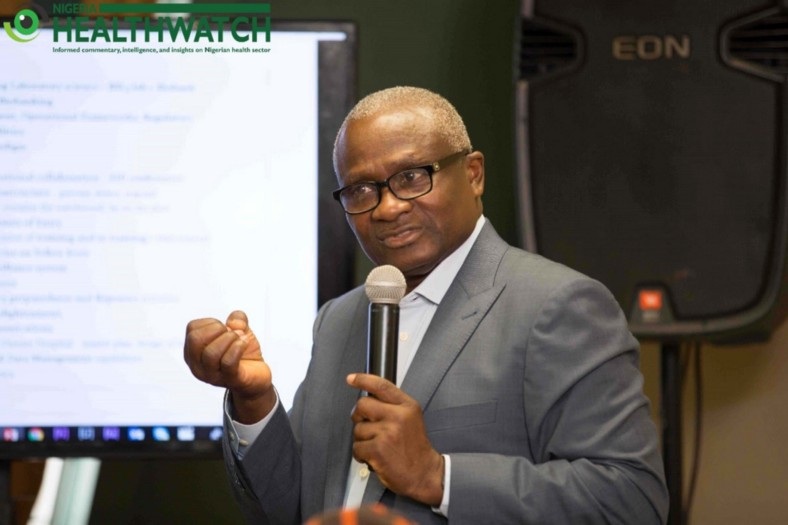
Nigeria is not yet fully prepared to handle a possible Ebola outbreak, with the country’s current level of readiness standing at 59 per cent, according to the Director-General of the Nigeria Centre for Disease Control and Prevention (NCDC), Dr. Jide Idris.
Speaking on ARISE News on Monday, Idris said a recent assessment of the country’s emergency preparedness revealed significant gaps that health authorities are urgently working to address.
While stressing that no country can ever be completely prepared for a disease outbreak, he said Nigeria must continue strengthening its response systems as global and regional health threats evolve.
“Our latest assessment puts us at about 59 per cent preparedness. Readiness is not static; it changes with circumstances. The important thing is to keep improving and adapting,” he said.

According to Idris, the NCDC recently carried out a comprehensive risk assessment to identify vulnerabilities and determine areas requiring immediate attention. One of the major concerns identified was the country’s points of entry, particularly airports and border crossings.
He explained that preventing Ebola from entering Nigeria remains the primary objective, prompting the Federal Ministry of Health to issue new protocols aimed at tightening surveillance on international arrivals.
The NCDC boss noted that states with international airports have been classified as high-risk locations because they serve as major entry points for travellers.
However, he warned that Nigeria’s porous land borders pose an even greater challenge.
“Not everyone comes into the country by air. A lot of people cross through land borders, making surveillance much more difficult. That’s why preparedness remains critical,” he said.
Reflecting on Nigeria’s successful containment of the Ebola outbreak in 2014, Idris said the experience provided valuable lessons that continue to guide the country’s response strategy.
He highlighted early detection, immediate isolation of suspected cases, contact tracing and rapid laboratory testing as the pillars of any successful Ebola response.
“Ebola spreads through direct contact. Once a case is detected, the person must be isolated quickly. Healthcare workers must also be protected, and proper sanitation measures must be in place,” he explained.
He added that adequate isolation facilities and fast laboratory diagnosis are essential to preventing wider transmission.
Despite acknowledging that Nigeria is not fully prepared, Idris said efforts are ongoing across the country to strengthen response capacity. Assessments are being conducted in states to evaluate isolation centres, public health emergency operations centres, infrastructure and emergency stockpiles.
“We are not where we want to be yet, but we are making progress. Preparedness has to cover the entire country, not just a few locations,” he said.
The NCDC is also expanding laboratory capacity, training healthcare workers, supplying protective equipment and reagents, and reinforcing standard operating procedures to ensure a more coordinated response in the event of an outbreak.
Beyond Ebola, Idris revealed that Nigeria is currently battling between seven and eight disease outbreaks, including cholera and Lassa fever.
He noted that Lassa fever continues to persist in some communities due to cultural practices, including the consumption of rats and bushmeat, which can increase the risk of transmission.
“In some areas, the rodents that carry Lassa fever are considered delicacies. Changing such behaviours remains one of the biggest challenges,” he said.
Idris also called on state governments to play a more active role in disease prevention and outbreak management instead of relying heavily on federal authorities.
“Public health is everyone’s responsibility. State governments must take ownership and provide leadership in protecting their people,” he said




