


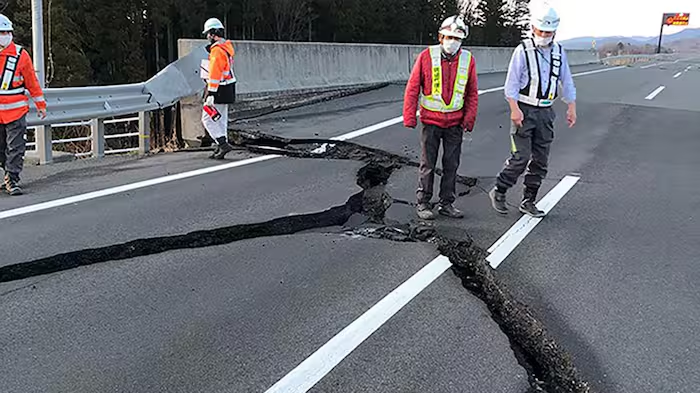
A strong 7.2-magnitude earthquake struck off Japan’s northern coast during Thursday morning’s rush hour, rattling communities across the northeast and briefly disrupting rail services, though authorities said there was no tsunami threat.
The quake struck off the coast of Iwate Prefecture at a depth of about 50 kilometres (30 miles), according to the Japan Meteorological Agency (JMA), which upgraded its initial estimate of 6.9 magnitude. The U.S. Geological Survey measured the tremor at 6.9.
The powerful shaking was felt across dozens of towns and cities in northeastern Japan and reached as far south as Tokyo, where residents reported mild tremors.
At least eight people were injured in Aomori and Iwate prefectures, according to Japan’s Fire and Disaster Management Agency. Officials said the injuries were mostly caused by falling objects or people losing their balance during the quake. No life-threatening injuries have been reported.

The earthquake struck a region that has experienced a series of significant seismic events in recent months, including one that prompted authorities to issue a week-long megaquake advisory in December.
In the town of Hashikami, Aomori Prefecture, primary school principal Tomoko Nagane said she was driving to work when her vehicle began swaying from side to side.
“The shaking lasted for quite a while,” she told public broadcaster NHK.
Although students who had already arrived at school were unharmed, some were frightened and in tears. Classes were later cancelled, and all pupils were safely sent home.
Prime Minister Sanae Takaichi said the government had activated its emergency response team and was closely monitoring the situation.
“Our priority is protecting lives,” she told reporters, urging residents in affected areas to remain alert for possible aftershocks.
Television footage from cities including Sendai and Morioka showed people continuing their daily routines, with no immediate signs of major structural damage. Reporters on the ground described the shaking as lasting several minutes.
Rail operators temporarily suspended some bullet train and local rail services to conduct safety inspections before gradually restoring operations.
Authorities also confirmed that there were no abnormalities at nuclear facilities, including the Fukushima Daiichi nuclear plant, which was severely damaged during the devastating 2011 earthquake and tsunami.
Government spokesperson Minoru Kihara said inspections at nuclear power stations and a spent-fuel reprocessing facility in Aomori found no signs of damage.
Japan sits along the seismically active Pacific Ring of Fire, one of the world’s most earthquake-prone regions, and experiences thousands of tremors every year. While most are minor, powerful earthquakes remain a constant risk across the country.




