


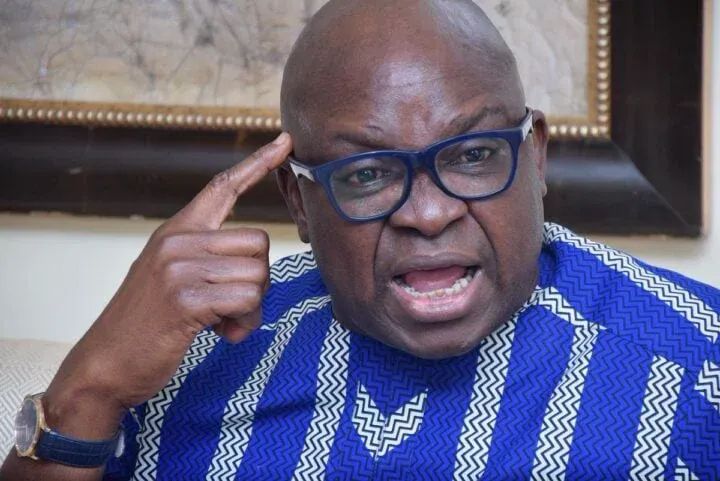
ABUJA, NIGERIA — Former Ekiti State Governor Ayodele Fayose has praised President Bola Tinubu over the conduct of the August 15 Osun State governorship election, saying the exercise demonstrated that Nigeria can hold elections in which the will of voters prevails.
Fayose contrasted the Osun election with the 2018 Ekiti governorship election, which he said was influenced by what he described as the use of “federal might” against his administration. According to the former governor, the absence of similar pressure during the Osun poll showed a different approach under Tinubu.
Speaking during an appearance on TVC News on Tuesday, Fayose argued that the Federal Government had the capacity to influence the outcome of the Osun election if it had wanted the All Progressives Congress (APC) candidate to win at all costs.
He said the fact that the opposition candidate, Ademola Adeleke, was able to secure victory demonstrated what he considered a more democratic approach to the electoral process under Tinubu.

“If the federal government wants to take an election, they will take it,” Fayose said, recalling his experience during the 2018 Ekiti election.
Adeleke, who contested the Osun election on the platform of the Accord Party, defeated APC candidate Bola Oyebamiji and African Democratic Congress candidate Najeem Salaam. Adeleke secured 511,067 votes, while Oyebamiji polled 444,815 votes and Salaam received 17,180 votes. Adeleke won 19 local government areas, while Oyebamiji won the remaining 11.
Fayose said the outcome was significant because President Tinubu appoints key officials within Nigeria’s security and electoral architecture, including the chairman of the Independent National Electoral Commission, the Inspector-General of Police and the Chief of Army Staff.
He argued that the combination of those institutions could have been used to influence an election if the Federal Government had chosen to do so. Instead, Fayose said, the Osun result showed that the administration allowed voters to determine the outcome.
The former governor described Tinubu as “magnanimous” in his handling of elections and said Nigerians should appreciate what he viewed as a commitment to allowing democracy to function.
“We have to thank God for this president for showing that it is possible to have an election of our dreams,” Fayose said.
Fayose then turned to his experience in Ekiti in 2018, when he was still governor but was not a candidate in the governorship election. He had supported his then-deputy governor, Kolapo Olusola, who contested the election on the platform of the Peoples Democratic Party.
Kayode Fayemi of the APC ultimately won that election with 197,459 votes, defeating Olusola, who secured 178,121 votes. Fayemi subsequently returned as governor after previously serving in the position from 2010 to 2014.
Fayose alleged that several actions by federal authorities during the 2018 campaign and election period amounted to the deployment of federal power against him and his political camp.
He claimed that his security details were withdrawn shortly before the election and that communications around the Ekiti Government House were disrupted. He also alleged that former Department of State Services Director-General Lawal Daura coordinated aspects of the federal government’s actions surrounding the election.
“Ekiti was taken from me in 2018 by all means possible,” Fayose said, describing the alleged withdrawal of security personnel and disruption of communications as examples of what he called “federal might.”
The former governor’s comments come amid continuing political debate over the conduct of elections in Nigeria and the influence of federal institutions during state-level polls. His comparison places particular emphasis on the difference between the 2018 Ekiti election and the recently concluded Osun contest.
Fayose maintained that Tinubu’s conduct during the Osun election reflected a desire to allow democratic competition to thrive. He said the President’s “body language” suggested that he wanted democracy to succeed in Nigeria.
The comments also come after FCT Minister Nyesom Wike reportedly said he could have helped Tinubu secure an APC victory in Osun if the President wanted the party to win “at all costs.” That statement generated reactions from political figures, including ADC chieftain Dele Momodu.
For Fayose, however, the significance of the Osun election lies in what he sees as evidence that federal power does not necessarily have to determine the outcome of state elections.
His remarks are likely to fuel further discussion about the role of federal institutions, security agencies and political influence in Nigerian elections, particularly as political parties prepare for future electoral contests.
While Fayose’s account of the 2018 Ekiti election represents his own allegations and political assessment, his praise of the Osun poll reflects his view that the result demonstrated a more open electoral environment.
The former governor ultimately urged Nigerians to recognise the importance of allowing voters to freely determine their leaders, presenting the Osun election as an example of what he believes Nigeria’s democratic process can achieve when political power does not override the choices of the electorate.




