


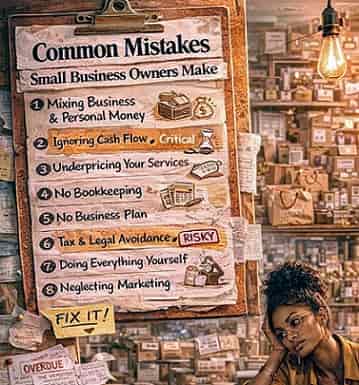
Running a small business in Nigeria can look successful from the outside. A business owner may have customers every day, receive transfers regularly, post products consistently on Instagram and WhatsApp, and still discover at the end of the month that there is almost nothing left.
This is one of the uncomfortable realities of entrepreneurship. Making sales is not the same as making money.
Across Nigeria, thousands of entrepreneurs are working harder than ever, yet some remain trapped in a cycle where money enters the business and disappears almost immediately. The problem is not always a lack of customers. Sometimes, it is the small decisions made repeatedly behind the scenes.
From poor pricing to mixing personal expenses with business money, these mistakes can quietly destroy a business without the owner immediately recognising what is happening.

For DDM News, understanding these mistakes is important because many entrepreneurs do not need to work harder; they need to manage what they already have better.
Selling Without Knowing Your Real Cost
One of the biggest mistakes small business owners make is pricing their products based only on what they paid for the main item.
A fashion entrepreneur, for example, may buy fabric for ₦15,000, sew a dress and sell it for ₦25,000, believing that ₦10,000 is profit. But what happens to transportation, electricity, tailoring, packaging, marketing, delivery, alterations and the entrepreneur’s own time?
Once those expenses are calculated, the supposed ₦10,000 profit may be much smaller.
This is why entrepreneurs need to understand their actual cost of production, not simply the amount paid to purchase materials.
A product should be priced with the full business expense in mind. Otherwise, an entrepreneur can be selling every day while gradually losing money.
Mixing Business Money With Personal Money
Another silent business killer is treating the business account like a personal wallet.
A customer pays ₦50,000 and the business owner immediately uses ₦10,000 for food, ₦5,000 for transportation and another ₦10,000 for an unrelated personal expense.
By the time it is time to restock, there is not enough money available.
The entrepreneur may then conclude that the business is not profitable.
In reality, the business may be generating money, but the owner is withdrawing from it without a proper system.
Even a small business should have some separation between business finances and personal finances. The owner should know how much money belongs to the business and how much can safely be taken out.
Giving Too Much Credit
“Pay me later” sounds harmless until it becomes a major part of a business model.
Credit sales can be particularly dangerous for small businesses because entrepreneurs often need cash immediately to restock. When several customers owe money at the same time, the business can suddenly become cash-strapped despite having many outstanding sales.
Some customers may delay payment for weeks or months. Others may disappear completely.
Entrepreneurs who sell on credit need clear rules. Who qualifies? How much can they owe? When must payment be made? What happens when the deadline passes?
Friendship and business should not be confused.
A customer who cannot pay on time can create a financial problem that affects the entire business.
Chasing Sales Instead of Profit
There is a growing obsession with sales numbers.
Business owners celebrate when they sell 50 items in a week, receive hundreds of orders or generate millions of naira in revenue.
But revenue alone does not tell the whole story.
A business can generate ₦2 million in sales and still make very little profit if its expenses are too high.
The more important question is not simply, “How much did I sell?”
It is also, “How much did I actually keep after everything was paid for?”
Entrepreneurs need to monitor profit margins, operating expenses and cash flow instead of focusing exclusively on revenue.
Trying to Be the Cheapest
Many Nigerian entrepreneurs believe lowering their prices is the easiest way to attract customers.
Sometimes it works temporarily. But constantly competing on price can put a business in a dangerous position.
If competitors are selling at ₦20,000 and an entrepreneur sells at ₦15,000 without understanding the cost structure, the business may attract customers while destroying its own profitability.
Instead of always trying to be cheaper, entrepreneurs should consider what makes their business different.
Better packaging, faster delivery, reliability, excellent customer service, stronger branding, convenience or superior quality can justify a higher price.
Customers do not always choose the cheapest option. They often choose the option they trust.
Spending Too Much on Appearance
Branding matters, but entrepreneurs can also spend beyond what their businesses can comfortably afford.
A beautiful logo, expensive packaging, office furniture, professional photographs and elaborate social media content can make a business look impressive.
But if the business cannot consistently pay its suppliers or restock products, appearance has become more important than sustainability.
A business should grow its image alongside its financial capacity.
It is better to have simple packaging and healthy cash flow than expensive packaging and an empty business account.
Failing to Keep Records
Some entrepreneurs still operate their businesses from memory.
They know approximately how much customers owe, roughly how much they spent and approximately how much they made.
“Approximately” is not accounting.
Without proper records, it becomes difficult to identify which products are profitable, which customers owe money, where expenses are increasing and whether the business is genuinely growing.
A simple notebook, spreadsheet or accounting application can make a major difference.
The entrepreneur does not necessarily need complicated accounting software at the beginning. What matters most is consistency.
Every sale and significant expense should be recorded.
Depending Entirely on Social Media
Instagram, TikTok, Facebook and WhatsApp can be powerful marketing channels, but building a business entirely around social media can be risky.
Algorithms change. Accounts can be restricted. Engagement can fall. Customers can also move from one platform to another.
A smart entrepreneur should gradually build assets they can control, such as a customer database, email list, website, WhatsApp customer list or strong repeat-customer network.
Social media should help the business acquire customers, but the business should not become completely dependent on an algorithm to survive.
Ignoring Repeat Customers
Some businesses are constantly looking for new customers while neglecting people who have already bought from them.
That can be expensive.
A previous customer already knows the business, understands the product and has experienced the service. Getting that person to buy again can be easier than convincing a complete stranger to make a first purchase.
Entrepreneurs should follow up with previous customers, introduce new products, offer useful updates and create reasons for satisfied customers to return.
A successful business does not only ask, “How do I get more customers?”
It also asks, “How do I make the customers I already have want to come back?”
Growing Too Quickly
Growth sounds like the ultimate goal, but uncontrolled growth can destroy a small business.
An entrepreneur may receive more orders than the business can handle and immediately hire workers, rent a bigger shop, buy more equipment and increase expenses.
If the increase in revenue does not match the increase in costs, the business can become financially weaker despite appearing larger.
Growth should be measured carefully.
Sometimes the smartest business decision is not to expand immediately but to improve systems, increase efficiency and strengthen profitability first.
The Biggest Mistake Is Not Learning From the Numbers
Perhaps the most dangerous mistake is refusing to look honestly at what the business is saying.
If sales are falling, investigate why.
If expenses are increasing, identify where the money is going.
If customers complain about delivery, improve the process.
If one product sells well while another remains untouched, study the difference.
Business owners do not need to be perfect. They need to pay attention.
Entrepreneurship in Nigeria comes with real challenges, from rising operating costs and unstable purchasing power to competition and changing consumer behaviour. But not every business problem is caused by the economy.
Some are created internally through poor financial discipline, weak record keeping and decisions made without enough information.
The entrepreneur who learns to separate personal and business finances, calculate proper prices, control expenses, understand customers and measure real profit already has an advantage.
The goal should not simply be to have a business that is busy.
The goal is to build a business that is profitable, organised and capable of surviving beyond the next sales cycle.
For many Nigerian entrepreneurs, the next level may not require another viral post, another loan or another expensive strategy. It may begin with something much simpler: sitting down, examining the numbers and finally understanding where the money is going.
That is where sustainable business growth begins.
DDM News will continue to examine the realities behind Nigeria’s growing entrepreneurial economy, highlighting not just how people start businesses, but how they can build businesses that actually last.




